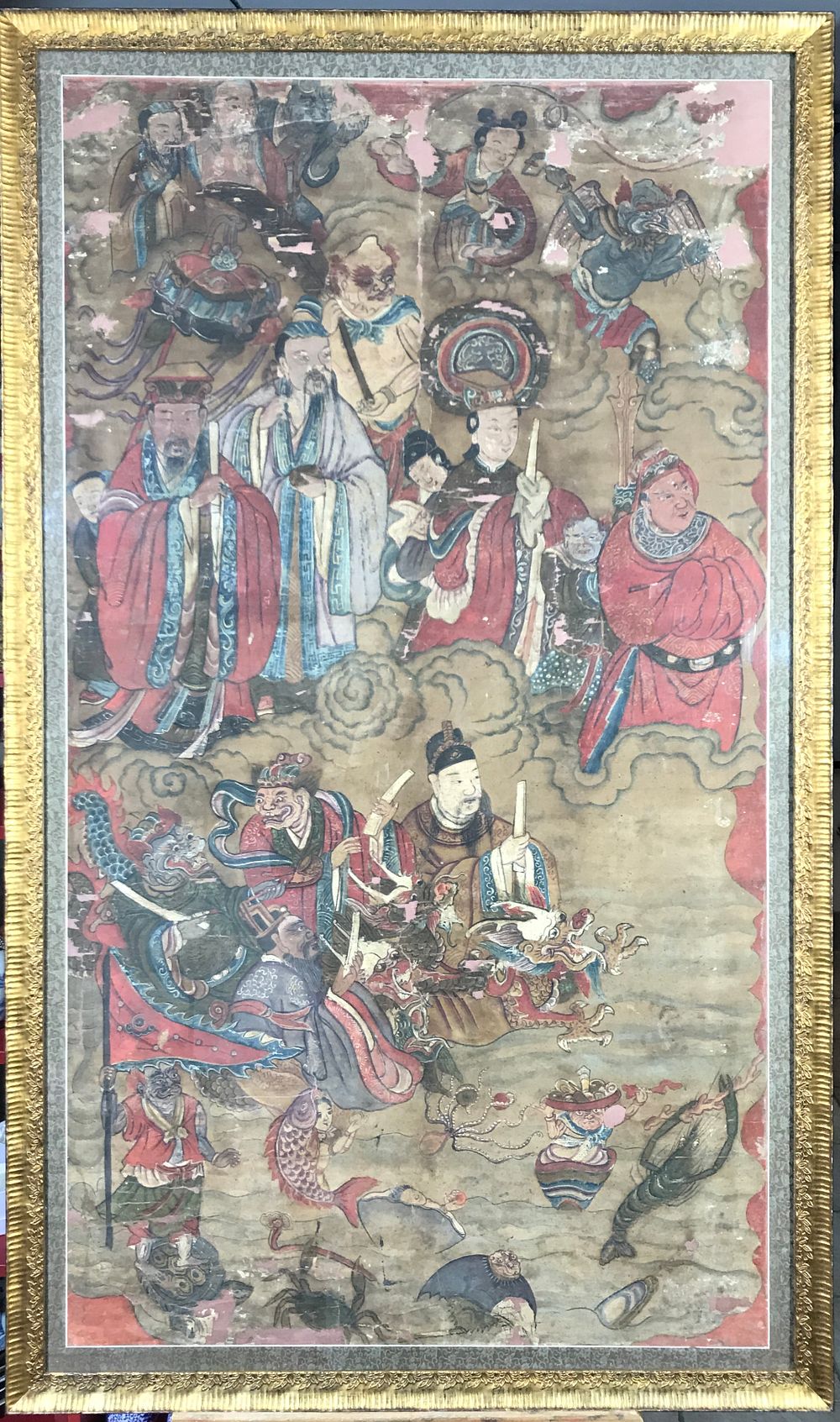
Bidspirit auction | Ancient Ming Dynasty Taoist Painting
Ancient Ming Dynasty Taoist Painting - Ancient Ming Dynasty Taoist Painting PROVENIENCE: China PERIOD: ca. 16th/17th century, Ming Dynasty (1368–1644), by unknown artist DIMENSIONS: 147 x 87.5 cm CONDITION : The painting has been professionally restored with Conservation Backing Boards and is framed under plexiglass. IMPORTANT DELIVERY NOTE : Due to the size and fragility of the object, only the following delivery methods are possible. - Pickup available in Pesaro city (Italy), directly from the seller. ALTERNATIVE DELIVERY : - Direct private delivery will be agreed upon and organized exclusively with the seller within Italy. NOTE: We work hard to give the right importance and value to objects as they deserve. We carry out studies and research with great passion, honoring the essence of authentic objects. So please, see all pictures, because are part of the description. Thank you and have a good consultation. DESCRIPTION : A Taoist painting on paper from the Ming period (1368–1644), dated to the 16th century, likely during the reign of Emperor Jiajing (嘉靖), who ruled from 1521 to 1567. He was a Taoist and persecutor of Buddhism. The dating of this work is deduced from the depiction of certain characters, such as the third-eyed warrior god Erlang Shen (二郎神) and the Four Dragon Kings (四大龍王), whose popularity spread thanks to Ming-era literature, with the 16th-century novels titled 封神演義 (The Investiture of the Gods) and 西遊記 (Journey to the West). The artist's choice to bring together the main divine figures of the Taoist pantheon makes the painting truly rare. Some of these deities hold in their hands wooden tablets called Fulu (符箓) “seals and records” (a name which also has the meaning of “talisman”), writings of celestial origin, edicts from the spiritual world or orders from a specific deity, more generally they designate the written magical formulas used in Taoism. The figures at the top of the painting, from left to right: - At the far edge of the upper left margin is Lü Dongbin (呂洞賓) of the Eight Immortals (八仙), patron saint of ink makers and benevolent toward the sick. - Next comes Laozi (老子), supposed author of the ”Dao De Jing” and founder of Taoism. From the 1st century AD, he became one of the main deities of the Taoist pantheon. - Legend has it that Laozi summoned Li Tieguai (李鐵拐) from among the immortals. Standing behind him and to his left, he appears as a ragged and infirm beggar. He leans on his metal walking stick and in his other hand holds his magical medicines, used to comfort the sick and needy, so much so that his image became the emblem of doctors and pharmacists. - Next come the figures of Dianmu (電母) “Mother of Lightning” and Leigong (雷公) “Lord of Thunder” or Leishen (雷神) “God of Thunder” with his hammer, the celestial married couple who punish earthly and divine evildoers with the weapon of lightning. The figures in the center of the painting, from left to right: - In the left margin, behind the Jade Emperor (Yuhuang 玉皇), appears the half-length figure of a palanquin bearer (Zhi qishou 执旗手) holding the imperial standard, cylindrical in shape, with red and blue-green ribbons and feathers. This is because the plumes of the imperial standards were made from kingfisher feathers (翡翠鳥). The turquoise-blue feathers of this bird were particularly sought after. From ancient times until the first half of the 20th century, they were used in Diancui (点翠), a style of Chinese art characterized by kingfisher feathers used as inlays for art objects and ornaments: hairpins and pins, headdresses, fans, and screens. - In the foreground, dressed in red, is the Jade Emperor (玉皇), the supreme deity of heaven, and therefore known as Heavenly Father (天公), as he is one of the major deities in the Taoist pantheon. From the 9th century onwards, he became the patron saint of the Chinese imperial family, considered the heavenly equivalent of the earthly emperor. The ritual feast of the Jade Emperor is celebrated during the first lunar month. On this day, Taoist temples perform a ritual in honor of the god called the Adoration of Heaven (拜天公), where priests and monks prostrate themselves at the feet of statues, burn incense, and prepare votive food. - At his side, dressed in gray robes, is Yang Tianyou (杨天佑), the Taoist scholar and physician who married the sister of the Jade Emperor (玉皇) named Yaoji (瑶姬) after saving her life; in fact, in his right hand he holds a medicinal herb and in his left a bowl containing the medicinal cure. - Further back is the depiction of the first of the Eight Immortals (八仙), named Zhongli Quan (钟离权). His main attribute is a giant feather-shaped fan, which he uses to ward off evil creatures and also to awaken the souls of the deceased. - From behind the right shoulder of Yaoji (瑶姬), sister of the Jade Emperor (玉皇), the head of her daughter Yang Chan (Holy Mother of Hua Shan, one of the five sacred Taoist mountains) appears. - Following in the foreground,