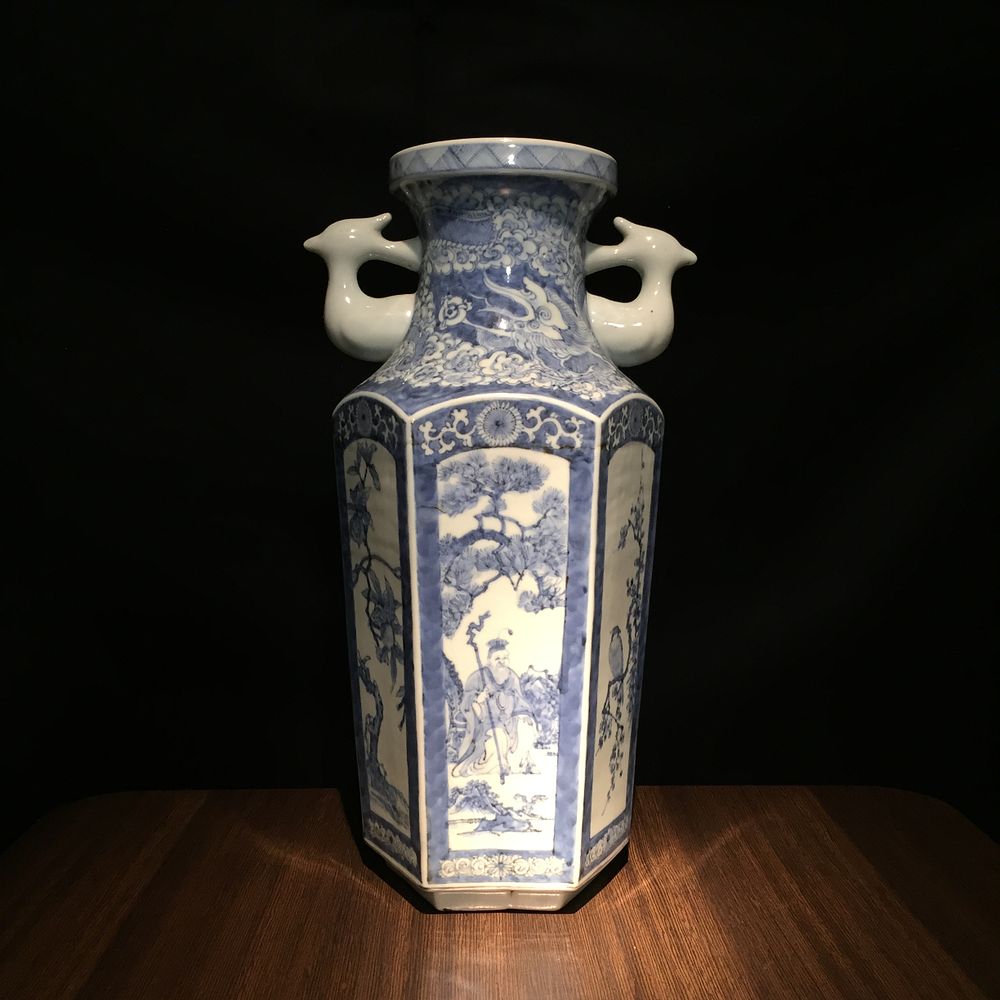
Bidspirit auction | EXCLUSIVE JAPANESE VASE - Tōzan-yaki
EXCLUSIVE JAPANESE VASE - Tōzan-yaki (東山焼) Heron Ears Vase (鷺耳花瓶) Made in Himeji (姫路製) Ceramic also known by the names of Shinjo Higashiyama ware (新庄東山焼) - Tōzan-yaki (東山焼) Heron Ears Vase (鷺耳花瓶) Made in Himeji (姫路製) Ceramic also known by the names of Shinjo Higashiyama ware (新庄東山焼) NOTE: We work hard to give the right importance and value to objects as they deserve. We carry out studies and research with great passion, honoring the essence of authentic objects. So please, see all pictures, because are part of the description. Thank you and have a good consultation. DATA SHEET Period: late Edo period, 1822-1845 about Height: 39,5 cm Top diameter: 12 cm about Weight: 3,94 kg CONDITION OF THE CERAMIC The peculiarity of this blue and white ceramic, with a hexagonal shape and “heron ears”, consists also in the ancient technique of restoration through the use of charred pitch (see photos of the inside of the ceramic). Ceramics restored with this technique are very rare. This is a restoration technique used by many peoples from the Neolithic until the 19th century. HISTORICAL DESCRIPTION Tōzan-yaki is the name of Higashiyama ceramics which literally means “eastern mountain”, is the common name for the hilly area in the eastern part of Shinjo City in Yamagata Prefecture, where the village is covered with a thick layer of clay. It became a kiln for the Himeji Sakai clan in the late Edo period (1603-1868). It is said that during the Yasunaga period (1772-1781), a certain Kiya from the port of Hyōgo (Kobe city) ordered Kosuke Shigeta to build a kiln in Higashiyama, in the village of Itohiki, Shikama district (Higashiyama, Himeji City). However, according to historical facts, the Higashiyama kiln was built by Fujisaku Hashizume in the same village in 1818. In 1822, Tōzan-yaki began in Shikahigashi County (present-day Higashiyama), Himeji City, Hyōgo Prefecture. It focused primarily on Arita blue and white ceramics and eventually came under the patronage of the Sakai clan of the Himeji domain. It is also known as Himeji-yaki. The most important type of Higashiyama ware is dyed works with paintings by Gosu (cobalt blue from China) on white pottery, and these heron ears are also a symbol of Himeji Castle. Around the Tenpō era (1831-1845), the kiln was moved to Otokoyama, which is located northwest of Himeji Castle. Shuzo Tachibana, who became the leader, learned pottery from Shuhei Ogata in Kyoto. In addition to blue and white pottery, he creates a wide range of earthenware, çaldon and gold leaf. In the Otokoyama kiln, production is mainly porcelain. Celadon from Higashiyama ceramics was valued for the elegant beauty of the glaze color. Around the Ansei era (1855-1860) and until the end of the Edo period, production gradually declined. (From the book: Herbert H. Sanders, Connaître et réaliser la céramique japonaise, Dessain et Tolra, Paris 1976) (A) PICTURE REFERENCE : - Title: 姫路藩窯 東山燒 Himeji Domain Kiln Higashiyama Ware Image 20 page 41: 六角花瓶 hexagonal vase, 39.5cm 11.8cm (B) PICTURE REFERENCE : - 2018 Poster of the “Himeji Domain Kiln Higashiyama Ware Exhibition” 「姫路藩窯東山焼展」 Himeji City Shosha no Sato / Arts and Crafts Museum collection 姫路市書写の里・美術工芸館蔵 - 姫路藩窯東山焼と永世舎——鐵元堂コレクション Publisher: 金木犀舎 (10 November 2023) (B1) PICTURE REFERENCE : Second poster of the “Himeji Domain Kiln Higashiyama Ware Exhibition” (C) PICTURE REFERENCE : “The feudal prince of the family of Sakai, in the province of Harima, founded the pottery for the purpose of imitating the Arita ware of the class known as sometsuke, painted in blue under the glaze. The early ware appears to have no mark; the one given dates about 1820, when the imitation was successful. Porcelain, painted with symbols, landscapes, etc., was produced, as well as celadon porcelain, also after the Chinese style. Like many of the other private factories, when the power of the Shogun ceased, the interest of the princely patron in the fictile art, the personal element, diminished and expired; so that, in many cases, even if the kilns were not closed, the work degenerated, as was the case here. I have not been able to find why the ware received the name Tozan, for the mark indicates the place of origin in this case — Made at Himeji”. (J. F. Blacker, The ABC of Japanese Art, The Coop. Clark Co., Limited, Toronto [between 1911 and 1918], p. 320.... ....The reason for the name Tozan is explained by Anderson William: “The Tozan porcelain was manufactured from about 1840, at Himeiji (Harima), the materials coming from Mount Tozan. It consisted chiefly of celadon and blue and white”. (Anderson William, The Pictorial Arts of Japan. With a Brief Historical Sketch of the Associated Arts, and Some Remarks Upon the Pictorial Art of The Chinese and Koreans, Sampson Lowe, Martson, Searle, & Rivington, London 1886, p. 109) (D) PICTURE REFERENCE : HIMEJI VASE LINK JAPANESE AUCTION : https://aucview.aucfan.