Bidspirit auction | Japanese Satsuma ceramic vase, in
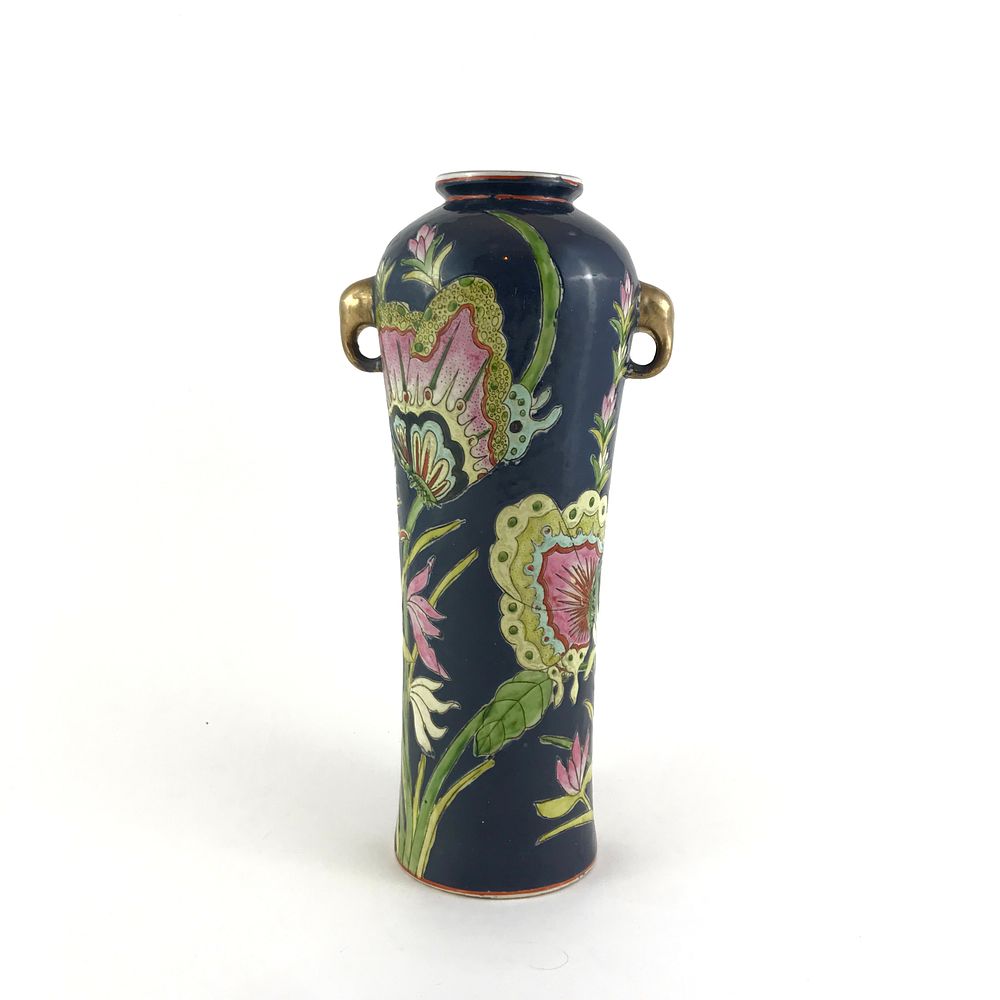
Japanese Satsuma ceramic vase, in “Kinkozan” style (錦光山), imprinted with the Chinese seal indicating the Tongzhi kingdom (大清同治年製, 1861 – 1875), from the Qing dynasty. - Japanese Satsuma ceramic vase, in “Kinkozan” style (錦光山), imprinted with the Chinese seal indicating the Tongzhi kingdom (大清同治年製, 1861 – 1875), from the Qing dynasty. This leads one to believe that the vase was made at the time of Kobayashi Sobei, fifth generation Kinkozan ceramist; in fact, the history of Kinkozan pottery begins in the mid-17th century. From around 1870, Kobayashi Sobei began to successfully export Kinkozan ceramics to the West. Kobayashi Sobei died in 1884 and his son continued his father's business until his death in 1927, which resulted in the closure of the factory and production. Mythological and naturalistic scenes became Kinkozan's favorite decorations, with a style that (especially in the floral subjects) is very reminiscent of the European Art Nouveau of the late nineteenth and early twentieth centuries. An example of this is the Dutch Art Nouveau ceramic version of “Gouda plateel” or earthenware made by a company called “Aardewerkfabriek Fayence-en Tegelfabriek Holland” in Utrecht, Holland in 1894. Even before this period Kinkozan produced Satsuma ware with this design (see in the images the Kinkozan vase compared to a Dutch Gouda plateel vase). The use of a dark blue enamel as a background in many of these works, combined with some pure gold elements, became his hallmark. Vase dimensions : Height 37 cm about Handles distance 15.5 cm about Top diameter 7.6 cm about Bottom diameter 11.5 cm about Vase weight : 1.69 Kg Parcel with safe and solid packaging materials. - Ready to ship in 2/3 Days - Shipment time from 3 to 15 days : depends on the distance of Country. - Worldwide Delivery with professional couriers - Tracking Code Shipment