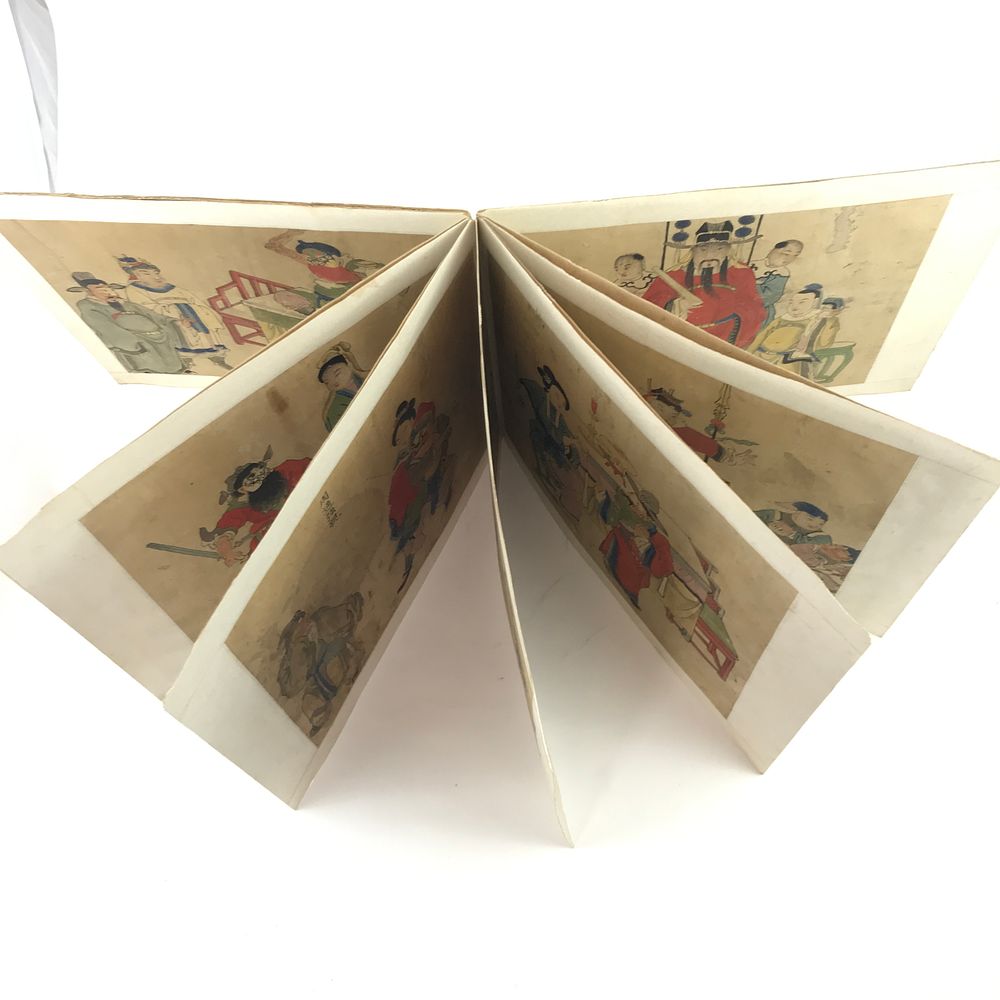
Bidspirit auction | Rare and antique Chinese album
Rare and antique Chinese album from the 19th century 加打龍化魏 Jiā dǎ lóng huà Wèi The unpredictable intrigues of the dragon of Wei - 加打龍化魏 Jiā dǎ lóng huà Wèi The unpredictable intrigues of the dragon of Wei[1] Board dimensions: 27,5 x 34 cm Extremely rare album composed of twelve Chinese plates created in the mid-Qing dynasty (1644–1911), ink and colors on paper, which narrate a complete story of court intrigues, whose subjects are legendary demons and divinities, immortal heroes, courtesans and imperial dignitaries, set during the final years of the Northern Song Dynasty (960-1127 AD). 1) The first panel opens with a Chinese Celestial Officer, whose red beard refers to 沙僧 Shā Sēng (Buddhist name 沙悟淨 Shā Wùjìng which means ”clay aware of purity”, as he is a river demon), he is became the third disciple of the Buddhist monk 玄奘 Xuánzàng, so that from a cruel demon he changed his behavior into a benevolent creature; his characteristic is the talent of oratorical persuasion, capable of maintaining people's attention with his reasoning and his upright voice. In this oratory scene, he holds a vase under his left arm, symbol of his history as a disciple of the deities of heaven. In the iconography he is depicted with the vase and one of the narratives says that he broke the valuable vase during the Peach Festival, either out of anger or inadvertently, causing the wrath of the Jade Emperor who punished him by exiling him to earth. 2) The second panel depicts 祝融 Zhù Róng, also known as 重黎 Zhòng Lí, god of fire and the south often depicted sitting on a tiger. As happens with many deities of ancient myths, 祝融 Zhù Róng has also been historicized, in fact the researcher Sima Qian portrays him as a real person who held the government position of Minister of Fire (the red and yellow symbol in the headdress coincides with the emblem of fire). Qui è rappresentato proprio in queste vesti storiche, con l’abito tradizionale 汉服 Hànfúdi colore rosso, in uso a partire dalla dinastia Han (206 a. C. – 220 d. C.) e prima dell’avvento della dinastia Qing (1644-1912 d. C.). Questi solleva la mano destra mostrando uno spillone avvelenato.Here he is represented precisely in these historical clothes, with the traditional red dress 汉服 Hànfú, in use starting from the Han dynasty (206 BC – 220 AD) and before the advent of the Qing dynasty (1644- 1912 AD). He raises his right hand showing a poisoned pin. The woman on the right of the scene seems to make a pact with this Minister, signed by the calligrapher holding paper and brush to the right of 祝融 Zhù Róng. This can also be deduced from the appearance of the dragon in the upper right corner of the sheet, contained in the cloud-shaped cartoon [2] that comes out of the woman's head (an appearance connected to the malevolent meaning of the writing that appears in the sixth panel: 加打龍化魏 Jiā dǎ lóng huà Wèi “The unpredictable intrigues of the dragon of Wei”). 3) In the third panel there is the image of 钟馗 Zhōng Kuí, a deity of Chinese mythology, traditionally considered triumphant over ghosts and evil beings, who seems to escort a princess or concubine on the back of a donkey, as if to warn her of possible dangers. 4) In fact, in the fourth panel, the same princess faces a clash with another subject who wears a mask on his face. 5) In the fifth panel, another masked demon carries the princess on his shoulders to carry her to safety, turning to the wise hero 周同 Zhōu Tóng (archery teacher and second tutor of military arts of the famous general 岳飞 Yuè Fēi of the Song dynasty of the South) and seems to want to inform him of the danger and ask him for advice. The elderly master maintains a listening posture. 周同 Zhōu Tóng, died in 1121 AD. C., is represented here at a venerable age, leading one to think that this story of court intrigue is set during the reign of Emperor 徽宗 Huī Zōng, in office from 1100 to 1126, known for his artistic talents and for having promoted Taoism. Here this Chinese writing appears: 周通强親 Zhōu Tōng qiángqīn (The powerful relatives of Zhou Tong), referring to his faithful and powerful ancestors and celestial allies. 6) The sixth plate features the writing 加打龍化魏 Jiā dǎ lóng huà Wèi (The unpredictable intrigues of the dragon of Wei), reminding us of the dragon that appeared in the third plate. Here two female figures, an old woman and a young woman, seem to offer a reward contained in a vase to a prisoner who is undergoing the punishment of the ”wooden collar”, in order to carry out the plot against the princess. 7) Thus in the seventh panel the corrupt prisoner, wearing combat clothes, faces 钟馗 Zhōng Kuí in a duel. 8) In the eighth panel the princess is again approached by a masked person (perhaps the same as the fourth panel but with other clothing) and, fearing for her safety, she holds a dagger in her hand, hiding it behind her back. 9) In the ninth panel 钟馗 Zhōng Kuí, holding a spear, puts to flight the Minister of Fire 祝融 Zhù Róng who rides a white horse.