Bidspirit auction | 315 x 49 cm -
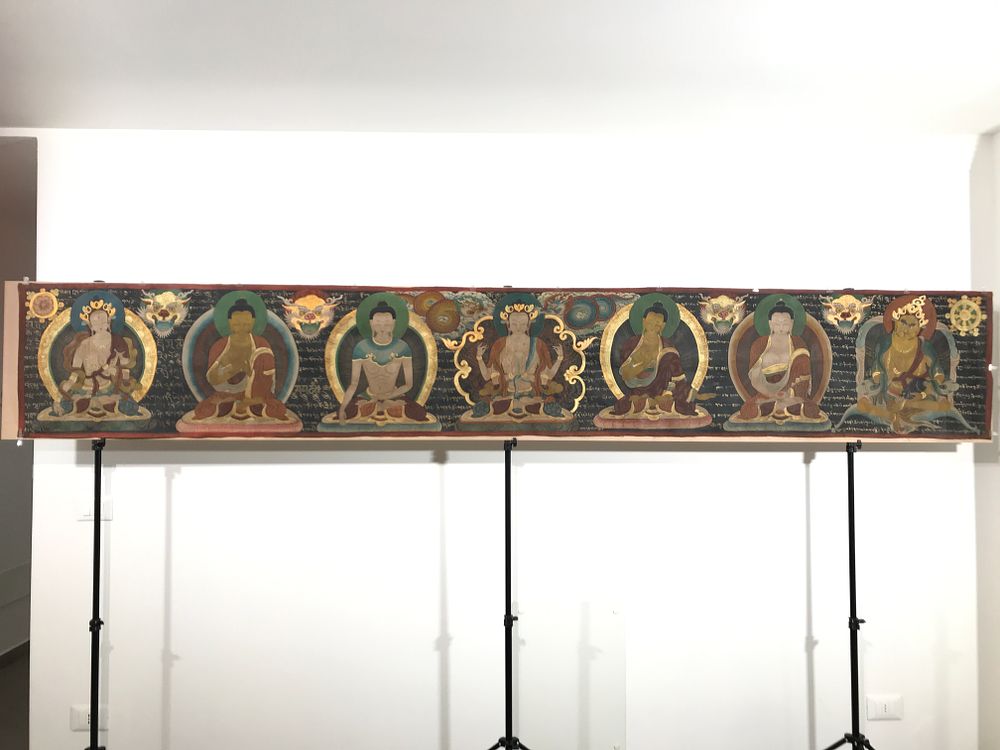
315 x 49 cm - Rare Tibetan horizontal thangka made for monasteries, hand painted - Rare Tibetan horizontal thangka Provenience : Tibet (private collection) Period : ca. XX sec. Dimension: 315 x 49 cm Description : Tibetan horizontal thangka made for monasteries, hand painted (bris-tan) on cotton canvas, with gold writing on a black background (na-tang) and colored figures (tson-tang). The gold used is 24 carats. The water-soluble pigments are both mineral and organic and are tempered with a solution of grass and natural organic glue. As a rule, the five Buddhist colors (pancha-varna) are also used in this painting: White (transforms ignorance of the apparent illusory reality into the wisdom of true reality), Yellow (transforms pride into wisdom of identity), Blue (transforms sloth into compassionate wisdom), Red (transforms the illusion of attachment into wisdom of discernment), Green (transforms envy into wisdom of realization). The scroll is divided into seven sections (which Buddhist number symbolizes completeness), each section is occupied by a divine figure which, from left to right, are: - White Tara with seven eyes in Varada Mudra; - Shakyamuni Yellow Buddha in Dharmachakra Mudra (this mudra represents ”the beginning movement of the Wheel of Dharma”, where the thumb and middle finger of the right hand form a circle named Vitarkamudra, ”the exposition of the doctrine” and with the index finger of the left hand turns the wheel); - Shakyamuni White Buddha in Bhumisparsha Mudra; - Avalokitesvara (Tib. Chenrezig Wangchug) as Bodhisattva of great compassion, depicted as Sadaksarin (Lord of the six syllables, i.e. of the mantra Oṃ Maṇi Padme Hūṃ), sitting cross-legged (padmasana), the two external hands are in Shuni Mudra and the two central ones hold the Cintamani stone (precious stone of desire); - Shakyamuni Yellow Buddha in Shuni Mudra; - Shakyamuni White Buddha in Dhyana Mudra; - Kubera Jambala, Indian god of prosperity and wealth also known as Dhanapati who, in Tibetan symbolism, becomes Vaishravana (Tib. Nam Those), one of the four great kings of the four directions, he is the guardian of the north who presides over the border between the manifest and the unmanifest. His color is yellow, and he is the king of the Yakscia, holding the standard in his right hand and in his left a mongoose spitting gems from its mouth. The mongoose (mungo; nakula) is a symbol of material and spiritual wealth, the traditional enemy of Naga and snakes (both guardians of treasure). The mongoose is often depicted spitting out jewels or pearls and belongs to the god of wealth Kubera. At the top of the scroll, are painted a sequence of Buddhist symbols. Among the deities, Kirtimukha (Zeeba or Zipak) is represented with the colors blue and yellow; he is the guardian of the doors which derives from Hindu iconography and he is a demon who devours himself up to the head. It is a symbol of warning against greed, greed and attachment to earthly things. Instead, in the right and left margins of the painting, we find the symbol of the Wheel of Dharma (chakra in Sanskrit, 'khor-lo in Tibetan), The image of the wheel is a universal symbol and is present in all Oriental cultures. Already in pre-Buddhist India it was widespread with the dual meaning of weapon or Sun. In Buddhist culture the wheel is closely associated with the concept, of the beginning movement of the Wheel of Dharma, by Buddha, with the occasion of the first public exhibition of his doctrine in Sarnath, near Benares (modern Varanasi) in the Gazelle Park. For this reason the Wheel of Dharma is often represented between two gazelles. The meanings of the Dharma Wheel can be multiple. According to the three trainings of Buddhist practice, the hub represents training in moral discipline that stabilizes the mind; the rays represent the understanding of the emptiness of all phenomena which allows us to eliminate our ignorance at the root; finally, the external circle identifies the concentration that allows you to practice the Buddhist doctrine. It also represents the Eightfold noble path that leads to liberation, the Sangha (the community of Buddhist disciples) and Shakyamuni Buddha. In a more general sense, among the eight auspicious symbols, the Dharma Wheel symbolizes Buddhist teaching as a whole and reminds us that the Dharma embraces all things. It is the symbol of the Dhyanibuddha Vairociana and is also represented on the soles of the Buddha's feet. Parcel with safe and solid packaging materials. - Ready to ship in 2/3 Days - Shipment time from 3 to 15 days : depends on the distance of Country. - Worldwide Delivery with professional couriers - Tracking Code Shipment