Bidspirit auction | Ancient and elegant Japanese Kakemono
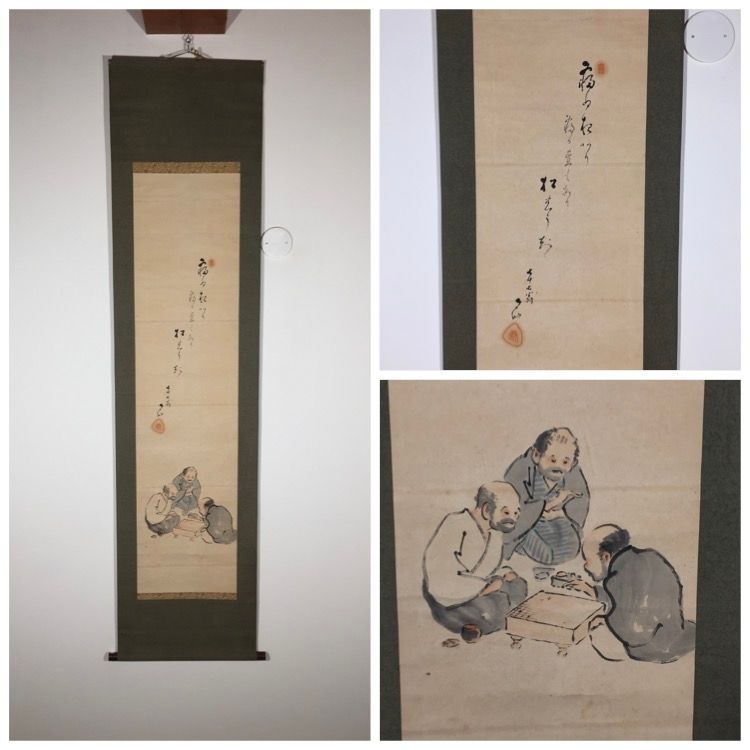
Ancient and elegant Japanese Kakemono from the Edo period (1603-1868 AD) with a beautiful poem in the Sōsho (草書) or “Herb Writing style”. - Ancient and elegant Japanese Kakemono from the Edo period (1603-1868 AD) featuring a beautiful poem in Sōsho (草書) style, or ”Grass Script”. GENERAL DESCRIPTIONThis painting is a kakemono (hanging scroll). The artwork was executed by a late 19th-century painter at the age of 77, who wished to create an 写し Utsushi (a devotional copy or a stylistic homage) inspired by a theme or a text originally composed by or dedicated to Gessen. The author placed his own verses on the front, signing with his age (77 years old) and his personal seal. However, on the back of the scroll, he recorded the name of the master who inspired him, including it in a poetic title and playing on the meaning of the name Gessen (literally ”the Moon Hermit”) to acknowledge the intellectual source of the work. SUBJECTThe artwork depicts a casual, daily scene in the style of the ”Southern Literati Painting” (南画 Nanga / 文人画 Bunjinga), a school that is much more free, poetic, and intuitive compared to the Northern school. The subject of the painting is three elderly men focused on playing 碁 Go (the traditional Asian strategic board game). CALLIGRAPHY Across the upper part of the scroll flows a poetic inscription executed in a fluid and energetic calligraphy, topped and accompanied by the author's typical red seals, which authenticate the writing and painting while serving as an additional compositional element. The calligraphic style is the famous Sōsho (草書), known as the ”Grass Script”, characterized by an extreme cursive form. The shapes are abstract and focused on the energy of movement (Ki) rather than legibility, with syllables merging into a single fluid stroke (连绵词 Renmen). Due to the artistic nature of this style, multiple historical kanji take on the same simplified cursive shape. TRANSLATION AND COMMENTARY OF THE TEXT ON THE FRONT OF THE PAINTING 夜のl底に / 霧中雲外 / 松ちり Yoru no soko ni / muchū ungai / matsu chiri ”In the depths of the night / amid the fog and beyond the clouds / pine needles fall” This specific combination is part of a traditional poem (a haiku or a waka). Specifically, the phrase matsu chiri or matsu chirite (松ちりて) is a seasonal reference (kigo) linked to the end of winter or the beginning of spring, when old pine needles fall to make room for new growth. The ”Opening Seal” (Inshu 引首) at the top is a classic Baiwen (白文), meaning ”white characters” on a red background. AUTHOR'S SIGNATURE AND SEAL The subsequent handwritten Japanese characters above the red seal read 七十七翁 (Nanajuunana-ō), which literally translates to ”the 77-year-old old man.” In traditional Japanese and East Asian art, it was a common custom for painters, poets, or calligraphers to indicate their advanced age within their signature (especially on important longevity milestones such as 77 years old, called 喜寿 Kiju or ”happy age”). Below and slightly to the left of the age, also in a fluid cursive style, is the artist's name or pseudonym, followed by the ”Validation Seal” (known as Gō-in 号印 and also Hanko 判子) in Zhuwen (朱文) style, meaning ”vermilion characters” on a white background, executed in ”seal script” (篆書 Tensho). This seal faithfully represents and reproduces the natural section of a raw stone and is called Shizen-in (自然印), or ”natural seal.” The imprinted character is 閑 (Kan), meaning ”leisure, quiet, idleness.” In the literati context, it refers to a peaceful life free from worldly obligations, which perfectly complements the act of playing 碁 Go in the midst of nature. TRANSLATION AND COMMENTARY OF THE TEXT ON THE BACK OF THE PAINTING 宵ぬれて / 月仙 / 松の内 Yoi nurete / Gessen / Matsunouchi ”Wet by the dusk / Gessen (lit. the Moon Hermit) / during the first days of the year” This poetic title summarizes the preceding text, stating that in the evening dew, Gessen (which can refer both to the name of the famous Zen Buddhist painter and to the literal meaning of ”Moon Hermit”) is wet during the ”days of the pine” (New Year's), known as 松の内 Matsunouchi—the seasonal word (kigo) for winter and the New Year. It indicates the first week of the new year (traditionally from January 1st to 7th, or up to the 15th in some regions), the period when houses are adorned with decorative pine trees to welcome the deities. Period: circa 19th century Dimensions : 188 x 54.5 cm. Material: Paper and Silk Technique: Handpainted Author : Gessen (月僊) Parcel with safe and solid packaging materials. - Ready to ship in 2/3 Days - Shipment time from 3 to 15 days : depends on the distance of Country. - Worldwide Delivery with professional couriers - Tracking Code Shipment