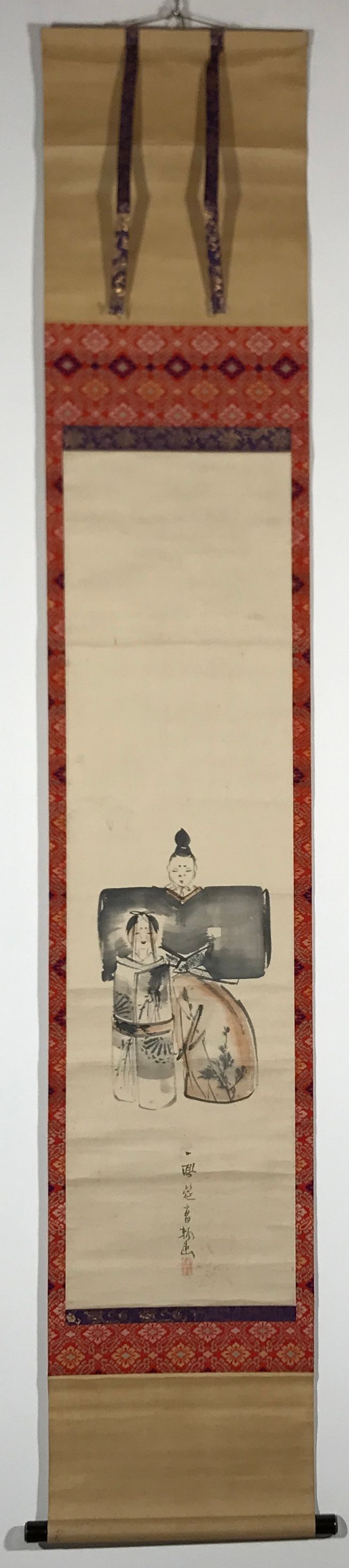
Bidspirit auction | Edo period kakemono with Tachi-bina
Edo period kakemono with Tachi-bina (立ち雛) , “Standing Dolls”, made by Mori Ippo (森一鳳) 1798-1871 - Edo period kakemono with Tachi-bina (立ち雛) , “Standing Dolls”, made by Mori Ippo (森一鳳) 1798-1871 Subject: A type of hina dolls (雛) called tachi-bina, which are characterized by being standing rather than seated. Tachi-bina are likely the origin of all hina dolls, as they evolved from the dolls anciently used for Hinanagashi (雛流し). In this ritual, all impurities were transferred to paper figures with human likenesses and cast away by letting them float down the river. This practice also gave rise to the famous festival dedicated to the healthy growth of girls, Hinamatsuri (雛祭り), the Doll Festival celebrated every year on March 3rd. To ward off evil and misfortune from their daughters, families display a private collection of decorative dolls on this occasion. These dolls, handed down from mother to daughter, represent the imperial couple and the imperial court. For this reason, when people think of hina dolls today, they usually picture a pair of dolls dressed in rich fabric garments and seated on a platform with a red background, a style that became popular between the mid and late Edo period (1603-1868). Artist: Mori Ippo (森一鳳) 1798–1871 (Japanese date: Kansei 10th year – Meiji 4th year; 寛政10年 – 明治4年). The writing says: 一鳳寫 柳圃 (Ippō sha / Ryūho) = ”Painted by Ippō [stage name] Ryūho” (lit. ”willow garden”). The writing on the back of the kakemono says: 立雛 (Tachibina) 百於九 (Hyaku ni kyū) 森一鳳 (Mori Ippo) = ”Hina Dolls (standing) / Nine of a Hundred / Mori Ippo”. Biography: The painter was born into the Iwasaki family in the village of Yoshida, Hyogo. He studied under the Osaka artist Mori Tetsuzan (森徹山) (1775-1841). He married Tetsuzan's daughter, Ryu, and succeeded the Mori family, but was eclipsed by another adopted son, Mori Kansai. He left behind many exceptional paintings, and his work deserves to be re-evaluated.He is said to have been born in Yoshida, Banshū (southwestern part of Hyōgo Prefecture). His given name (na) was Keishi (敬之), his adult name (azana) was Shikō (子交), his artist name (gō) was Ippō (一鳳), and his common name (zokushō) was Bunpei (文平).He studied under Mori Tetsuzan in Osaka and was adopted by him before 1833 (Tenpō 4). He participated in the construction of the imperial palace during the Ansei period (1854-1859) and served the Hosokawa clan of the Higo domain (now Kumamoto Prefecture) as a painter alongside Tetsuzan. He exhibited works at the 1844 (Tenpō 15) calligraphy and painting exhibition honoring Ōkyo and Nangaku.His style was more lyrical and carefree than that of Tetsuzan, who had introduced the Maruyama Ōkyo style to Osaka. His works were reportedly highly popular among merchants due to a pun on the title of a painting. The piece depicts a summer boat where people are ”cutting water-grass” (mo-karu), a phrase that sounds identical to ”making a lot of money.” He lived in Yodoya-kōji, Nakashima, and other locations. Parcel with safe and solid packaging materials. - Ready to ship in 2/3 Days - Shipment time from 3 to 15 days : depends on the distance of Country. - Worldwide Delivery with professional couriers - Tracking Code Shipment