Bidspirit auction | epanaphoras
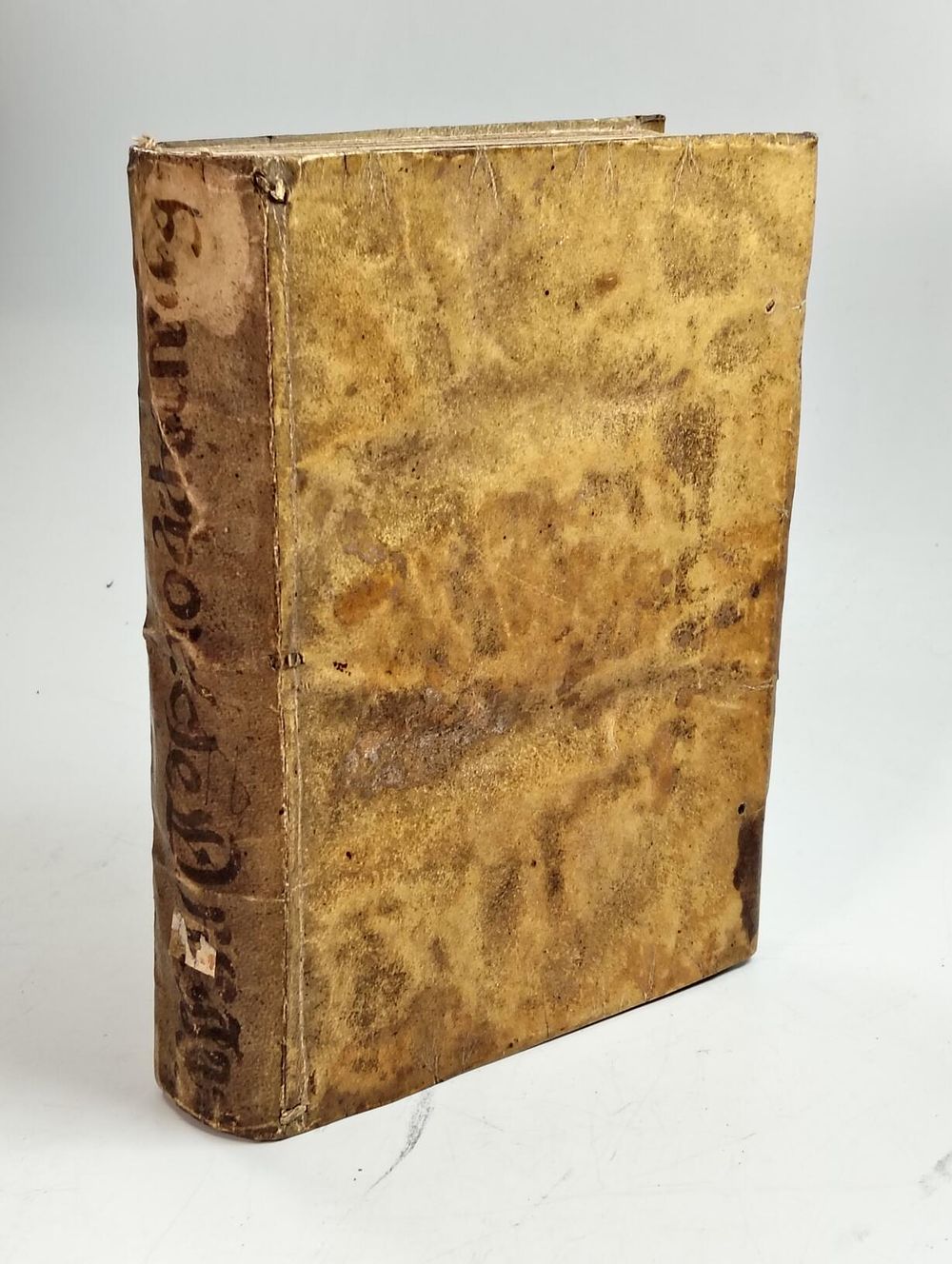
epanaphoras - MELO (Francisco Manuel de) EPANAPHORAS de Varia Historia Portugueza . [...] em Cinco Relaçoens de Svcessos pertencentes a este Reyno. Que contem negocios publicos, Politicos, Tragicos, Amorosos, Beliscos, Triunfantes. Lisboa: Antonio Craesbeeck de Melo, 1676. [ ]2, A-Z, Aa-Ii8, Kk6; [4], 624, [2] pp.; 200 mm. Rare edition of this important and classic text by D. Francisco Manuel de Melo. The work is divided into five epanaphoras with the following titles: 1. Alterations of Évora, year 1637 ; 2. Shipwreck of the Portuguese Armada in France, year 1627 ; 3. Discovery of Madeira Island, year 1420 ; 4. Conflict in the English Channel between the Spanish and Dutch Armies, year 1639 ; 5. Restoration of Pernambuco, year 1654 . D. Francisco Manuel de Melo, born in 1608 in Lisbon, studied at the Jesuit College of Santo Antão, was a soldier under the command of Diogo de Mendonça Furtado, embarked on the Crown's fleet that sank in 1627, fought against the Turks in naval combat and was knighted for his deeds, frequented the Madrid court where he became friends with Quevedo, one of the most important literary figures of the time in Castile, and also had contact with Lope de Vega, Calderón, Tirso de Molina, among others. When the Restoration Revolution took place, he was arrested and taken to Madrid where he remained for 4 months. In 1644 he was arrested again for reasons that are unknown to us. He remained in the Castle, then transferred to the Belém Tower, was tried and sentenced for instigation of murder to perpetual exile to the coast of Africa, in the second instance to exile to India, and in the third instance it was decided that he would be exiled to Brazil, where he remained for eleven years. In 1655 he left for the New World, returning to exile in 1658, taking refuge on his farm in Entre-Rios. In 1660 he was in Lisbon leading the sessions of the Academia dos Generosos and during the government of Castelo-Melhor, of whom he was a friend, he was entrusted with several important diplomatic missions. Upon his return, he was nominated as a deputy for the Junta dos Três Estados. He died in 1666. Possessing a vast and lively culture, he “wrote an astonishing work” [Dic.Lit.] and was considered by M. y Pelayo to be the greatest literary figure of the time after Quevedo. Rebelo da Silva states that D. Francisco Manuel de Melo should be considered “one of the first scholars of his time and perhaps the most substantial and concise prose writer in the Portuguese language” [cit. from Dic.Lit.]. The published texts are immense and are divided into history, including classic works such as the present one or the “Historia de los Movimientos y separación de Cataluña y de la Guerra entre la Magestad Católica de Don Dilipe el Cuarto Rey de Castilla y de Aragón y la Deputación General de aquel principado”, poetry, polemics and various other themes. Very rare. ! Please note that this translated text was generated by Google. !