Bidspirit auction | Owar Germanice Nieuhuisel / Vizzegrad,
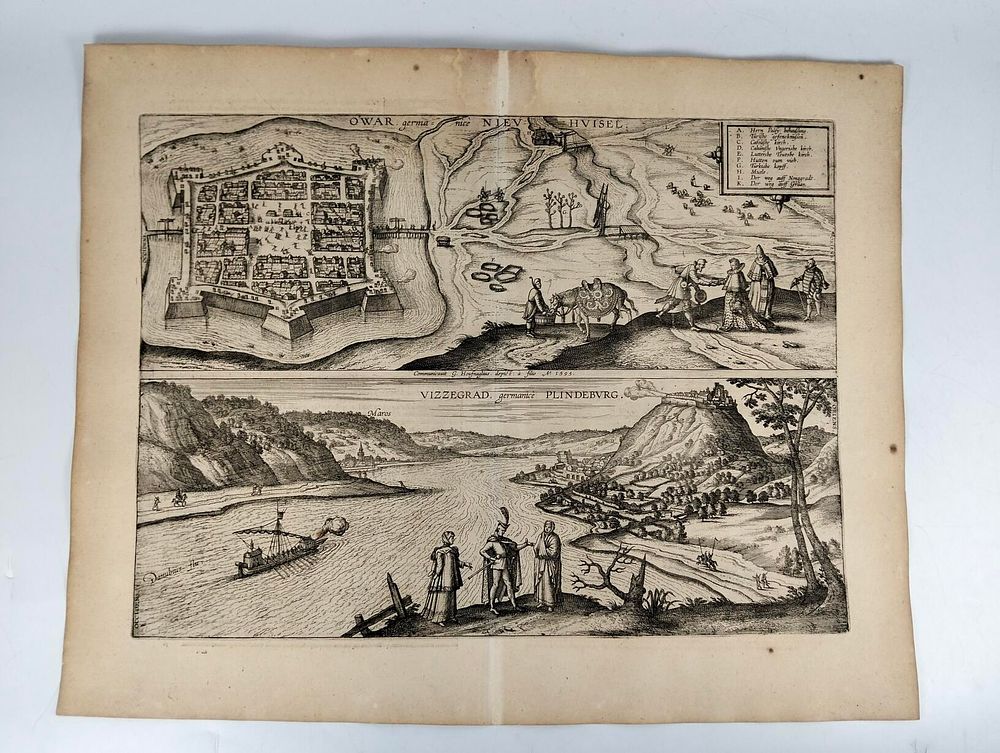
Owar Germanice Nieuhuisel / Vizzegrad, Germanice Plindeburg. Colónia, c. 1596. - [NOVÉ ZÁMKY / VISEGRÁD]. Owar Germanice Nieuhuisel / Vizzegrad, Germanice Plindeburg. Communicavit G. Houfnaglius depicta à filio A° 1595. Georg BRAUN; Frans HOGENBERG (eds.), after drawings by Georg (Joris) HOEFNAGEL and his son. [Cologne, Georg Braun & Frans Hogenberg, c. 1596; date “1595” on the plate]. Engraving; 425 × 535 mm (sheet). Sheet with two views: in the upper half, plan of the fortress of Nové Zámky, in Slovakia, identified as “Owar, Germanice Nieuhuisel”, quadrangular, surrounded by a broad water-filled moat and earthworks, with angular bastions and an internal regular grid of streets and buildings; at right, landscape with paths, cultivated fields and a group of Hungarian figures in local dress, accompanied by pack animals; cartouche with alphabetical legend of the principal defensive elements. In the lower half, panoramic view of the Danube valley with the castle of Visegrád (“Vizzegrad, Germanice Plindeburg”) rising on a steep hill at right, the lower town and villages along the river, where a rowing boat sails; in the foreground, a group of four figures in Hungarian costume, reinforcing the ethnographic dimension of the scene. Verso with descriptive text in Latin under the headings UVAR. and VICEGRADUM , paged [55], belonging to volume V of the Civitates orbis terrarum . The views show two strategic positions in the defence of the Kingdom of Hungary against the Ottoman Empire: the modern bastioned fortress of Nové Zámky (Érsekújvár), conceived in the 16th century according to the principles of Italian military engineering, and the ancient royal castle of Visegrád, an important residence of the Hungarian kings, here already depicted partially ruined after conflicts with the Turks.