Bidspirit auction | FERREiRA (António). LUZ Verdadeyra, e
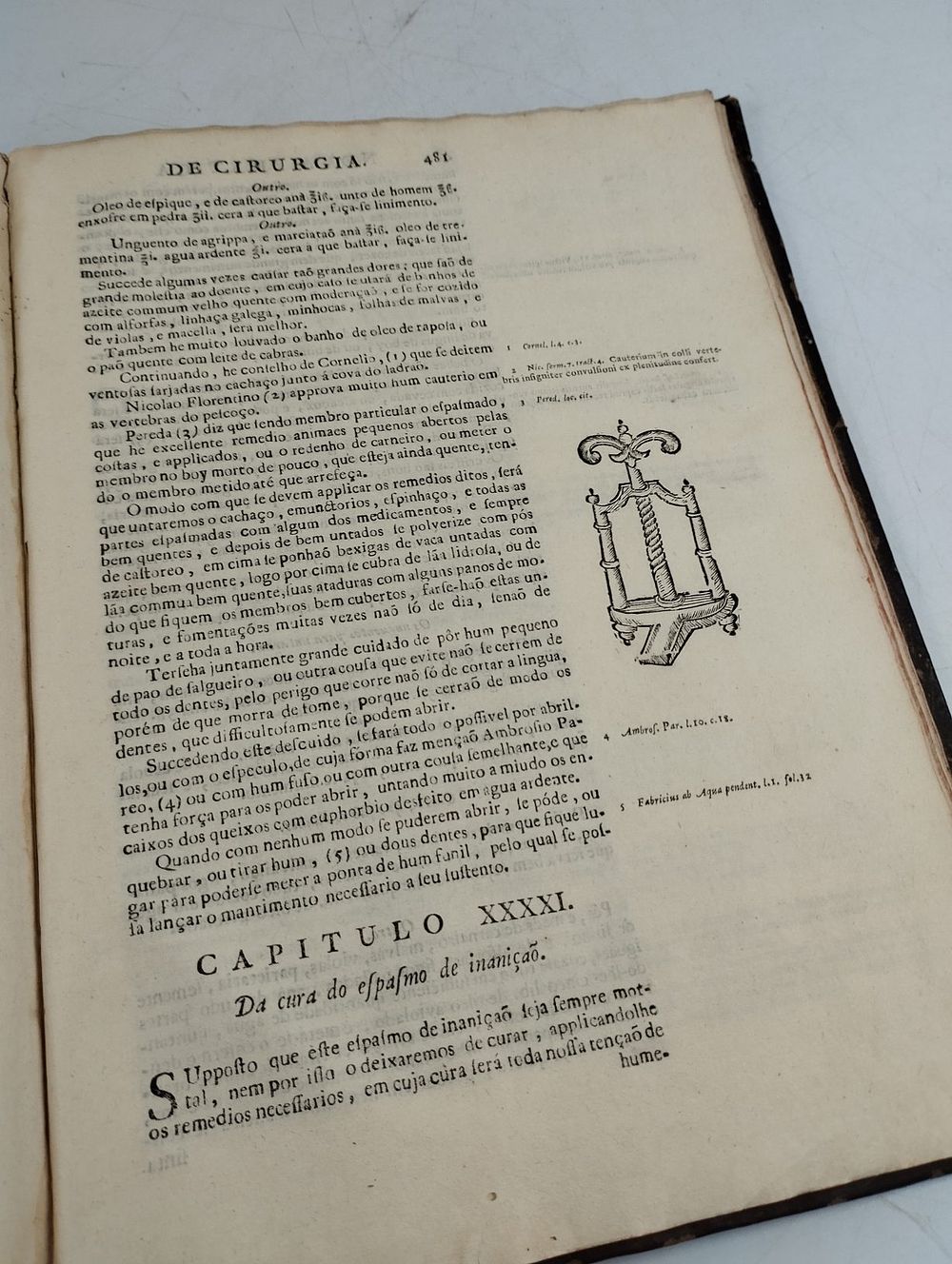
FERREiRA (António). LUZ Verdadeyra, e Recopilado Exame de Toda a Cirurgia. Lisboa. 1705. - FERREiRA (António) LUZ Verdadeyra, e Recopilado Exame de Toda a Cirurgia . Acrecentado nesta Quarta Impressam com huma Nova Pratica do mesmo Author, com todos os accidentes, que podem sobrevir às feridas. Lisboa: Na Officina de Valentim da Costa Deslandes, Impressor de Sua Magestade, 1705. [20], 528 [aliás 568] pp.; 290 mm. Fourth printing, supplemented with the New Practice of Surgery by the same author. António Ferreira (Lisbon, 1616 - 1679) studied in Coimbra, where he practiced anatomy and surgery. Appointed to a commission in Tangier during an epidemic, the success of his work was such that King John IV granted him the honor of Surgeon of his Royal Chamber; he also served as surgeon of the General and Royal Hospital and of the prisons of the Holy Office, and was tasked with accompanying the Queen of England, Catherine of Braganza, to London in 1662, where he acquired new knowledge. He is considered, alongside António da Cruz, the most notable Portuguese surgeon. The True Light , of which five editions were made, was augmented with a brief Addition and a new treatise mentioning how a surgeon should conduct himself, and with the New Practice and Theory of Surgery . The first edition was published in Lisbon by Domingos Carneiro in 1670; the second at the printing house of Miguel Deslandes in 1683; the third by João Galrão in 1693; the present fourth printing, from 1705, was published at the printing house of Valentim da Costa Deslandes – son of the printer of the second edition – and is the first to incorporate the New Practice as an integral part of the work, significantly increasing the text. The fifth and final edition was published by Joseph Filippe in 1757. The work, with pagination errors common in the different printings (the correct pagination is 568 and not 528 as indicated), has a frontispiece printed in black and red with the Portuguese royal coat of arms. The National Library of Portugal (BNP) records two distinct typographical states of this fourth printing of 1705, distinguishable by variations in the vignettes and typographical ornaments. Rare and prized. ⚑ Auto-translated via Google Translate ¶ Inocêncio, I, 142 e XXII, 269; Barbosa, I, 274 e II, 541