Bidspirit auction | GARAU (P. Francisco). EL SABIO
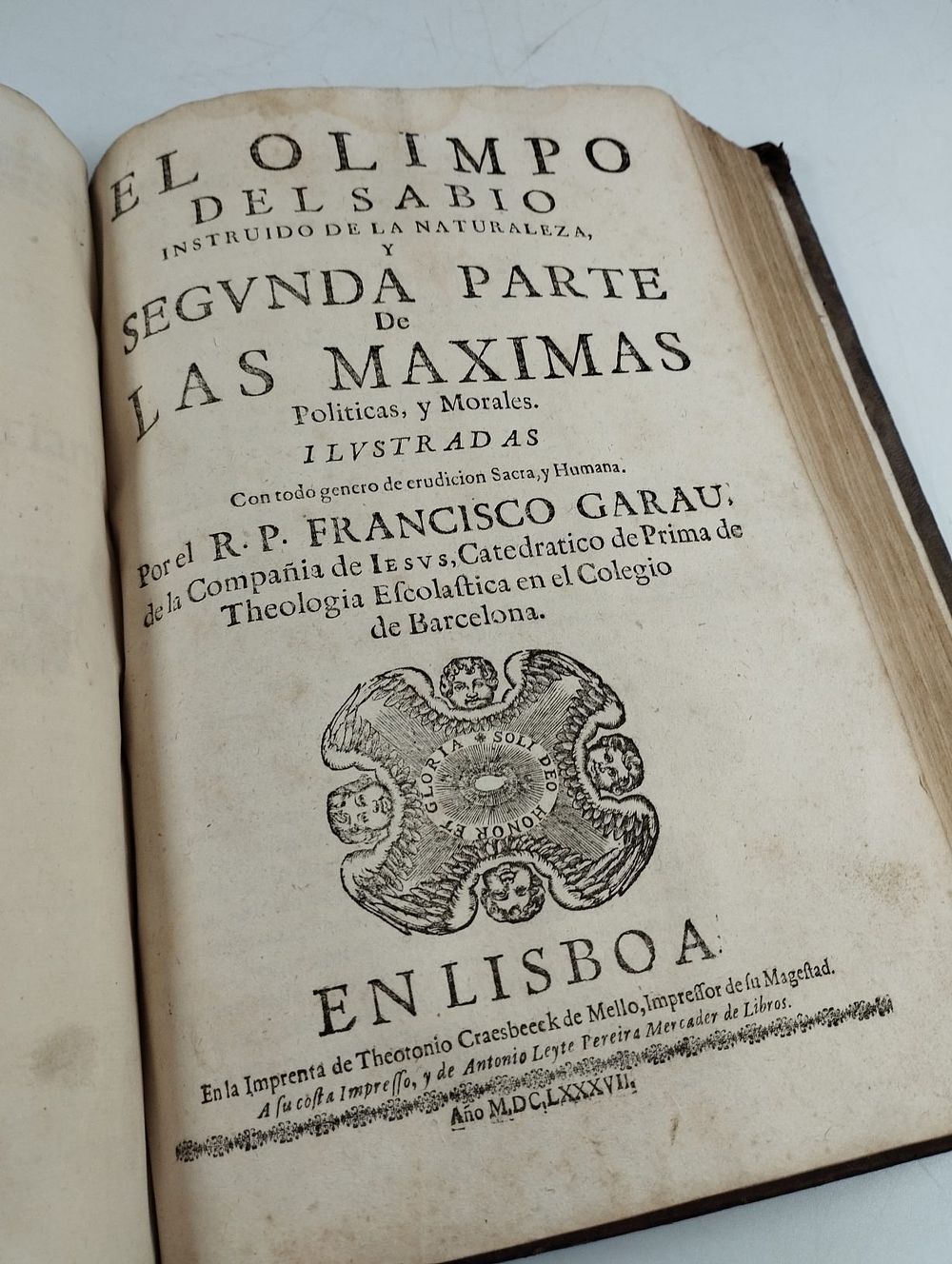
GARAU (P. Francisco). EL SABIO INSTRUIDO DE LA NATURALEZA, En Quarenta Maximas Politicas, y Morales. En Lisboa. 1687. - GARAU (P. Francisco) EL SABIO INSTRUIDO DE LA NATURALEZA, En Quarenta Maximas Politicas, y Morales . Ilustradas con todo genero de erudicion sacra, y humana, por el R. P. Francisco Garau [...] Sacale a Luz Jacinto Dou [...]. En Lisboa: En la Imprenta de Theotonio Craesbeeck de Mello, 1687. 2 v. em 1.; [ ]2, +4, [ ]1, A-Z4, Aa-Nn4, [14], 278, [10] pp.; ¶4, ¶5, A-Z4, Aa-Zz4, [18], 368 pp.; 300 mm. This Lisbon edition brings together the first two parts of the emblematic cycle by Father Francisco Garau: El Sabio Instruido de la Naturaleza en Quarenta Máximas Políticas y Morales (whose first edition appeared in Barcelona, by António Ferrer, in 1675) and El Olimpo del Sabio Instruido de la Naturaleza , the second part of the maxims (whose first edition was published in Barcelona in 1681). Francisco Garau (Gerona, 1640 - Barcelona, 1701) was a Jesuit from Girona of remarkable culture and ingenuity, dedicated to teaching the humanities and theology in various Jesuit colleges, where he enjoyed great recognition in his time. In the panorama of Spanish literature, Garau's books, abundant and remarkably successful in terms of publication, judging by their successive editions from the time of their publication until the third decade of the 18th century, are not easy to define and contextualize. The strategy employed by Garau to instruct his wise man through nature is fully integrated into the emblematic rhetorical machine, for in his judgment ”each creature's nature is a hieroglyph, and in each hieroglyph is encoded a document of good living.” The Jesuit develops in the work a set of forty fables inspired by Aesop, which he calls ”fictions, ” with the moral purpose of providing the reader with ”a river full of clean stones to throw against the Goliath of sin.” The second part, Olympus , presents homologous maxims of an analogous nature. This Lisbon edition was printed by Theotonio Craesbeeck de Mello, royal printer, at the expense of the bookseller António Leite Pereira, and is the only Portuguese edition of the collection. Highly regarded and unusual in a Portuguese edition. ⚑ Auto-translated via Google Translate