Bidspirit auction | [D. JOSÉ I]. COLÉGIO DE
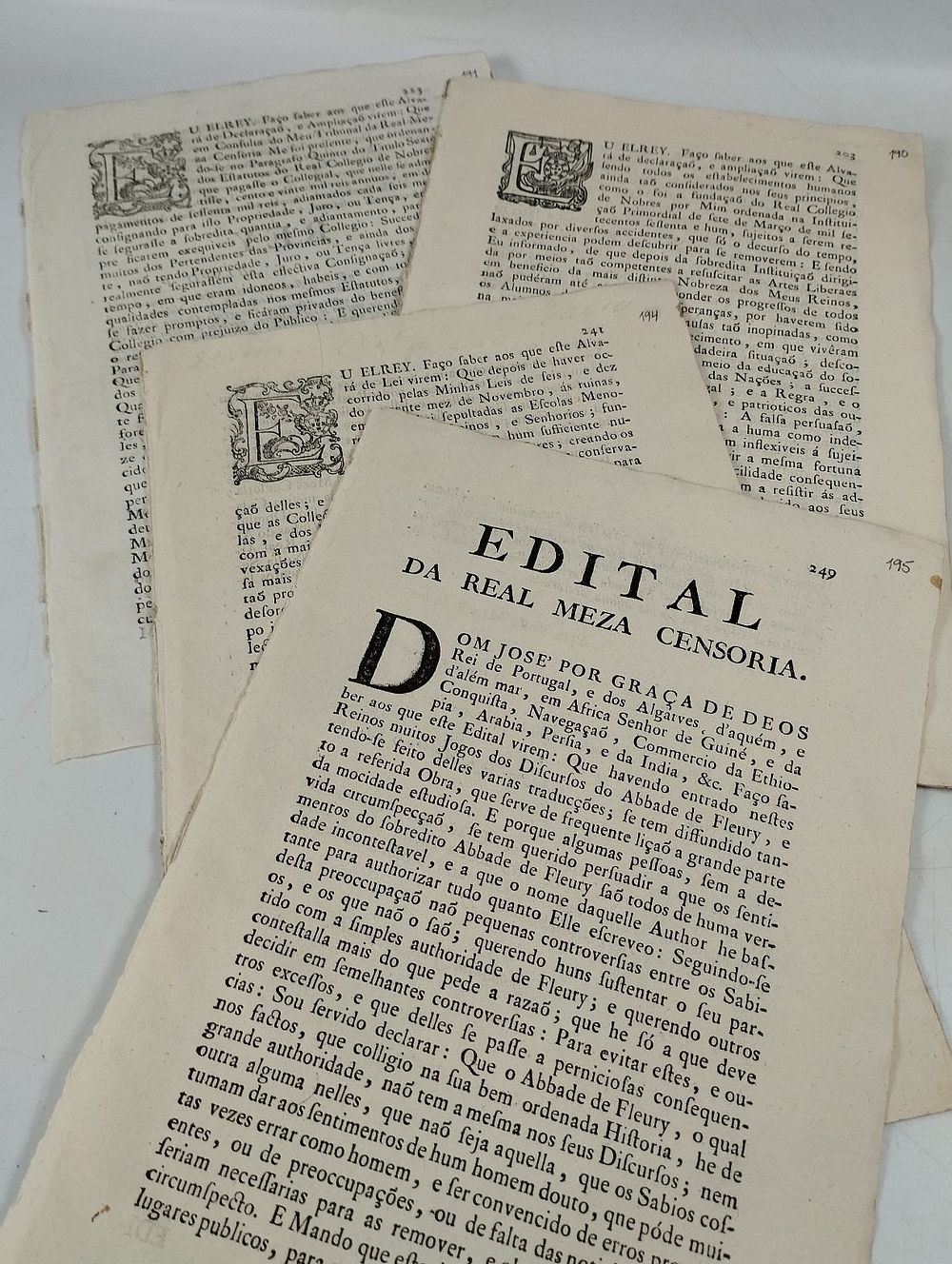
[D. JOSÉ I]. COLÉGIO DE NOBRES E ESCOLAS MENORES — Reforma de 1772. 1772. - [D. JOSÉ I] COLÉGIO DE NOBRES E ESCOLAS MENORES — Reforma de 1772 . 1772. 4 diplomas régios: 2 Alvarás, 1 Alvará de Lei, 1 Edital. This set of four decrees from the great educational reform of 1772 constituted the culmination of Pombal's educational policy: the expansion of the statutes of the Royal College of Nobles, the regulation of payments to College students, the creation of the Literary Subsidy Board for the financing of Minor Schools, and the declaration by the Royal Censorship Board regarding the authority of the Abbot of Fleury. While the 1759 reform had abolished Jesuit education and created the system of royal schools, the 1772 reform consolidated its financial base and reorganized the College of Nobles. c. 1772 (D. José I) — Expands and declares the Primordial Institution of the Royal College of Nobles given on March 7, 1761, for the reasons stated therein; revision and updating of the statutes of the main educational establishment of the noble elite. July 23, 1772 (King Joseph I) — Declares that students of the Royal College of Nobles who do not meet the requirements of the Statutes must pay a single quarter in advance every three months with security; and that those who do not pay within fifteen days will be irrevocably dismissed; financial regulation of access to the College. November 25, 1772 (King José I) — Creates a Board with exclusive jurisdiction for the collection and distribution of levies for the Masters and Professors of the Minor Schools; also includes a provision regarding the transfer of Mathematical Sciences from the College of Nobles to the University of Coimbra; a fundamental decree for the financing of royal public education. November 26, 1772 (King Joseph I) — Edict from the Royal Censorship Board declaring that the Abbot of Fleury, of great authority on historical facts, does not have the same authority in his speeches; and that his opinions in speeches are not incontestable, to avoid controversies and pernicious consequences; regulation of the authority of history textbooks in education. This collection documents four facets of the 1772 educational reform: the revision of the statutes of the College of Nobles, the financial discipline of its students, the creation of a funding mechanism for the Minor Schools (literary subsidy), and the delimitation of the authority of a widely used history textbook. Essential documentation for the study of educational reform in Pombaline Portugal and the history of public education in Portugal. ⚑ Auto-translated via Google Translate