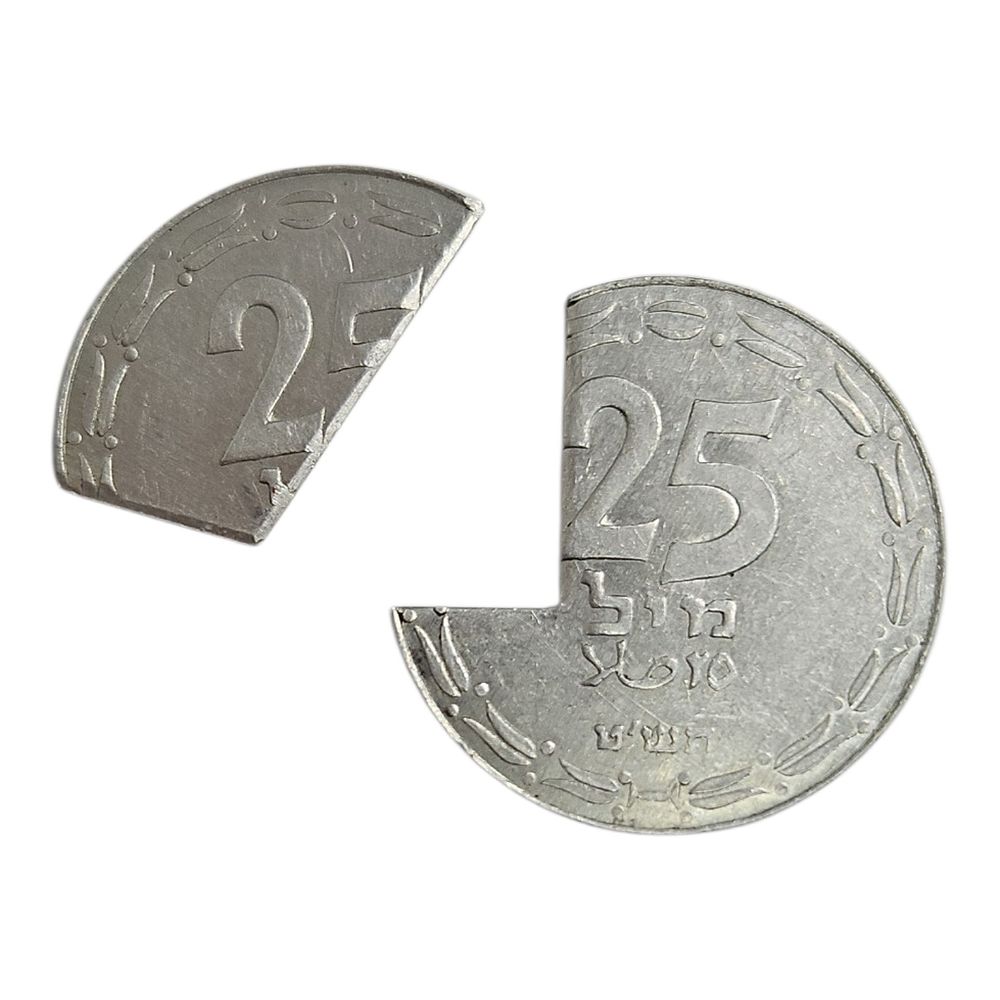
Bidspirit auction | Two very rare, clipped 25-mil
Two very rare, clipped 25-mil coins from Israel. They are documented in the *Shekel* journal and in the 2003 Romano auction; such pieces are known as authentic ”clipped” specimens—coins cut from various metals for testing purposes during the minting process. This specific item is a standard coin that has been clipped. - 1949 25 Mils Pattern Pieces By Arthur Reich In 1948, the first coins of the newly established State of Israel were introduced. The first issues, the 1 Lira and 25 Mils coins, were struck in aluminum. Due to the severe shortage of various metals during the war, these coins were released into circulation. However, because of the serious shortage of aluminum, production was discontinued in July 1948. It was decided to strike the 25 Mils coin again in 1949 using the same design. However, because of the poor striking quality of the 1948 coins, caused by the hardness of the material, the Mint decided to test several alternative metals. Pattern pieces were struck in brass, bronze, copper, and another harder metal, in order to determine which material would be the best replacement for aluminum. Test strikes were produced in Rivers, Quebec, Canada. The results obtained with the harder metals were not satisfactory, as there were concerns that the dies would crack. At the time, a full-scale war was in progress, and it was believed that sufficient quantities of any of the metals tested would not be available for the production of a full circulating coinage. The Israeli Government had already placed an order for a complete series of circulation coins to be struck abroad. The coins were produced in England by Imperial Metal Industries and were on their way to Israel. Once the first shipment of the 1949 25 Mils coins arrived, the testing program was abandoned, and aluminum was once again used for the regular production of the 1949 25 Mils coins. The pattern pieces struck in the harder metals were destroyed by cutting them with metal shears. A few examples escaped destruction and are now in the hands of collectors in their cut and damaged condition. Unfortunately, no records remain indicating how many pieces of each metal were struck, how many were destroyed, or how many have survived. After all, these events had taken place nearly thirty years earlier. The coins were dispersed among collectors during the 1980s and sold at a ”Romano” auction in 2003. In our Auction 74, we had the privilege of selling one of these pattern coins, struck in either aluminum or white metal.