Bidspirit auction | Kfar Ata, 1944 (5705) –
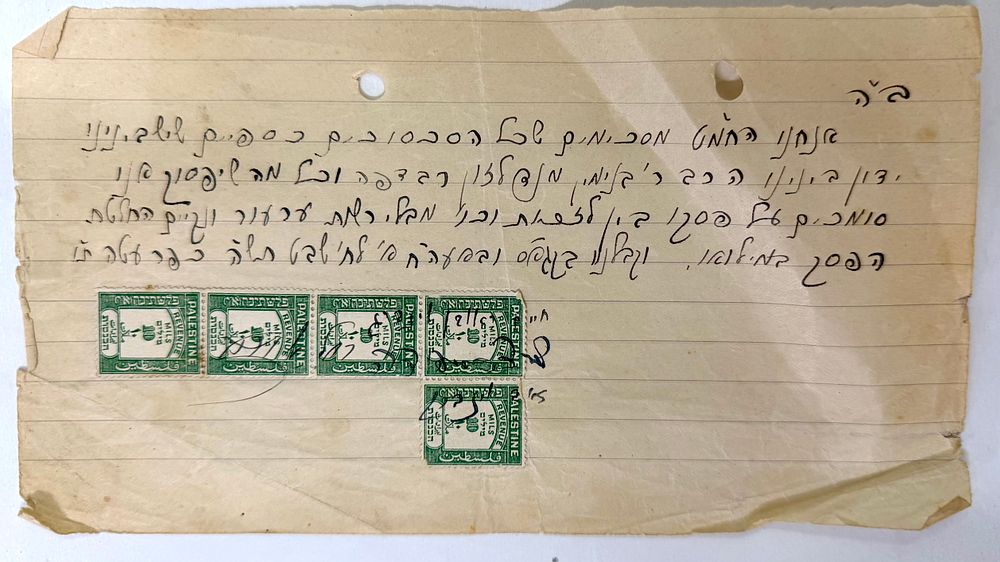
Kfar Ata, 1944 (5705) – Arbitration Agreement Handwritten and Signed by Rabbi Binyamin Mendelsohn, Rabbi of Kfar Ata - Kfar Ata, 1944 (Hebrew year 5705) – Original arbitration deed (Sh’tar Borerut), an agreement transferring the resolution of financial disputes to the judgment of Rabbi Binyamin Mendelsohn, Rabbi of Kfar Ata (Land of Israel). The document is handwritten and composed by Rabbi Mendelsohn himself, and bears the signatures of the involved parties, affixed with British Mandate-era revenue stamps. A rare and authentic document illustrating rabbinical arbitration and civil dispute resolution within the Jewish community during the British Mandate period, signed by Rabbi Binyamin Mendelsohn (1904–1979) — a respected rabbinic authority, later known as the rabbi of Komemiyut and a leading figure in promoting observance of the Shmita (Sabbatical year) in Israel. Rabbi Binyamin Mendelsohn (1904 – May 21, 1979) was the rabbi of Kfar Ata (later Kiryat Ata) and subsequently the rabbi of the Haredi moshav Komemiyut. His name became widely known in connection with the “Yossele Schumacher affair”, one of the most famous legal and social controversies in Israel’s early years. Rabbi Mendelsohn was a prominent advocate for strict observance of the Sabbatical year (Shmita) without reliance on the Heter Mechira (sale permit). He played a key role in the Keren HaShvi’it (Seventh-Year Fund), which provided financial support to farmers who refrained from cultivating their fields during the Sabbatical year in accordance with Jewish law. He was born in 1904 in Płock, Poland, to Rabbi Menachem Mendel Mendelsohn, a Hasid of Alexander and head of a local yeshiva, and to Chana Devorah, granddaughter of Rabbi Moshe of Zaleszyn, author of Mishpat Tzedek, and a descendant of Rabbi Mordechai Yaffe and the Warka Hasidic dynasty. He studied primarily under his father. His first wife, Miriam, passed away at a young age, and he later married the daughter of Rabbi Aharon Moshe Chaimovitz of Budzanow, Poland. During the leadership of Rabbi Avraham Mordechai Alter of Gur (the Imrei Emes), Rabbi Mendelsohn became a devoted Gerer Hasid, and upon the Rebbe’s encouragement, immigrated to the Land of Israel in 1934, where he was appointed rabbi of Kfar Ata. In 1952, he accepted the invitation of the residents of Komemiyut to serve as their rabbi. He worked tirelessly to promote observance of Shmita, traveling among agricultural settlements and convincing farmers to uphold the Torah commandment. In 1973, he expanded the activities of Keren HaShvi’it to include even non-Haredi farmers who chose to leave their land fallow during the Sabbatical year. In August 1961, the police attempted to arrest Rabbi Mendelsohn in connection with the kidnapping of Yossele Schumacher, but residents of Komemiyut prevented the arrest. In May 1962, he was arrested again on suspicion of involvement in hiding Yossele and another child. His arrest provoked widespread protest among Orthodox Jews in the United States. At a major rally of the Union of Orthodox Rabbis of America and Canada, leading rabbis such as Rabbi Yosef Eliyahu Henkin, Rabbi Moshe Feinstein, and Rabbi Yaakov Kamenetsky spoke out against his detention. During the trial, Rabbi Mendelsohn refused to testify under cross-examination but made a statement declaring that at first he was unaware that the child living in Komemiyut was Yossele, and once he discovered it, he ordered that the boy be returned. Regarding the second child, he said that he had indeed intervened to prevent the boy from being handed over to his stepfather, as the boy had pleaded with him to save him from missionary influence. “There was no fear of secular education, ” he explained, “but rather the fear of conversion. If such a sacred commandment conflicts with state law, I am willing to endure any suffering for having fulfilled the Torah’s command.” On June 21, 1962, Rabbi Mendelsohn was acquitted by the District Court under Judge Binyamin Halevi after the prosecution withdrew the charges, following the admission by a key witness that he had lied in his testimony. The court, however, noted that the rabbi had been aware that Yossele Schumacher was being held in Komemiyut and had not taken active steps to return him to his parents. Rabbi Mendelsohn was highly esteemed by leading Torah sages, including the Belzer Rebbe, Rabbi Aharon Rokeach, Rabbi Avraham Yeshaya Karelitz (the Chazon Ish), and other great rabbis of his generation. He passed away on 24 Iyar 5739 (May 21, 1979) and was buried at Har HaMenuchot Cemetery in Jerusalem.