Bidspirit auction | Public Notice and Warning –
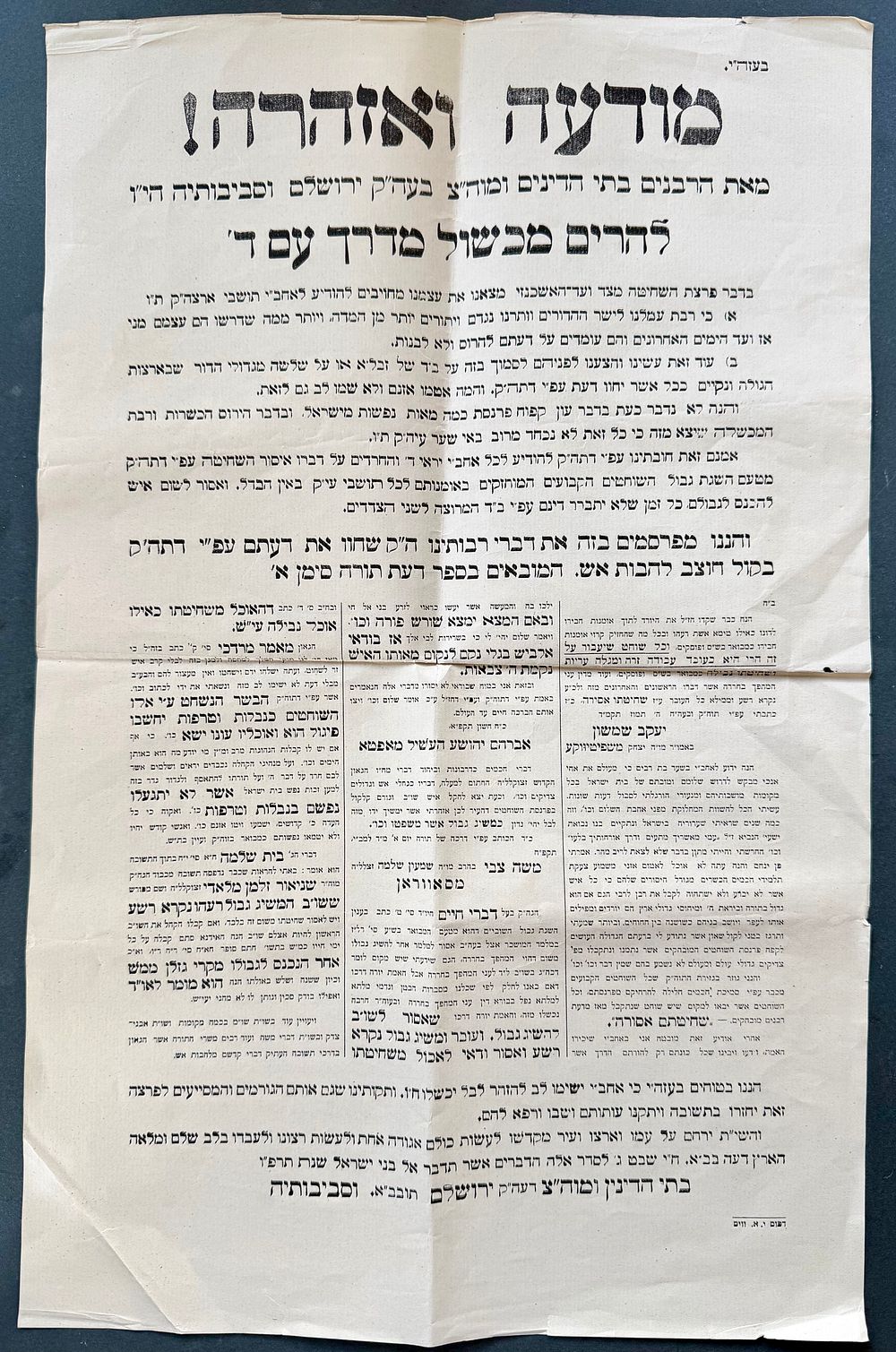
Public Notice and Warning – Against the Breach in Ritual Slaughter Supervision by the Ashkenazi Committee | Issued by the Rabbinical Courts and Moatzot Tzedek of Jerusalem | 1926 (5686) - A rare and important rabbinical broadside from Jerusalem, 1926, issued by the city’s rabbinical courts and authorized Moatzot Tzedek, during the British Mandate era. The poster, dramatically titled “Notice and Warning!”, denounces what it describes as a “serious breach in the shechita (kosher slaughter) system” introduced by the Ashkenazi Committee. The rabbis accuse the committee of appointing new shochtim (ritual slaughterers) without proper authorization, thereby encroaching upon established religious authority (masigei gvul) and invalidating the meat as non-kosher (treifah). The text cites halachic sources, notably Daat Torah, to rule that any slaughter performed under the new system is forbidden. It warns the public not to purchase or consume meat under this unauthorized supervision. Signed collectively by the Rabbinical Courts and Moatzot Tzedek of Jerusalem and its surroundings, dated 18 Shevat 5686 (February 2, 1926). 📜 Details: • Place: Jerusalem, under the British Mandate • Date: 18 Shevat 5686 (February 2, 1926) • Issued by: The Rabbinical Courts and Moatzot Tzedek of Jerusalem • Subject: Religious dispute over control and supervision of kosher slaughter • Language: Hebrew • Technique: Letterpress printing • Dimensions: 51 × 33 cm • Condition: Very good, preserved folds, clean and legible print 📖 Historical Context: This poster reflects the bitter conflict between the newly established Chief Rabbinate of Palestine (under Rabbi Abraham Isaac Kook) and the ultra-Orthodox Eda HaChareidis, who rejected its authority. The struggle over shechita supervision symbolized the larger political and religious schism between the Zionist and anti-Zionist factions within the Jewish community of Jerusalem. An authentic and rare historical document, illustrating one of the earliest and most public religious disputes in modern Jerusalem’s rabbinic history.