Bidspirit auction | Signed Letters, Eva Michaelis Stern
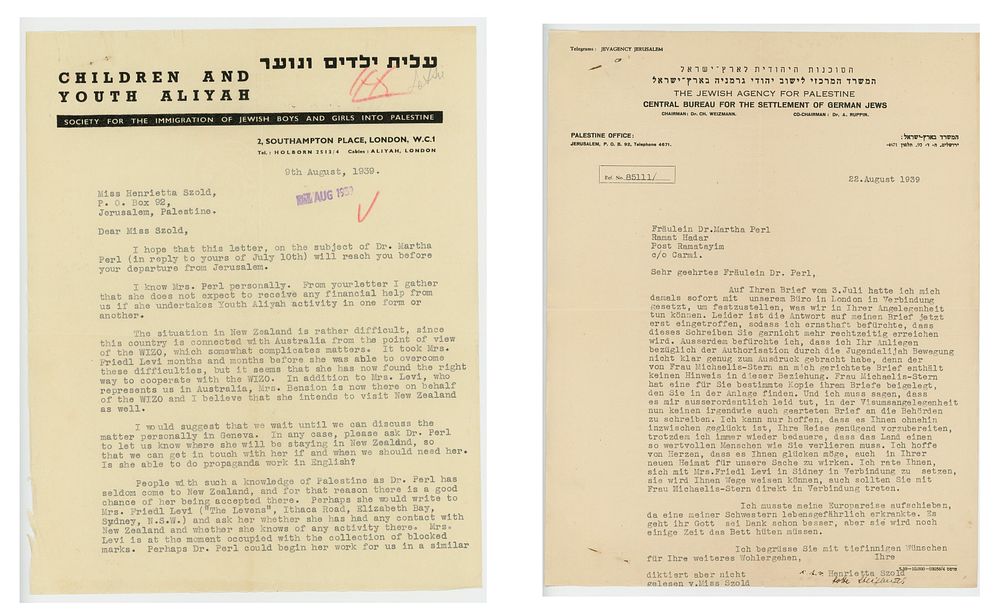
Signed Letters, Eva Michaelis Stern and Henrietta Szold. August 1939 – Aliyat HaNoar, Office for the Settlement of German Jews in Palestine. - 1: Letter from Henrietta Szold to Dr. Martha Perl in London, regarding her trip to Australia and New Zealand, to promote WIZO affairs there. Letter in German typewritten and signed by Szold. Official letter of the Jewish Agency for Palestine, Central Office for the Settlement of German Jews in Palestine. Page (1) 27x20 cm. Very good condition. 2: Letter from Eva Michaelis Stern to Henrietta Szold. The letter was sent from London on 9.8.1939 and received in Jerusalem on 17.8.1939. The letter concerns Dr. Martha Perl's trip to Australia and New Zealand, to promote WIZO affairs there. Typewritten English letter signed by Eva Michaelis Stern. Official stationery of the ”Children and Youth Elite” London. Page (2) 25x20 cm. Very good condition. Eva Michaelis Stern was a Zionist activist in the German Youth Aliyah. In 1937 she was interrogated by Adolf Eichmann. From the Central Zionist Archive: Eva Michaelis' Interrogation by Eichmann During a routine cataloguing of the personal archive of Eva Michaelis - Stern (1904 - 1992), preserved in the Zionist Archive, one of our archivists recently came across a chilling document, which tells of an interrogation at the Gestapo offices in Berlin in the late 1930s. The document was written by Michaelis, who was one of the founders of the Youth Aliyah Office in Berlin and one of its dominant figures. In the document, she tells how she was summoned for questioning by Adolf Eichmann, who at that time headed the Jewish department of the secret police in Nazi Germany. Beyond the interrogation itself, the document provides a glimpse into a dark period in Germany, and reflects how, despite the efforts of Zionist activists to present an appearance of ”business as usual” in the years before World War II, fear bubbled beneath the surface. The watchful eye of the Gestapo, which controlled everything, gradually managed to unravel the bonds of belonging of German Jews to the country in which they had lived for years. The document, read as a short suspense story, also teaches about the fickleness of human nature and the thin line between friendship and enmity. ”It was in December 1937, on one of those gloomy winter days, typical of the Berlin winter, ” writes Michaelis. “During the Nazi period, as long as we were allowed to continue our work, we tried to work as much as possible to alleviate the plight of German Jews, and we all remained seated at our desks until late hours.” A telephone call interrupted the work routine that evening: “This is Mr. Müller – you know very well who I am – you must report to the secret police offices immediately, ” the voice on the other end of the line ordered Michaelis. Müller was the pseudonym of Eichmann’s Jewish informant, and Michaelis, who knew who the man was and who he worked for, complied, but not before asking her secretary to wait for her in a nearby café. “If I’m not out in an hour, tell my family and my fiancé, ” she told her, before entering the building whose basement was a prison, and whose many traces that had come within its walls had disappeared as if they had never existed. “The entrance to the infamous building on Prince Albert Street was completely dark, ” she says. ”The only light came from an illuminated poster, which greeted those who came with advice, designed to stretch their frayed nerves to the limit: 'Breathe deeply. There is nothing to fear.'” Inside the building, Michaelis was led by two Gestapo officers to a small interrogation room, where an unpleasant surprise awaited her. Next to the interrogator sat a former activist from the Youth Immigration Office, who had been fired by Michaelis for misconduct. ”I immediately understood that she was the reason I was summoned for questioning. This was her revenge for being fired, ” says Michaelis. During the interrogation, the interrogator accused Michaelis of spreading anti-Nazi propaganda outside Germany, a charge that Michaelis denied. Following this initial interrogation, Michaelis was summoned a few days later for another interrogation, this time in front of Eichmann himself. ”He entered the room without even glancing at me, and began firing questions like from a machine gun, ” she recalls. After a brief interrogation, Eichmann accused Michaelis of using her work in the Youth Aliyah Office as a cover for spreading anti-Nazi propaganda, and forbade her from continuing in her position. He released her, but not before demanding that she leave her passport with him. Michaelis, who had anticipated the request in advance, arrived without a passport and was released on her way. Following the interrogation and with the advice of the other members of the Youth Aliyah Office, Michaelis left Germany shortly after and immigrated to Eretz Israel. She continued to be active in the Youth Aliyah until 1952,