Bidspirit auction | Arie Aroch Streichman (1906–1993)
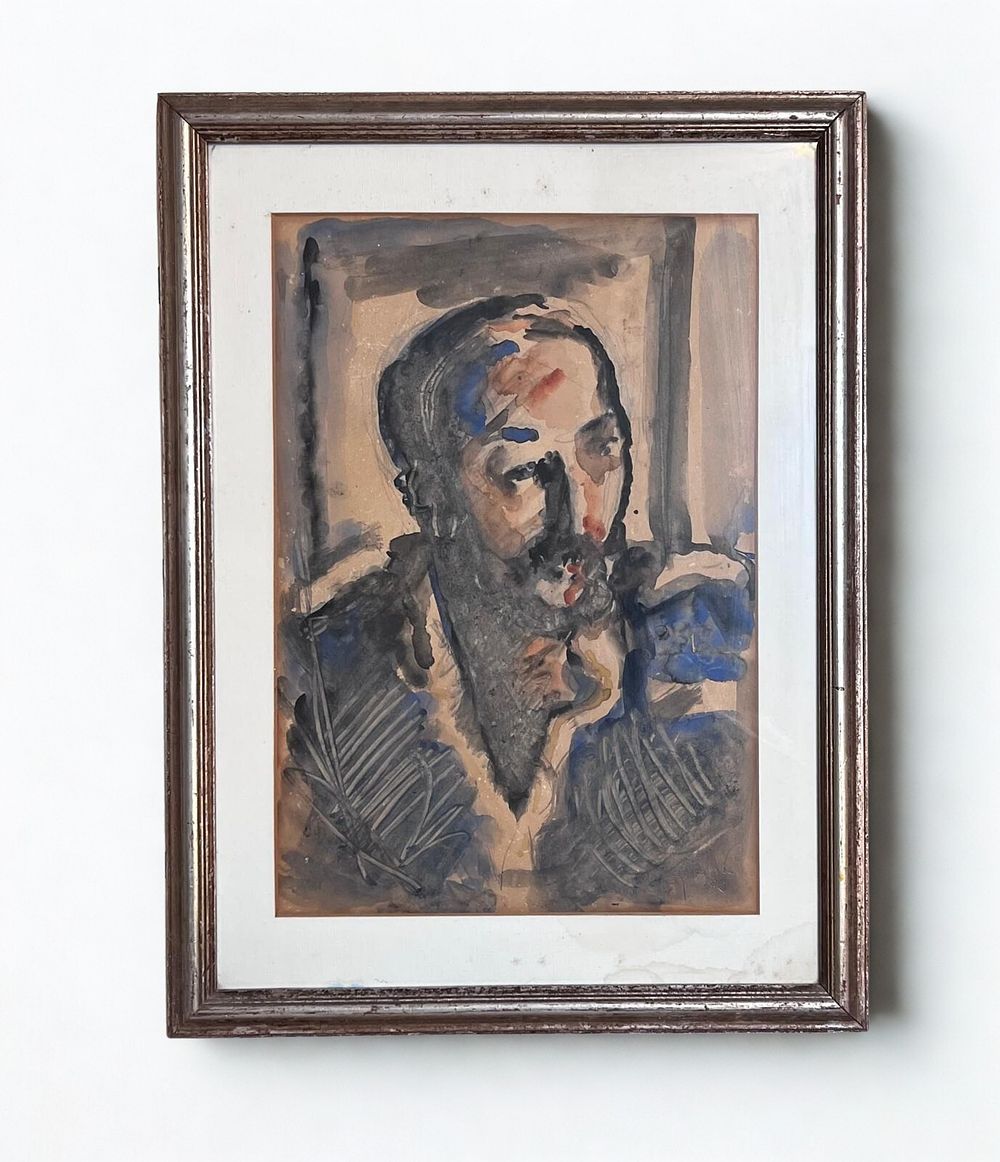
Arie Aroch Streichman (1906–1993) - Portrait of Israel Argaman (Art Dealer). Israel Argaman was an art dealer and the owner of Argaman Gallery in Dizengoff Center during the 1980s. Argaman was a complex and melancholy man who tragically took his own life while still young. In this portrait, Streichman captured his eyes with extraordinary brilliance. It was those eyes that struck me as well—the sadness within them, the deeply human quality of Argaman, a man who was sensitive and fragile. Without a doubt, this is Streichman's classic touch: through a few effortless brushstrokes and seemingly casual splashes of color, he conveys an entire emotional world. I truly take my hat off to him. This portrait comes from the home of Nahum Cohen, an architect and city engineer, who also entrusted us with the painting by Uri Stettner. Nahum Cohen was himself a painter and an author who wrote extensively on architecture in several languages throughout his career as an urban planner. He grew up in Jaffa before later moving to Tel Aviv. Arie Aroch Streichman (1906–1993) presents here a rare meeting point between the tradition of figurative portraiture and the modernist language associated with one of the founding figures of abstract painting in Israel. Watercolor on paper 47.5 × 32 cm Signed and dated. Framed. This work was created during Streichman's later years. A central figure in the ”New Horizons” group and one of the pioneers of lyrical abstraction in Israel, Streichman sought to connect local artistic practice with international trends, particularly those of the Paris School. Although he is most closely associated with abstract painting, he periodically returned to figurative subjects—especially portraiture—infusing them with his characteristic sensitivity to color and freedom of form. In this portrait of Israel Argaman, Streichman's mastery of watercolor is unmistakable. Free, fluid brushstrokes, delicate transparencies, and a tension between representation and abstraction define the composition. The sitter is not rendered in a purely realistic manner; instead, he dissolves into a network of vibrating lines and patches of color that lend the image an intense psychological and expressive presence. Works on paper from the 1980s are regarded as one of the most intimate chapters of Streichman's oeuvre, where decades of experience merged with a remarkable painterly freedom. This signed and dated work belongs to a highly sought-after body of work within the art market, and comparable watercolors from this period have appeared on numerous occasions at auction.