Bidspirit auction | Fundamental Work of Aggadah Ein
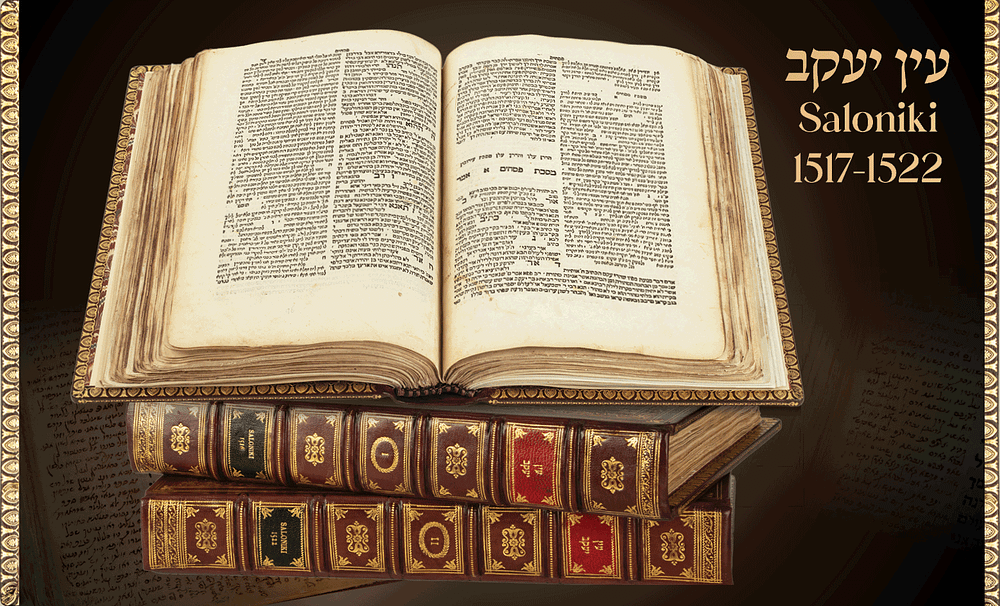
Fundamental Work of Aggadah Ein Yaakov First Edition 2 Complete Volumes Saloniki, 1517-1522 * Anthology of all Aggados and Midrashim found across Shisha Sidrei Mishnah and the Gemara. Masterfully written by Rabbi Yaakov ben Chaviv. ‘Ein Yaakov’ illuminates all sections of Aggadah from the Talmud Bavli as well as certain sections from Talmud Yerushalmi with the commentary of the Rishonim. ‘Ein Yaakov’ was enthusiastically received by Jewish congregations throughout the world and swiftly hailed as a foundational work of Aggadah and Jewish faith. A first edition copy of ‘Ein Yaakov’ is exceedingly rare, not only because any works printed in early 16th century Saloniki are valuable collectibles, but mostly because this sefer was in such widespread use and studied by Torah scholar and layman alike, that few copies survived the wear and tear of the ages. Complete copies like the present first edition are very valuable, rivaling incunables. There are virtually no known copies at all of this sefer in private collections. Beyond its actual content, the first edition of ‘Ein Yaakov’ has special significance as it constitutes the first printing of selected Gemara texts. Since ‘Ein Yaakov’ preceded the complete Bomberg edition of the Gemara, it likewise preceded the printing of any masechtos that remained unprinted during the incunable period. ‘Ein Yaakov’ also includes passages from the Talmud Yerushalmi printed in the Ein Yaakov for the first time! Talmud Bavli Nusach of Sephardic Sages and Nusach of Ashkenazi Sages Upon the completion of the Talmud by Rav Ashi and Ravina, the process of copying and disseminating the Talmud throughout the Jewish diaspora began. As a result of numerous transcriptions and the transfer from one manuscript to another, many textual variations emerged. Subsequently, scholars and commentators also edited the Talmud according to the interpretations that were known to them. Thus, just as occurred with the siddur that has Sefard and Ashkenaz versions, so too with the Talmudic text, two main schools of textual traditions developed: The French-Ashkenaz nusach and the Sephardic nusach. The French-Ashkenaz nusach was used by Rashi, the Baalei Tosfos and other Ashkenazic sages. This version originated in Eretz Yisrael, was brought to Italy, and from there spread to Germany and France. The Sephardic nusach was based on texts from the yeshivos of the Geonim in Bavel, and was used by Sephardic Rishonim such as the R”i MiGash, Rabbi Shmuel HaNagid, and the Yad Ramah. In the period of the Raavad, the Raza’h, and the Ramban, the French-Ashkenaz version had already penetrated into Spain. However, in several places, the Raavad, Ramban, and other Rishonim praised the ancient Spanish version, as its origins were rooted in the Babylonian yeshivos, which were close in time and place to the creation of the Talmud Bavli. With the invention of printing in the 15th century, the first printers began to produce masechtos of the Talmud in Spain and Italy. Of the Talmud editions printed in Spain, only remnants remain, representing the Spanish version. In contrast, the masechtos printed in Italy, in Soncino, Pesaro, and Venice, followed the French tradition. These editions were widely accepted and spread throughout the Jewish world, leading to the establishment of the French version while the Spanish version almost disappeared. One of the most important sources for preserving the Spanish version is the sefer 'Ein Yaakov, ' whose author was one of the sages of Spain. He had access to Talmudic texts in the Spanish tradition, ensuring its preservation in his work. This version of the early Spanish sages was preserved in the first edition of 'Ein Yaakov, ' printed in the year 1516, even before Bomberg's Talmud edition (1520-1523). However, subsequent printings of 'Ein Yaakov' introduced textual changes, incorporating alterations based on the French version. As a result, the original Spanish version, as presented in the early 'Ein Yaakov, ' disappeared and nearly became extinct. In his preface to maseches Brachos, the author of ‘Dikdukei Sofrim’ writes: “I also had the first edition of ‘Ein Yaakov’ that the author printed himself in Saloniki circa year 1516, and it is very different from the prevalent version of ‘Ein Yaakov’ and the Justinian Press edition from 1546 [in which they] changed the majority of the nusach based on the [widespread] version of the Gemara and destroyed much of it.” The first volume of ‘Ein Yaakov’ was printed by Rabbi Yaakov ben Chaviv himself and features extensive commentary by him. The second volume was printed after his passing by his son Rabbi Levi ben Chaviv, the Ralbach. [Bibliography: Abramson, Introduction to Maseches Avodah Zarah from the Bet Midrash L’Rabanim, Manuscript p. 12 note 1; Dimitrovsky, Seridei Bavli pp. 10-12; Spiegel, Amudim B'Toldot HaSefer HaIvri Vol.