Bidspirit auction | Sefer Yesod: Toras HaOlah by
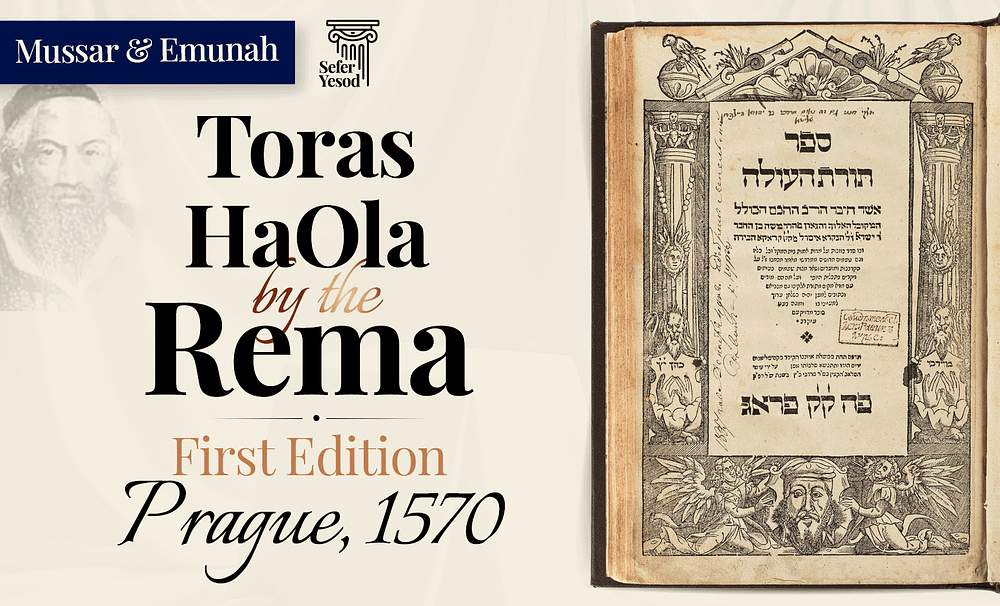
Sefer Yesod: Toras HaOlah by the Rema First Edition. Prague, 1570 Printed during the Rema’s lifetime! * Insights and elaborate discussions on the significance and meaning of the Beis Hamikdash, its precise measurements, the holy vessels, and the priestly garments, as well as discussions on the reasons and meaning of korbanos, by Rabbi Moshe Isserless, known as the Rema. The Rema himself wrote of his sefer that it contains ”wonderful explanations based on all four methods of Torah study – pshat, remez, drush and sod (simple explanations, allusions, deeper meanings and kabbalistic Torah, collectively known by the acronym ‘Pardes’)”. (Shu”t Rema Ch. 121) The Rema integrates both kabbalah and philosophy in this sefer, noting that ”the wisdom of kabbalah is equivalent to the wisdom of philosophy; they are just speaking in two languages”. (Toras HaOlah Vol. 3 Ch. 4). The present work repeatedly cites the Rambam’s ‘Moreh Nevuchim’ (Guide to the Perplexed). Sefer ‘Toras HaOlah’ was printed in the author's lifetime, and was the second sefer that the Rema brought to print. Rabbi Moshe Isserless, known as the Rema, was born in Cracow around the year 1535. He traveled to Lublin in his youth where he studied by the great Rabbi Shalom Shachna of Lublin, later marrying his daughter. Following his marriage, he settled in Cracow and began teaching Torah. Many of his disciples went on to become leading Rabbanim, such as the Sm”a, the Levush, the Masas Binyamin, Rabbi Avraham Horowitz – father of the Shla”h, and others. The Rema was appointed Rav of the great city of Cracow despite his young age and served in this position for twenty years. He passed away at a young age, on Lag Ba'omer of 1573. Until the rise of the Nazi regime, thousands would flock to his grave and a large gathering took place by his gravesite on Lag Ba'omer. He was revered by his contemporaries and on his tombstone are the words: ”From Moshe until Moshe there arose none like Moshe.” Prague, 1570. First edition. Page Count: [6], 173 leaves. Description: Illustrated title border. Condition: Good; nice copy. Fine new leather binding. Bibliography: Stefansky, Sifrei Yesod #500.