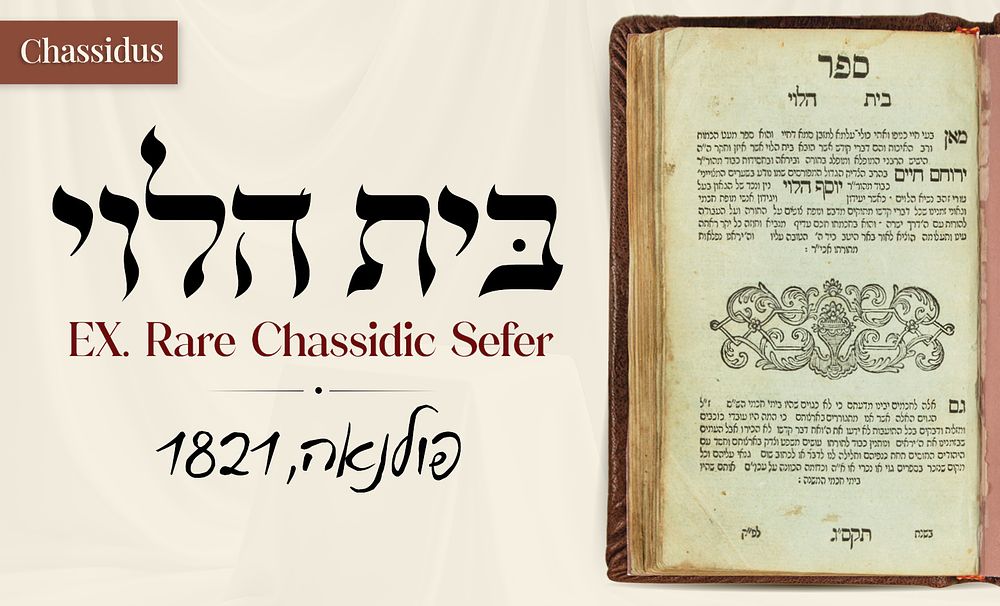
Bidspirit auction | Rare Chassidic Sefer Beis HaLevi
Rare Chassidic Sefer Beis HaLevi Polonne, circa 1821 * Chassidic commentary on Chamisha Chumshei Torah and selections of Maseches Berachos, Tehillim, Mishlei, and Avos by the holy Rabbi Chaim Yerucham of Dolina, the prominent talmid of Rabbi Tzvi Hirsch of Nadvorna, author of ‘Tzemach Hashem L’Tzvi’. This sefer is of extreme rarity. It has eluded the attention of some bibliographers due to its scarcity. It was reprinted in Lemberg in 1910, where the publisher, Baruch Frankel (a great-grandson of Rabbi Meir of Premishlan), noted that the sefer was ”unavailable anywhere in the world.” Additionally, this copy is exceptionally unique, featuring an unknown variant with a newly discovered commentary by the author. On the final page, a new leaf with additional text was pasted over the last section. It appears that the author sought to replace the original text with this new content, which includes a commentary on the verse in Tehillim, ”Baruch Hashem yom yom.” This commentary is not found in any other source and represents a fascinating discovery. (This text, as well as the text underneath it, is absent in the Lemberg edition.) Rabbi Chaim Yerucham HaLevi of Dolina was the son of Rabbi Yosef HaLevi, dayan in the Dolina community, and a descendant of Rabbi David HaLevi, son of Rabbi Shmuel HaLevi, son of the Taz. A leading disciple of Rabbi Tzvi Hirsch of Nadvorna, he remained closely connected to his Rebbe both in Dolina and later in Nadvorna. In this sefer, he shares remarkable teachings and observations he heard and witnessed from his revered teacher. (See below) Rabbi Tzvi Hirsch of Ziditchoiv writes about him in his approbation: ”My dear friend, the chassid who is outstanding in Torah and fear of sin, whom I have known since his youth as one who served my revered teacher. I recognize his modest and discreet conduct. Now, in his old age, he is traveling to the Holy Land with great mesirus nefesh.” In Parashas Tetzaveh of this sefer, Rabbi Chaim Yerucham recounts teachings he heard from Rabbi Tzvi Hirsch of Ziditchoiv: ”I heard from our teacher, the chassid of the Ziditchoiv community, regarding what is written in the Zohar...” Additionally, the sefer contains an approbation from Rabbi Avraham Dovid of Buchach. Polonne, circa 1821. First Edition. (The date on the title page, 1803, was falsified due to censorship. The rabbinical approbations date to 1821.) Page count: [4], 38 leaves. Size: 16 cm. Printed on blue paper. Staining primarily on the margins of the last third of the book. New leather binding. Stefansky, Sifrei Chassidus No. 83. Ginzei Yisrael No. 1145. Connection to His Rebbe, Rabbi Tzvi Hirsch of Nadvorna As mentioned, the author was the prominent disciple of Rabbi Tzvi Hirsch of Nadvorna. In his introduction, he recounts: “From the time I came of age, I established myself firmly alongside the righteous one, the holy light of Israel, our teacher Rabbi Tzvi Hirsh, of blessed memory, who in his later years was appointed as the Maggid Meisharim of the holy community of Nadvorna. During his time with us in the holy community of Dolina, I never left his tent, and he raised me as a father raises a son. I tasted the sweetness of his teachings that flowed from his holy mouth, and even after he moved to the holy community of Nadvorna, I traveled to him to hear his profound teachings on the mysteries of the Torah.” In this sefer, the author includes unique teachings and anecdotes from the Tzemach Hashem L’Tzvi. For example: In Parashas Re'eh (30:2), he writes of his certainty that his mentor could discern whether someone approaching him was righteous or wicked. In Parashas Bechukosai (23:1), he describes: “We experienced great fervor in our prayers, especially when praying in his sukkah, despite the crowding. Nevertheless, there was a miracle - although the space was densely crowded, everyone felt as though they had plenty of room. Even after prayer, we had no desire to return to our homes.” In Parashas Devarim (28:2), he recounts: “I heard from my teacher that when he was with the righteous Rabbi Yechiel Michel of Zlotchov, he observed Balei Teshuvah coming to confess before him. He would inquire...” The sefer also includes interpretations he heard from his teacher found in Parshiyos Toldos, Masai, Chukas, and Nitzavim.