Bidspirit auction | Minhagei Ashkenaz Important Early Manuscript
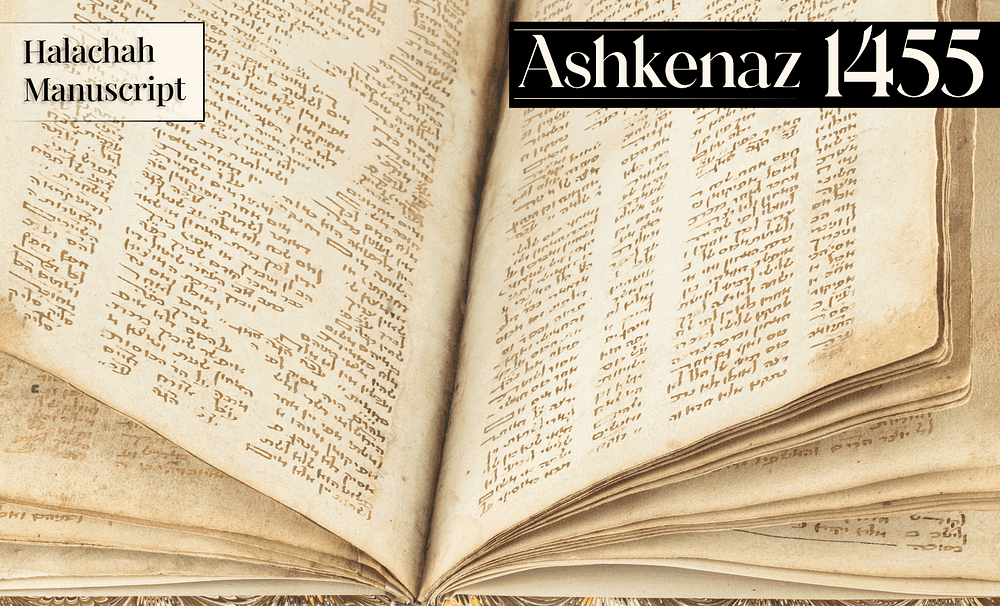
Minhagei Ashkenaz Important Early Manuscript Ashkenaz, 1455 * A cornerstone of Ashkenaz Jewry was the preservation of its traditions and customs. To safeguard this heritage, the Rabbanim of Ashkenaz compiled special sefarim, recording the traditions and practices observed in their communities. Presented here is a particularly significant and early manuscript, written in Austria in the 15th century, containing new discoveries. It was written by a highly authoritative scribe, a direct disciple of one of the leading sages of Ashkenaz (see below). In the colophon at the end of the manuscript, the scribe recorded the time and place of completion: ”Completed are the customs of the entire year, dedicated to the One who dwells in the heavenly abode, To Him I offer praise and joyous song…………….. I have finished writing it on the 19th day of Av, in the year 1455, here in the town of Dorstein. Thus writes humbly, Yitzchak bar Meshulam.” The town of Dorstein mentioned here is Durnstein, located on the banks of the Danube in Lower Austria. It is rare to find a manuscript in which the scribe shares so many personal details of his life. Yet here, the scribe generously reveals a wealth of biographical information. We learn that the scribe, Rabbi Yitzchak son of Meshullam of Durnstein, was born to Rabbi Shmuel son of Rabbi Yuda Akiva and Rebbetzin Rechlin. It appears he first studied under his father, whom he refers to as “my father, my teacher.” His father passed away in the year 1467 in the city of Rinteln and was laid to rest in Minden, while his mother passed away in 1469. Rabbi Yitzchak recounts that he studied the laws of shechitah and bedikah in the synagogue of Rav Livai the Elder (this is likely Rav Liva Landau, father of Rav Yaakov Landau, the author of Sefer Ha’Agur) by the great Gaon the Mahara”z may Hashem protect him, known as R’ Zavil of Andernach. He received formal ”kabbalah” (ordination) for shechitah from Rabbi Gotzlik of Zülpich (see attached research). The manuscript’s writing is particularly striking. The scribe sought to lend the writing an artistic dimension, and so he wrote in various geometric shapes and begins different sections with an enlarged letter. ******** The manuscript is the 'Sefer Minhagim' of Rabbi Avraham Klausner, one of the leading sages of Austria and teacher of the foremost authorities on Ashkenaz customs - the Mahari”l and Rabbi Isaac Tyrnau. A thorough scholarly examination of the manuscript has uncovered remarkable findings attesting to its uniqueness and importance. It includes never published glosses and valuable textual variants. Certain passages that appear in the printed version as marginal glosses are found here as part of the main body, and conversely, portions that are printed in the main text appear here among the glosses (see below for details on the structure of the work). Minhagei Mahara”k was first printed in 1559 (see adjacent item). The most comprehensive edition, based on all the important manuscripts of the work, was published in Jerusalem in 2006. Upon examination of the present manuscript, it appears that it is close in style to the Jerusalem manuscript (4199), which is considered the most authoritative manuscript of this work. However, it contains textual variants, some of which are superior to other manuscripts and as noted, it also has glosses not found in any other known copies, not even in the Jerusalem manuscript. In summary, this early and important manuscript has not yet come under scholarly examination. A new edition of this work would benefit greatly from this important and unique manuscript. ********* Rabbi Avraham Klausner , also known as Mahara”k (d. circa 1408), was one of the leading Torah authorities of “Chachmei Austria” and was the teacher of the Maharil and Rabbi Isaac Tyrnau who were the ”masters of Ashkenazic customs”. His disciples mentioned him with great reverence, often quoting his customs in their own works. In the introduction to 'Minhagei Maharil', Rabbi Klausner is described as ”great in his generation… and meticulous in preserving customs” (referring to ancient customs). Similarly, Rabbi Isaac Tyrnau, in the introduction to his well-known sefer of customs, praises him: ”The great scholar, our teacher Rabbi Avraham Klausner zt”l, my primary Rebbi, one of the foremost leaders of Austria and an expert and authority in the realm of traditions - from whose waters we drink.” Sefer HaMinhagim, which carries the name of Rabbi Avraham Klausner, is actually an ancient sefer of customs whose origins likely trace back to the beis medrash of Rashi and his talmidim. Throughout the generations, various sages penned glosses and additions to this sefer. One of the most renowned of these sages was Rabbi Avraham Klausner who edited the sefer and contributed his own annotations and notes. Durnstein, 1455. 19 × 14 cm. 23 leaves, paper.