Bidspirit auction | The Most Classic Commentary on
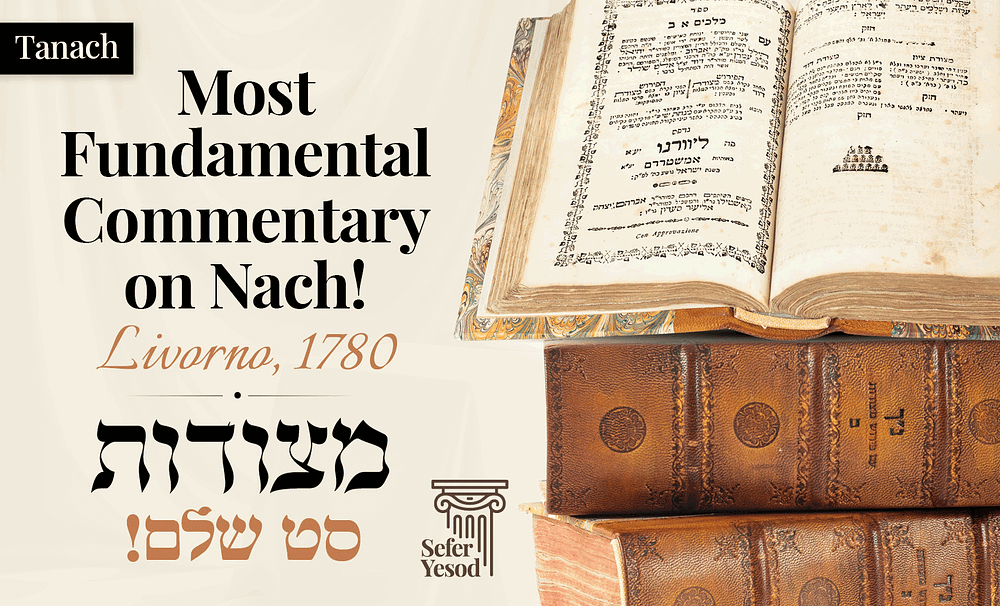
The Most Classic Commentary on Nach! Complete Set of Metzudas Livorno, 1780-1783 * Comprehensive classic commentary on the entire Nevi’im and Kesuvim by Rabbi Dovid Altschuler and his son Rabbi Yechiel Hillel Altschuler. This was the first time that a complete set of all the Metzudos on Nach appeared in print. A complete set with the exceedingly rare folding tables (see below), which are lacking in most copies. We checked many copies and none contained these tables, nor do they exist in the copies of the National Library in Jerusalem. Thus, in such complete form, it is extraordinarily rare. The work comprises two sections: Metzudas Dovid – a basic explanation of the text. Metzudas Tziyon – an interpretation of individual words. A. Nevi’im Rishonim . Livorno 1780–1781: 44, [1], 45–87; [1], 91 – 300 leaves B. Nevi’im Achronim . Livorno 1781–1782: 235; [1], 228 leaves + [1] large folded sheet (46 × 50 cm) featuring the structure and layout of the Beis HaMikdash (Tzurat HaBayis) as described in Sefer Yechezkel, along with two maps: one depicting the borders of Eretz Yisrael with the division of the inheritance of the tribes, and another showing the future division of the Land. The maps and the Tzurat HaBayis were originally printed on a large sheet divided into two — this copy preserves the original form, prior to being cut. Leaves 113–123 at the end of Sefer Yechezkel include a pamphlet entitled Binyan HaBayis with a partial title page. In it, the author references the illustrated sheet found at the end of the sefer (the illustrated sheet is also mentioned in the introduction to Sefer Yehoshua). C. Kesuvim . Livorno 1780–1783: 238, 33, [1], 33–185 leaves Size: 18.5 cm. This important edition includes content that was never reprinted in subsequent editions: 1. The pamphlet Binyan HaBayis (mentioned above) 2. The end of Nevi’im Rishonim features a chart listing the generations from Adam HaRishon until the era of the kings in chronological order, along with a parallel columned list of the kings of Yehudah and Yisrael. 3. At the beginning of the sefer are rare approbations by the Chida, Sha’agas Aryeh, and sages of Amsterdam and Italy. These did not appear in later editions. 4. The end of Kesuvim includes words from the author regarding the sources of his commentary; poems by the author, the publishers, and other Italian sages; and a chart for calculating the Hebrew calendar until the end of the 6th millennium – likewise never published in later editions. The commentary on Nevi’im Achronim was originally printed in Berlin in 1770, while the commentary on Kesuvim was printed in Zolkova in 1753. The present edition is the first time that the commentary on Nevi’im Rishonim was printed, together with all previously published material with additions and revisions. Complete 3-volume set with 14 title pages, in good condition. Attractive half-leather bindings. Bibliography: Stefansky, Sifrei Yesod, no. 29. For further details on the author and the printing process, see: Yeshurun III, pp. 618 and onward.