Bidspirit auction | Rare and Exceptional Three Sefarim
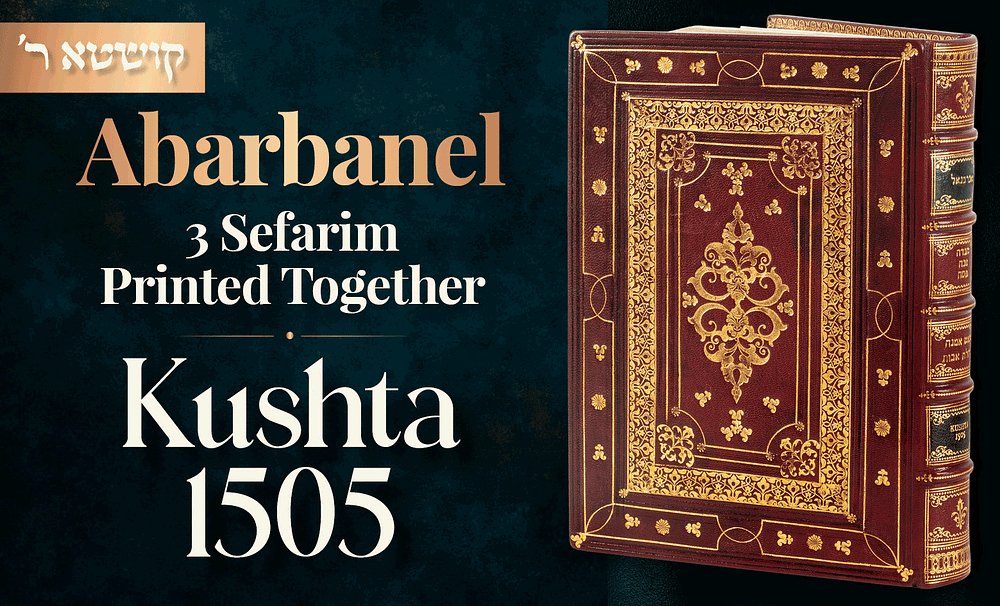
Rare and Exceptional Three Sefarim of Abarbanel Kushta, 1505 * Three important works by the great nobleman and scholar Don Yitzchak Abarbanel, printed in his lifetime – Rosh Amana, Zevach Pesach, and Nachalas Avos – among the earliest sefarim printed in Constantinople. The colophon leaf present in this copy (see below) is of exceptional rarity. These three works were printed together, as is evident from the colophon, but over the years, they became separated and were not preserved as one, and this is likely also the reason for the loss of the colophon (which pertains to all three works together). A volume containing all three works, exactly as it left the press in Constantinople, is extremely rare. The sefarim were printed without a title page; the first leaf of each section is blank, and on its verso is an elegant Constantinople-style border, in a filigree design featuring illustrations of animals, and at their center are poems in praise of the sefarim, composed by the author’s son, Rabbi Yehuda Abarbanel. It includes the following works: A. Rosh Amana – on the fundamentals of faith. This is Abarbanel’s most important philosophical-theological work, where he affirms the Rambam’s thirteen principles of faith, and provides responses to all the questions of Rabbi Yosef Albo in Sefer Ikarim and Rav Chasdai Crescas in Sefer Ohr Hashem. (Stefansky, Sifrei Yesod p. 236) B. Zevach Pesach – a comprehensive commentary on the Pesach Haggadah, including the full text of the Haggadah shel Pessach. It is among the earliest printed Haggados: the first Haggadah in the world printed with a commentary, and the first Haggadah printed in Constantinople. (Stefansky, Sifrei Yesod no. 451, Yudlov, Otzar HaHaggados no. 5) C. Nachalas Avos – a comprehensive and fundamental commentary on Pirkei Avos, with introductions on the transmission of the Oral Torah. It is one of the first commentaries published on Pirkei Avos. ‘Nachalas Avos’ is a classic commentary on Maseches Avos, and the Midrash Shmuel counts it in his introduction as one of the sifrei yesod he used for his commentary. (Stefansky, Sifrei Yesod no. 38, Otzar Pirkei Avos no. 4.) At the beginning of the Zevach Pesach Haggadah, there is an essential historical introduction in which the Abarbanel briefly recounts the painful events of his life, marked by numerous upheavals and changes. He narrates his escape from his native land of Portugal to Spain, fleeing the persecutions instigated by the King of Portugal. He reflects on the years he lived in wealth and honor in Spain, only to be confronted by the Expulsion of the Jews in 1492. Following this tragic event, he undertook a harrowing journey that led him to Naples, Italy. However, his struggles did not end there; he was once again forced to flee when Naples fell under the brutal conquest of the King of France. These significant works were composed in the city of Naples during the years 1495–1496. Each work concludes with a detailed colophon provided by Abarbanel, specifying the place and time of completion. The final leaf is entirely devoted to the colophon text: “These magnificent compositions were completed by the scholarly brothers… Rav David and Rav Shmuel, known as Ibn Nachmias, as well as Rav Yitzchak Kaspota… and they were completed on Thursday, 9th of Kislev 1505 [5266] in the great city of Constantinople, a metropolis and major center of Jewish life…” Constantinople, 1505. First edition. Page Count: Rosh Amana: [20] leaves. Zevach Pesach: [40] leaves. Nachalas Avos: [116] leaves. Total: [176] leaf. Size: 27 cm. Condition: A handsome and impressive copy, with some light restorations to the first and last leaves, a few tiny holes, mostly faint stains. New, elegant red leather binding with gilt decorations. Bibliography: Stefansky, Sifrei Yesod nos. 38/451; Yudlov, Otzar HaHaggados no. 5; Otzar Pirkei Avos no. 4. ________ The Abarbanel mentions the printing of these works in Constantinople in his teshuvos to Rabbi Shaul HaKohen (Venice 1574) in these words: ”Three works that were printed in Constantinople are here with you and they are: Rosh Amana, Zevach Pesach, Nachalas Avos.”