Bidspirit auction | Sefer Yesod Kushta Reish Ibn
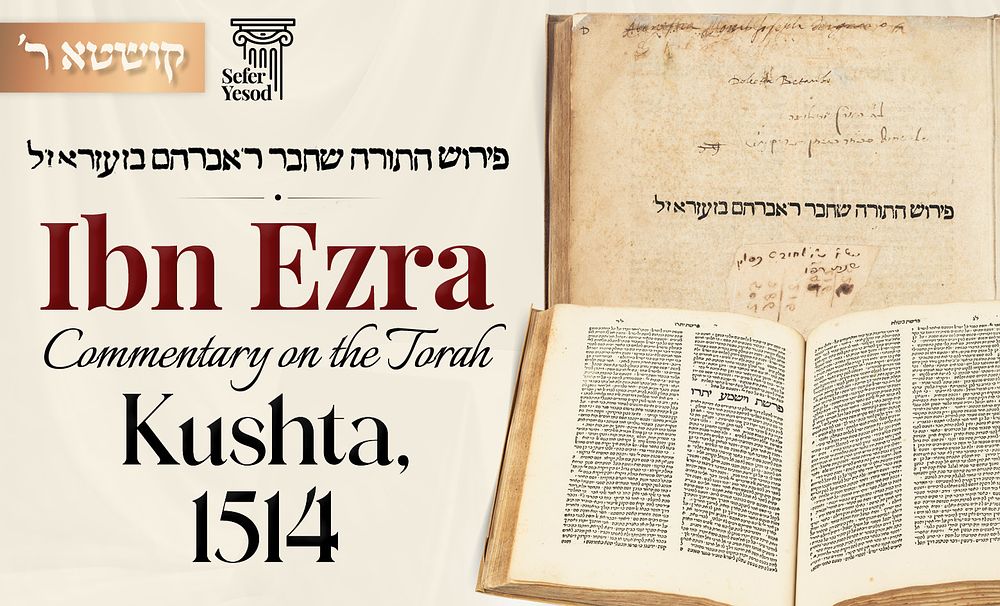
Sefer Yesod Kushta Reish Ibn Ezra Kushta, 1514 * A sefer of utmost rarity. The foundational and original commentary of the great sage Rabbi Avraham Ibn Ezra, one of the foremost early scholars of Spain, on the Chamisha Chumshei Torah. A complete and beautiful copy. One of the rarest sefarim printed in Constantinople. A sefer in such complete and good condition is virtually unobtainable. The interpretation of the Torah relies on three pillars: Rashi, Ramban and the Ibn Ezra. As one of the foundational commentators on the Torah, the commentary of the Ibn Ezra has been included in most editions of Mikra’os Gedolos. Rabbi Avraham Ibn Ezra was a brilliant scholar and proficient in every discipline — a commentator, poet, grammarian, astrologer, and philosopher, authoring sefarim in dozens of fields. Yet the crown jewel of his works is his foundational commentary on the Chamisha Chumshei Torah. The Rambam advised his son Rabbi Avraham to study only the commentaries of Ibn Ezra on the Torah, and thus he writes to him: ”You, my faithful son, I instruct you not to delve into various commentaries and works, nor to disturb your mind except with his commentary, his writings, and his sefarim, for they are very good and beneficial for anyone who reads them with proper reflection, a pure intellect, and sharp eye.” (Igros HaRambam, Leipzig, Vol. II, page 39) The sage Rabbi Yedaya HaBedersi writes to the Rashba in his letter of apology (Shu”t Rashba Vol. I Siman 411): ”And in the end there arrived the great sage, the renowned Ibn Ezra, who surpasses all those mentioned before him, in grasping truths, in diligence at the gates of wisdom, and in distancing errors of belief and misinterpretations of the books of the Prophets. Our fathers have told us of the joy of this land's great men - its pious and scholarly leaders – upon his arrival. He began to open the eyes of those in our regions and composed for them a commentary on the Torah and the Prophets...” The commentary was first printed in Naples in 1488, and here it was published for the first time after the incunabula period. At its end is a colophon: ”The work of this sefer was completed on the tenth day of the month of Sivan in the year 'Rav Chesed' [רע”ד - 1514] of the sixth millennium, by the youngest of the scribes, Rabbi Ashtrok of Toulon, may he be strengthened, here in the great city of Constantinople…” Constantinople, 1514 Page Count: 87 leaves + blank leaf. Size: 27 cm. Condition: Good. Censorship erasures. On the last leaf appears the signature of the apostate censor Dominico Yerushalmi in Hebrew and Latin from the year 1612. Signatures and glosses in Italian script. Antique parchment binding. A copy in such complete and good condition is virtually non-existent. Stefansky, Sifrei Yesod no. 2 / Yaari, Constantinople no. 24