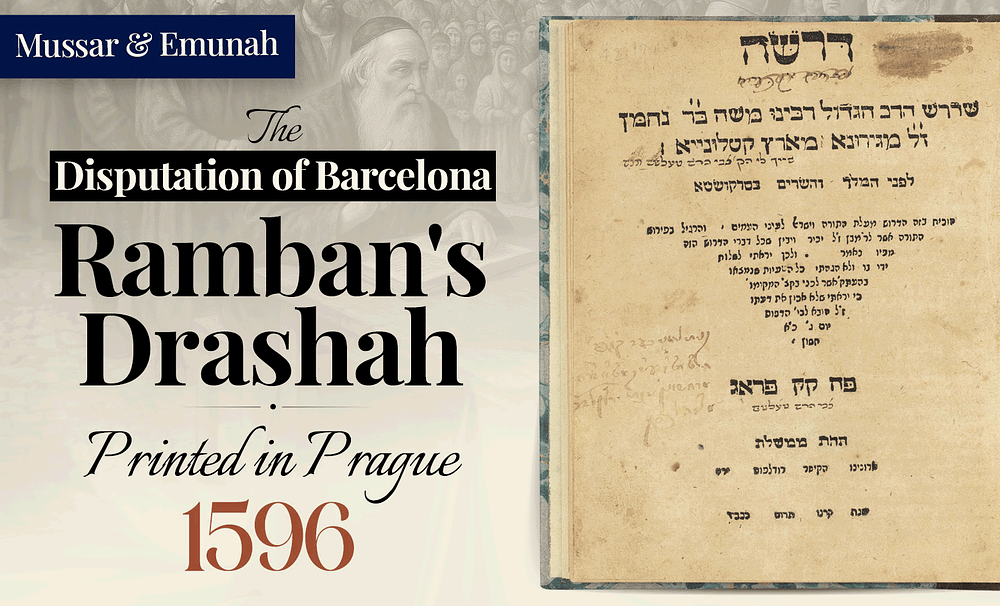
Bidspirit auction | Sefer Yesod Ramban's Drashah Before
Sefer Yesod Ramban's Drashah Before the King and Nobles Printed in Prague 1596 * An exceptionally historic and foundational drashah delivered by the Ramban “before the king and nobles, ” extolling the greatness of the Torah and the Jewish people. This drashah, known as ”Drashas Toras Hashem Temimah, ” was delivered by the Ramban, presumably following the great dispute with the apostates and Christians that took place in the presence of the king in the year 1263 in the city of Barcelona. (See the introduction to Drashas Toras Hashem Temimah, Kisvei haRamban vol. I, p. 139). In this drashah, the Ramban wove together and summarized, with remarkable genius, all the foundations of the Torah and the fundamentals of the Jewish faith. The breadth and depth of the subjects addressed in this derashah establish it as a central pillar of the Ramban’s writings, serving as a premier source for grasping the Ramban’s doctrine regarding the foundations of Torah (Yeshurun 16, p. 408). The drashah was first printed within the sefer Nofes Tzufim (Constantinople 1582) and here in this edition it was printed for the first time as a sefer on its own. The Disputation of Barcelona In the year 1263, the King of Aragon forced the Ramban to debate the apostate Fri Paul regarding the messianic claims of Yesh”u. The debate took place over four days in the city of Barcelona in the presence of the king, during which the Ramban responded with great wisdom to all the false arguments of Fri Paul. About two years later, the initiators of the debate claimed that the Ramban had slandered Christianity in his sefarim, and thus the Ramban was compelled in to flee Spain and immigrate to Eretz Yisrael. Prague, 1596. Bezalel Katz Press. Page Count: [11] leaves. Size: 17 cm. Condition: Good. On leaf [10] there is a small tear without any loss. New half leather binding. The title page features the signature of Rabbi Tzvi Hirsch Teltsh, one of the Dayanim of Nikolsburg (see Shu”t Chochmas Shlomo by Rabbi Shlomo Kwetsch, siman 14–15). Bibliography: Stefansky, Sifrei Yesod no. 485.