Bidspirit auction | Beautiful document by the Noda
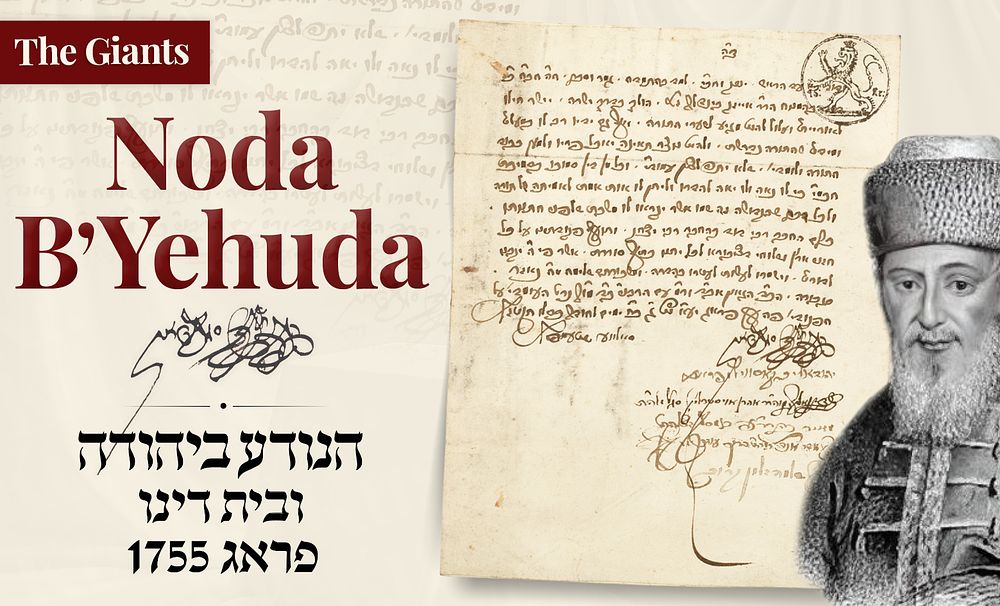
Beautiful document by the Noda B'Yehuda and his Beis Din Prague, 1755 * A letter of semicha for 'chaver' signed by Rabbi Yechezkel Landau, Av Beis Din of Prague, and the members of his Beis Din, from the earliest days of the Noda B'Yehuda's tenure in Prague. The Noda B'Yehuda began serving in the rabbinate of Prague at the start of 1755, and this document is from the end of 1755. This certificate was given to a student of the Prague Yeshiva, Reb Dovid son of Reb Isaac Bindlesh, on the 28th of Kislev 1755 . Rabbi Yechezkel Landau, Av Beis Din of Prague (1714–1793), is renowned as the Noda BiYehuda after his landmark halacha sefer. ”Gadol Hador, the glory of the era, extolled with praises, the crown and glory of Yisrael” (as written by Rabbi Yaakov Pick Berlin). ”The pure one of Yisrael, the captain of the ship and its leader, father of the sages” (from the drasha of the Chasam Sofer). In 1755, he became Rav of the illustrious city of Prague where he founded an important yeshiva that produced numerous Torah giants. He served in this role with distinction for nearly forty years. Signed with him are the leading sages and Dayanim of Prague from the early days of the Noda BiYehuda's leadership there. Some were students of Rabbi Yehonasan Eibeschutz who signed the letter of appointment of the Noda BiYehuda to the rabbinate of Prague. Rabbi Yehuda Leib Kasowitz of Prague (d. 1783), a student of Rabbi Yehonasan Eibeschutz, Raavad and head of the teachers in Prague, a close friend of Noda BiYehuda, and often referenced in Shu”t Noda BiYehuda and Tzelach. His writings were collected in the sefer Ginzei Yehuda (New York 1997). Rabbi Yitzchok Wolf Oistrelitz (d. 1762), a student of Rabbi Yehonasan Eibeschutz and one of the earliest signatories of the rabbinic document. A Rosh Yeshiva and Rav of the 'Chatzer HaGadol' synagogue in Prague (Mishpachot Kehillas Prague, p. 6). The Noda BiYehuda eulogized him at the beginning of Even HaEzer, Mahadura Kama, siman 10. Rabbi Meir Fischel of Bumsla (d. 1770) was one of the greatest students of Rabbi Yehonasan Eibeschutz and a leading teacher of Torah in Prague, teaching thousands of students during his forty-year tenure in Prague. The Noda BiYehuda's eulogy for him, which includes extraordinary matters that were revealed to him in a dream, was printed in the sefer Shu”t VeChiddushei Rabbeinu Meir Fischel. click here Rabbi Asher Anshel Ozerish (1685–1765) was a student of Rabbi Avraham Brod, one of the Dayanim of the Noda BiYehuda's Beis Din. Signed together with the above Rabbanim of Prague, Rabbi Yehudah Leib and Rabbi Yitzchok Wolf, on a letter of support for Rabbi Yehonasan Eibeschutz (Luchot Edut 8b), and also in approbations with the Noda BiYehuda. The Noda BiYehuda’s eulogy for him, in which he greatly praised him and wrote that he was ”the shield of the generation, ” was printed in Derashos HaTzelach (Drush 54). Rabbi Shlomo Zalman Karov (d. 1774) taught Torah in Prague for over forty years and was a signatory on the letter appointing the Noda BiYehuda as Rav of Prague. He was known for his advocacy before Empress Maria Theresa to have the decree of the expulsion of the Jews from Prague annulled (Mishpachot of Prague, p. 237; Korot Ha’itim by R.A. Tribitsch, student of Noda BiYehuda, letter 21). His signature is very rare. Prague 2/ 12 / 1755. Page count: [1] leaf. Size: 16 × 20.5 cm. An official document of the Beis Din, recognized by the authorities, bearing on its right side a stamp depicting a lion. Condition: Good, preserved in a new, handsome leather binding. Certificate of Chaver 'Chaver” which literally translates as “member” or “friend, ” is a title that was customary in earlier times for a Torah scholar (see Peirush HaMishnayos of the Rambam Demai 2:3). About six hundred years ago, Ashkenazic communities began to ordain young scholars with the title ‘chaver’, and in later periods, the title was given to those who completed their yeshiva studies, often in honor of their wedding. This title was used in all formal references, such as an aliyah to the Torah, on a kesuba, and on the gravestone.