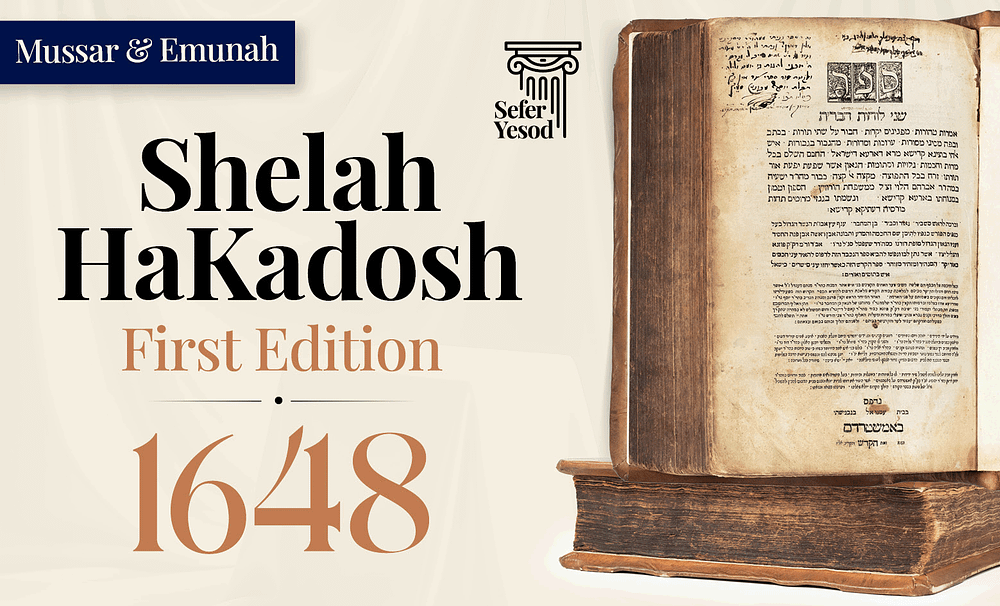
Bidspirit auction | First Edition of the Shl”a.
First Edition of the Shl”a. Amsterdam 1648–1649 * Pure and precious teachings arranged and presented by the divine sage, the holy luminary, master of Eretz Yisrael, the complete scholar in both revealed and hidden wisdoms, Rabbi Yeshaya HaLevi Horowitz; known as The Shl”a HaKadosh In the margins: hundreds of handwritten notes and subheadings by the gaon Rabbi Yosef Stathagen, author of Divrei Zikaron (see below). Rabbi Yeshaya Segal Halevi Horowitz, known as the Shlah HaKadosh (circa 1558–1630), is renowned for his exalted lineage and significant contributions to Jewish thought. His legacy is both wondrous and sacred. In Jerusalem, he authored ”Shaar HaShamayim, ” which deals with intentions in prayer, and the monumental ”Shnei Luchos HaBris.” This towering work encompasses the full spectrum of Jewish wisdom, including halachic novellae, ethics, and kedushah in every dimension, as noted in ”Shem HaGedolim” by the Chida. Shnei Luchos HaBris was embraced throughout the Jewish world as a foundational sefer for mussar and Yiras Shamayim, divine service, and character refinement. So much so that the gaon Rabbi Yonasan Eibeschutz wrote in Ya’aros Devash (vol. I, derush 12): “Any member of Klal Yisroel is obligated to study regularly every day, morning and evening, from sefarim of mussar—and foremost among them, the holy work Shelah, dedicated to Hashem...” The volume includes the introduction Vavei HaAmudim by his son, Rabbi Sheftel HaLevi Horowitz, Av Beis Din of Frankfurt, Vienna, and Pozna. Vavei HaAmudim is a significant work in its own right, founded on the three pillars upon which the world stands. Yet, out of deference to his father, he titled it merely an “Introduction” and printed it at the end of the book. The margins of this copy include extensive and valuable glosses by the gaon Rabbi Yosef Stathagen of Metz, Av Beis Din of Stathagen and its province, author of the renowned Divrei Zikaron see here . That sefer received enthusiastic approbation from the author of Semichas Chachamim, the gaon Rabbi Moshe Chagiz, who extolled it: “He was one of the pillars of the world, as evident from his sacred work, which is filled with wisdom, awe of Heaven, and mastery. For one who opens his eyes to observe, nothing compares to it.” (Mishnas Chachamim, entry Reish-Nun) The identity of the author of these glosses is confirmed by a note on leaf 321 stating, “I wrote this in my sefer Divrei Zikaron, ” which indeed appears there on leaf 93b. This, along with multiple additional parallels between the glosses and the printed work, strongly indicates that he is their author. On the title page appears the signature of Rabbi Eizik Berlin of Hamburg (1753–1865), along with handwritten marginalia in his script (leaves 66a and 234a). See Chachmei Ah”u, p. 122. Another signed gloss appears on leaf 214a: “the young Moshe...” (possibly referring to his brother, Rabbi Moshe Berlin). Amsterdam, 1648–1649. First Edition. Printed by Immanuel Benveniste. [3], 2-421, [1] 44 leaves. Size: 31 cm. Includes an additional title page for Vavei HaAmudim. A complete and beautiful copy. Final leaf has marginal tear with minor loss of a few letters. Bound in original wood boards covered in leather. Stefansky Sifrei Yesod, no. 359. Tefillas HaShelah The well-known Tefillas HaShelah—a heartfelt tefillah that Yidden around the world say in order that their children should merit to be ehrliche Yidden, yirei Shamayim—was first printed here, on leaf 258b. It has since become a tefillah that so many turn to with warmth and hope, and is cherished in homes across the frum world.