Bidspirit auction | Four Volume Manuscript, Sefer Regel
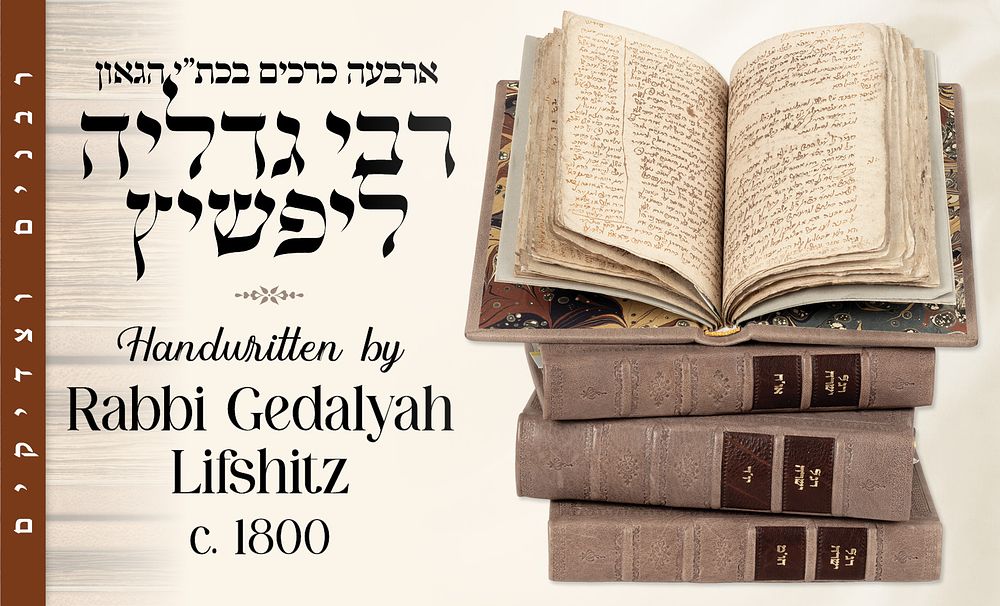
Four Volume Manuscript, Sefer Regel Yesharah On Shulchan Aruch. In the Handwriting of Rabbi Gedalyah Lifshitz, Father of the Tiferes Yisrael * A large, important, and comprehensive work on all four sections of the Shulchan Aruch — nine hundred pages — in the handwriting of Rabbi Gedalyah Lifshitz, most of which have never been published. The work contains a summary of the commonly-encountered halachos and a commentary that explains the reasons and foundations of the halachos, together with many original halachic insights for practical application, glosses on all parts of the Shulchan Aruch, and selections from the teshuvos of the Achronim, in a manner reminiscent of Pischei Teshuvah. A portion of it is arranged in two columns, the right for the summary and the left for the commentary. Rabbi Gedalyah Lifshitz (1746–1826) , Av Beis Din of Chadziesh and author of Regel Yesharah, was the son of Rabbi Yisrael Lifshitz, author of Ohr Yisrael, famous from the episode of the Get (divorce bill) of Cleves. In the present manuscript, he cites his father's work Beis Yisrael. Rabbi Gedalya's grandfather was Rabbi Eliezer Lifshitz, author of Shu”t Hashiv Rabbi Eliezer veSiach Hasadeh (see introductions to Tiferes Yisrael). He corresponded with the leading rabbanim of his era — Rabbi Yeshayah Pick-Berlin, Rabbi Shaul of Amsterdam author of Binyan Ariel, Rabbi Tzvi Hirsch of Galuga, Av Beis Din of Altona-Hamburg-Wandsbek, author of Tiferes Tzvi. When he turned once to Rabbi Akiva Eiger with a question, Rabbi Akiva Eiger replied: “I am unworthy that you should write to me, for before you the pathways of Gemara and the poskim lie fully revealed” (Me’oran Shel Yisrael, vol. I, p. 284). From his writings, the following appeared in print: Regel Yesharah (Dyhernfurth 1777), Chomrei Masnisa (Berlin 1784), Knesses Yisrael (Breslau 1818), Avi Ezri (Danzig 1843), Orchos Chaim (Vilna 1857), and chiddushim on several masechtos in the Vilna Shas. Rabbi Gedalyah’s son and primary disciple was Rabbi Yisrael Lifshitz, Av Beis Din of Danzig, author of Tiferes Yisrael on the six Sidrei Mishnah. Rabbi Yisrael attributed his lifelong devotion to Mishnayos to his father, as he writes in the introduction to Seder Nashim: “All this came to me through the guidance of my master… the crown of my head and the glory of Yisrael, our teacher and master, my holy father, the renowned gaon of blessed memory. I recall that already when I was a young child, he greatly urged me to learn the holy Mishnayos and to study them diligently every day.” In several places in the margins there are notes signed in the handwriting of his son Rabbi Eliezer, whom his father praised greatly. It is signed: “Eliezer the son of the gaon, our teacher Gedalyah Lifshitz.” Arranged in Choshen Mishpat are the principles of migo and kim li. In Yoreh Deah: the principles of safek sefeika, a summary of the 613 mitzvos, a kuntres “Simanim LaTorah” — mnemonics in acronyms for remembering concepts and rules — “Seder Halimud, ” and “The Principles of the Poskim.” Page Count: Orach Chaim: 119 leaves. Yoreh Deah: 173 leaves. Even Ha’ezer: 51 leaves. Choshen Mishpat: 109 leaves. A total of 452 leaves, written on both sides (about 900 pages). Size: 18 cm. The sections Even Ha’ezer and Choshen Mishpat have a title leaf (see below). Condition: The final leaf of Even Ha’ezer is faded, and this section is incomplete. Four sections bound in new leather bindings. Some sections of the work were printed over the years in various places, but the overwhelming majority was never published. The works on the Shulchan Aruch cited above — Avi Ezri and Orchos Chaim — are not the manuscripts before us. For the biography of Rabbi Gedalyah Lifshitz, see: “Rabbi Gedalyah ben Yisrael Lifshitz, Father of the Tiferes Yisrael: His Life and Writings, ” Yeshurun, vol. 18, pp. 804–823. Provenance: Collection of Rabbi Raphael Reichman z”l. ------------------ Title Page of the Choshen Mishpat Section With Hashem’s help Regel Yesharah, Part Eight On Shulchan Aruch, Choshen Mishpat Praise to Hashem — I have clarified all the commonly encountered halachos and, beside them, their main reasons, drawn from the Rishonim and Achronim, with additional insights of my own. I have added glosses to the Sema at the ends of the simanim, as well as the principles of migo at the end of siman 82, and likewise the principles of kim li there. So writes the lowly and broken-hearted one, who looks toward serving Hashem according to the yearning of his heart — together with my sons, may Hashem guard them and bestow upon them abundant good for long and good days — who bear the name of my father, our master and teacher, the gaon Rabbi Yisrael, and of my grandfather, our master and teacher, the gaon Rabbi Eliezer zt”l, and likewise my mother, my teacher, Rebbetzin Rivkah, zt”l. Ever looking toward Hashem’s salvation, in the merit of our holy Torah — Amein and Amein.