Bidspirit auction | Manuscript on Parchment. Work of
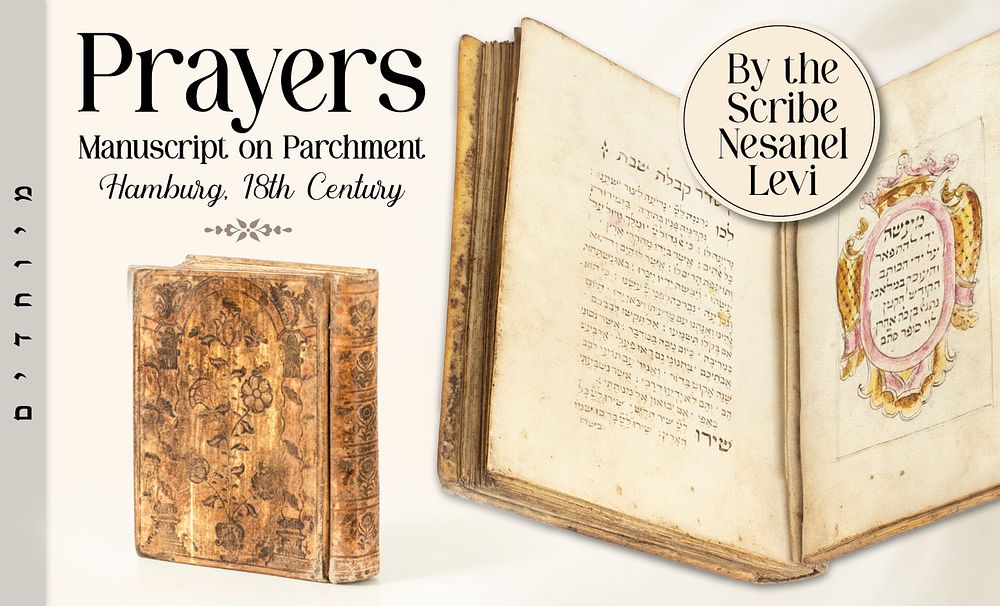
Manuscript on Parchment. Work of the Renowned Scribe Nesanel Levi. Maariv Prayers for Shabbos and Festivals. Hamburg, 18th Century * The Maariv prayers for Shabbos and the Three Festivals, together with the Ashkenazic Ma’ariviyos piyutim, in a small-format manuscript (12 cm), written entirely on parchment. The manuscript opens with a colorful, decorated, and illustrated title page, and is bound in its original parchment binding, impressed with fine floral ornaments and columns. The writing is in a fine Ashkenazic square script, with the instructions written in Yiddish–Deutsh (German in Hebrew letters). On the reverse of the title page, within a colorful medallion ornament, the scribe recorded: “Crafted with pride, by the writer and one engaged in sacred labor, the humble Nesanel son of the honorable Aaron Levi, a sofer sta”m.” Nesanel Levi was an 18th century scribe serving the Three Communities of Altona, Hamburg, and Wandsbek from his residence in Hamburg. He was widely known in his time as an expert scribe. A number of his works are known, and they are part of private collections and national libraries, among them: a Pesach Hagaddah from 1757 (Jeselsohn Collection); a Pesach Hagaddah from 1762 (Israel Museum Collection); a Pesach Hagaddah from 1771 (Moldovan Collection; facsimile: Tel Aviv, 1971); the Bamberger Hagaddah (facsimile: Tel Aviv, 1972); and Sefer Sod Hashem from 1763 (manuscript in the Jewish Theological Seminary Library, New York), as well as Sod Hashem from 1763 (Collection of the Jewish Community of Copenhagen). The present work, previously unknown, now joins the list of creations produced by the pen of the master scribe Nesanel Levi. *** In the eighteenth century, the art of producing manuscripts written and adorned on parchment experienced a revival in Ashkenazic lands. These luxurious manuscripts were commissioned in advance by Jews of high social standing and reflect the great wealth and stature of the “Court Jews, ” who were close to royal households, or of the “leaders and heads of the community.” The contents include the order of Kabbalas Shabbos, the Maariv prayers for Friday night and the Three Festivals, the order of Kiddush for Shabbos and Festivals, and the Ma'arvis piyutim. The Ma'arvis are a group of piyutim that were recited in Ashkenazic communities during the Maariv service on the Three Festivals. According to scholars, the reason that the evening prayers and Ma’ariviyos were written in a separate, small volume was for reasons of convenience, so as not to carry a full and large machzor for the relatively brief Maariv service. For this reason, the Ma’ariviyos are often missing from machzor manuscripts, as they were written in a separate booklet. Hamburg, 18th Century. Parchment. Page Count: [42] leaves. Size: 9.2 × 12 cm. The title page and the medallion on its reverse are decorated and illustrated in gold and red colors. At the end appears the order of Havdalah; following it, the scribe began to write the verses of “Veyiten Lecha, ” but did not complete them. Condition: Good; a few light stains. Parchment binding. Housed in a leather case from that period. Bibliography: On the Moldovan and Bamberger Hagaddos, see: Tuvia Perschel, Ma’amarei Tuvia, vol. VI, pp. 463–466. On the Ma’arvis piyutim, see Ezra Fleischer, “On the Characteristics of the Maariv Piyutim, ” Sinai, 69 (1971), pp. 127–134.