Bidspirit auction | 1493 NUREMBERG CHRONICLE ANTIQUE INCUNABULA
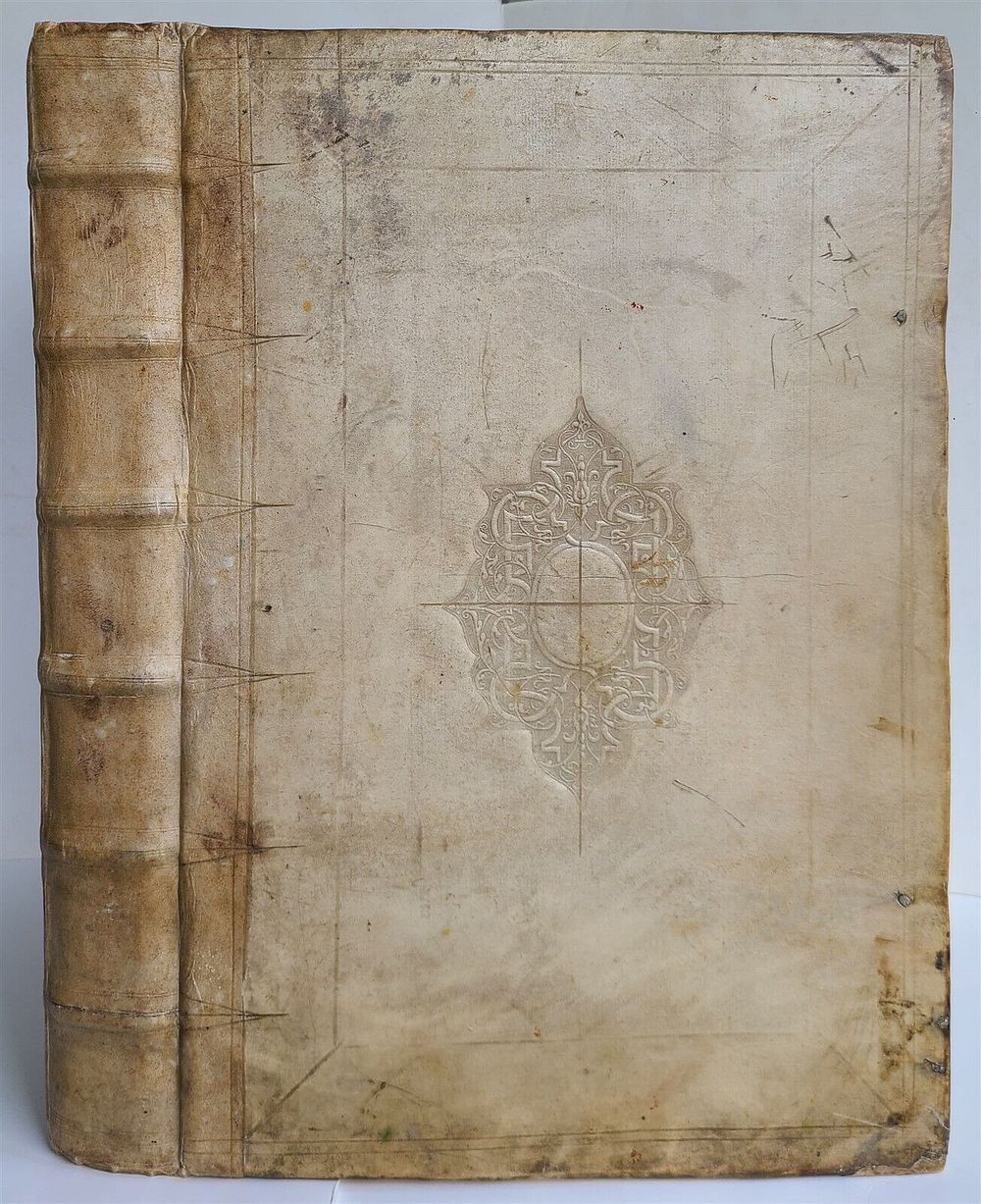
1493 NUREMBERG CHRONICLE ANTIQUE INCUNABULA LIBER CHRONICARUM HARTMANN SCHEDEL - NUREMBERG CHRONICLE SCHEDEL, HARTMANN (1440-1514) Liber chronicarum [in German: Das Buch der Croniken und Geschichten.] Nuremberg: Anton Koberger for Sebald Schreyer and Sebastian Kammermeister, 23 December 1493 Imperial folio (427 x 290 mm), 297 leaves (of 298, without final blank). 59-64 lines and headline, table and parts of the text in two columns. Types: 24:111G (text), 9:165G (headlines), xylographic title and c. 1809 woodcut illustrations printed from 645 blocks by Michael Wolgemut, Wilhelm Pleydenwurff and their workshop, including Albrecht Durer comprising 29 double-page town views, 8 full-page woodcuts and double-page maps of the World and of Europe by Hieronymus Munzer after Nicolas Khrypffs 17th-century Dutch vellum stamped with large central arabesque, re-backed in style. Some browning and staining, the xylographic title re-margined and laid down, a few leaves with marginal repairs (including first index leaf) and a large tear affecting the image to leaf 268, about 30 leaves with short minor marginal tears or minor worming, leaf 188 with a few words in three lines erased. Provenance: A few leaves with early ink marginalia. FIRST EDITION IN GERMAN of the Nuremberg Chronicle, printed in the same year as the Latin edition. The German and Latin editions were planned simultaneously, with the German edition of Georg Alt's translation appearing five months after the Latin edition. One of the most extensively illustrated books of the 15th century. The 29 large double-page city views, many illustrated for the first time, are accurate in depicting distinguished features of each city. In addition, it includes many details of 15th-century daily life: carpenters with their tools, astronomers and their instruments, a chess player, archers, bridges, derricks, dishes, furniture, windmills, ships, beds, houses, fortifications, weapons, tents, wharves, ferries, books, drawing materials, dogs, horses, and other animals, as well as costumes. Hartmann Schedel's Nuremberg Chronicle epitomizes ”the commercial sophistication, economic power and technical virtuosity that brought the art of print to this extraordinary climax” (Pettegree). Reference: BMC II 437. BSB-Ink. S-197. Bod-Inc. S-110. Goff S-309. GW M40796. HC *14510. Pettegree, The Book in the Renaissance, New Haven, 2011 p 42; Reske. The Production of Schedel's Nuremberg Chronicle Wiesbaden, 2000. Ellen Shaffer The Nuremberg Chronicle, Los Angeles, 1950. Wilson, The Making of the Nuremberg Chronicle Amsterdam, 1976. From Wikipedia: Illustrator Michael Wolgemut and Wilhelm Pleydenwurff Subject History of the world, Published 1493, by Anton Koberger, The Nuremberg Chronicle is an illustrated encyclopedia consisting of world-historical accounts, as well as accounts told through biblical paraphrase. Subjects include human history in relation to the Bible, illustrated mythological creatures, and the histories of important Christian and secular cities from antiquity. Finished in 1493, it was originally written in Latin by Hartmann Schedel, and a German version was translated by Georg Alt. It is one of the best-documented early printed books—an incunabulum—and one of the first to successfully integrate illustrations and text. Latin scholars refer to it as the Liber Chronicarum (Book of Chronicles) as this phrase appears in the index introduction of the Latin edition. English speakers have long referred to it as the Nuremberg Chronicle after the city in which it was published. German speakers refer to it as Schedelsche Weltchronik (Schedel's World History) in honor of its author. Woodcut from 1493 depicting the burning of Jews in the 14th century, today in the Jewish Museum of Switzerland in Basel Two Nuremberg merchants, Sebald Schreyer (1446–1503) and his son-in-law, Sebastian Kammermeister (1446–1520), commissioned the Latin version of the chronicle on 29 December 1491. They also commissioned Georg Alt (1450–1510), a scribe at the Nuremberg treasury, to translate the work into German. Both Latin and German editions were printed by Anton Koberger in Nuremberg. Contracts were recorded by scribes, bound into volumes, and deposited in the Nuremberg City Archives. The first contract, from December 1491, established the relationship between the illustrators and the patrons. The painters, Wolgemut and Pleydenwurff, were to provide the layout of the chronicle, to oversee the production of the woodcuts, and to guard the designs against piracy. The patrons agreed to advance 1,000 gulden for paper, printing costs, and the distribution and sale of the book. A second contract between the patrons and the printer was executed in March 1492. It stipulated conditions for acquiring the paper and managing the printing. The blocks and the archetype were to be returned to the patrons once the printing was completed. The author of the text,