Bidspirit auction | 1495 INCUNABULA BIBLE 3 FOLIO
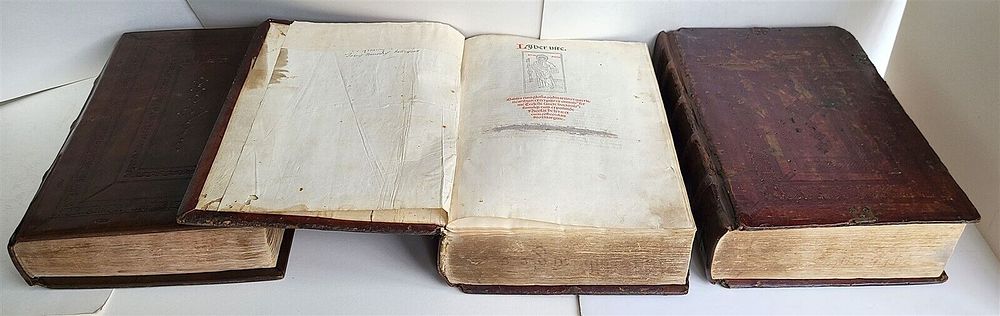
1495 INCUNABULA BIBLE 3 FOLIO VOLUMES COMPLETE ANTIQUE ILLUSTRATED BIBLIA LATINA - BIBLIA LATINA CUM GLOSSA ORDINARIA WALAFRIDI STRABONIS ALIORUMQUE ET INTERLINEARI ANSELMI LAUDUNENSIS ET CUM POSTILIS NICOLAI DE LYRA EXPOSITIONIBUSQUE GUILLELMI BRITONIS IN OMNES PROLOGOS S. HIERONYMI Printed in Venice by Paganinus de Paganinis, 18 April 1495. Text in Latin. Edited by Bernardino Gadolo of Brescia and Secondo Contarini; with Gadolfo's dedicatory preface addressed to Cardinal Francesco Todeschini Piccolomini, the future Pope Pius III. Bound in 3 MASSIVE THICK FOLIO VOLUMES: 10 1/4 by 14 3/4” (leaves measure 36 cm x 25 cm) comprising over 3000 pages in total, ILLUSTRATED WITH 54 WOODCUTS First two volumes bound in a splendid original ca. 1500 Venetian blind-tooled brown goatskin over thick wooden boards; covers decorated with arabesque knot-work centerpieces enclosed in concentric borders of floriated and 'winding vines' rolls; spines very neatly rebacked retaining most of the original backstrips blind-ruled to a cross-hatched diamond pattern. Both of these volumes originally had four clasps each; all are now gone, retaining, however, small brass nailheads at edges of the front cover, where the clasps' straps used to be attached. The 3rd volume in a very tastefully produced modern binding of brown polished morocco over wooden boards blind-tooled to match the style of the original Renaissance bindings on the 1st two volumes. A fragment of a 13th-century(?) vellum manuscript used as a spine liner, with a portion visible at gutter over front free endpaper in Vol.I. Foliation: [13], 1398 [i.e. 1498] leaves (forming 1511 leaves, i.e. 3022 pages in total). Foliation continuous throughout all three volumes. (Numerous errors in numeration.) Signatures: a8 b6[-b6 last preliminary] c-z8 [et]8 [con]8 [rum]8 2a-2d8 2e-2f6 2g-2r8 2s-2v6 2x-2z8 2[et]8 2[con]8 2[rum]8 3a-3p8 3q-3r6 3s-3z8 3[et]8 3[con]8 3[rum]8 A-V8 X-Y6 Z-3S8 3T10 3V-3Z8 1-438 4410. COMPLETE, except only for the last preliminary leaf b6 (prefatory material to the Glossa Ordinaria) before the beginning of Genesis. The Biblical text is complete; the title-page and the colophon are present. Inner blank ff6 is present. Biblical text printed in double columns, interspersed with interlinear glosses (in very small type), surrounded by commentary (Lyra's Postilla and Glossa Ordinaria); 83 lines of gloss per page. All text in Gothic types of various sizes: Type: 5:79G, 10:92G, 10*:130G, 11:270G, 13:68G, 14;102G, 15:54G. Capital spaces with guide initials (unrubricated). Title page (a1r) printed in red snd black, with a fine woodcut printer's device depicting St. Peter holding a pair of keys and a book (with printed motto ”Tu es Petrus”). Further 54 woodcut (mostly large) illustrations in text. Incipits on the first page of Genesis (c1r) printed in red. Preliminaries include a short address to the reader 'Ad intelligentiam ordinis et signorum huius sacrosancti libri...' on verso of title page, followed by a dedicatory epistle by the editor Bernardino Gadolo to Cardinal Francesco Todeschini Piccolomini (future Pope Pius III); a short prefatory note ('Translatores Biblie') on the translators of the Bible; two prologues by Nicolaus de Lyra; St. Jerome's letter to Paulinus and his Prologue to the Pentateuch, both with Guillelmus Brito's commentary. Nicolaus de Lyra's Contra perfidiam Judaeorum at the end of the last volume (447r-10r), with the the Colophon on recto of the final leaf 447r (verso blank). Verso of the same endpaper with (partially removed) 16th-century inscription, including the popular early 16th-century jocular verses on the importance of Lyra's commentary (with a play of words on his name): Lyra non lyrasset, ] totus mundus delirasset', i.e. ”Had Lyra not played the lyre, the whole world would have gone hay-wire ”. Very Good antiquarian condition. All bindings tight and very solid, joints and hinges intact, all boards firmly attached. Internally, with occasional light soiling and mild marginal water-staining. A few leaves lightly browned. An inked-out early inscription to title page; a couple more pages with minor early manuscript marginalia. Front free endpaper in Vol.I with top portion cut off and restored, a 20th-century acquisition note in Italian on recto, and a 16th-century inscription (partially removed) on verso; title page and the next preliminary leaf with very neat (and barely noticeable) marginal repairs at edges. In Vol.II, a few leaves in the first quire with very neat archival repairs (affecting only a few words of commentary), and some leaves with two small marginal wormholes (in outer margin, not affecting any text). Vol.III with a few leaves in the first and last quire with neat archival repairs (slightly obscuring a few words of commentary but generally without loss of legibility); several leaves in Vol.III with slightly heavier damp-staining, but mostly confined to the top margin. In all,