Bidspirit auction | NAPOLEON I: (1769-1821) Emperor of
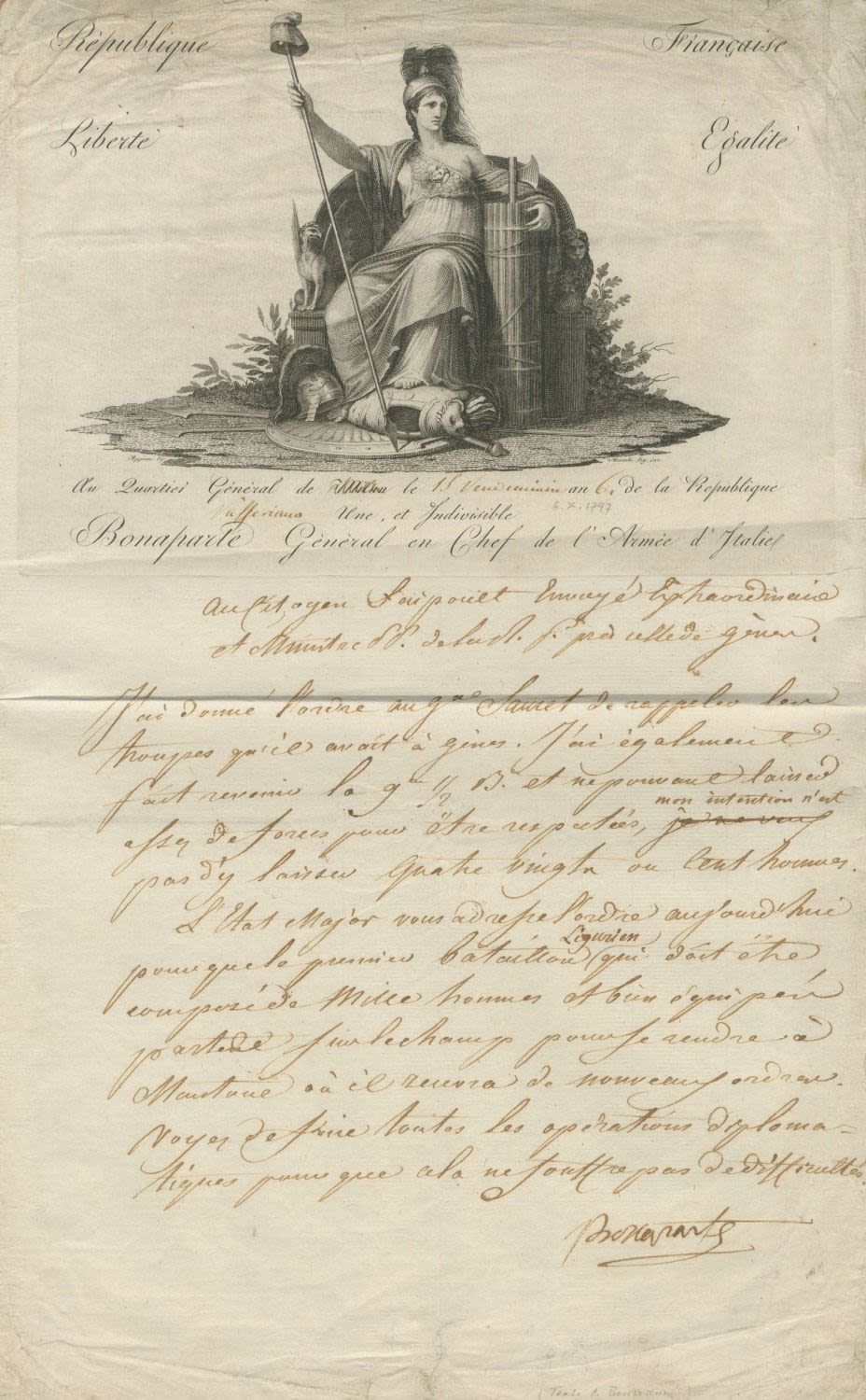
NAPOLEON I: (1769-1821) Emperor of France 1804-14, 1815. A good L.S., `Bonaparte - NAPOLEON I: (1769-1821) Emperor of France 1804-14, 1815. A good L.S., `Bonaparte´, a good example signature, one page, large folio, Head Quarters at Passariano, Udine, 6th October 1797, to citizen Faipoult, Plenipotentiary Minister, envoy of the R.F from Geneva, in French. The letter bears an impressive and large revolutionary vignette to the heading, created by Appiani, showing the French Republic symbols, including Marianne, France´s national symbol of liberty and the Phrygian cap, and the printed text ''Republic of France - Liberty - Equality''. Beneath this magnificent vignette, the printed text states ''Bonaparte General in chief of the Army of Italy''. Napoleon explains to his correspondent that he has made come back his troops which were in Geneva, further stating `I have ordered General Sauret to call back this troops positioned in Genova. I have also ordered the 9th half-brigade to leave, as I could not have enough number of men to be respected, and I have no intention to leave there eighty or a hundred men ´ further saying `.. the first Ligurian battalion with one thousand well-equipped men will march to Mantua..´, and concludes stating `Make all the necessary diplomatic efforts in order to avoid any difficulty.´ With blank integral leaf. Overall age wear and creasing, mostly to edges with extremely small tears, but not affecting the text or signature. G The present letter is written in the hand of Louis Antoine Fauvelet de Bourrienne (1769-1834) French Diplomat. Best known for his Memoirs of Napoleon Bonaparte. A close youth friend of Napoleon since they met at the Military Academy at the age of 8 years old. In 1797, General Bonaparte urgently summoned Bourrienne to Italy for the negotiations with Austria, where his knowledge of law and diplomacy was useful in drafting the terms of the Treaty of Campo Formio on 7th October 1797, the day after the present letter was written. Bourrienne would also accompany Bonaparte to Egypt as his private secretary. Andrea Appiani (1754-1817) Italian neoclassical Painter. Appiani was created pensioned artist to the Kingdom of Italy by Napoleon. He rendered multiple portraits of Napoleon, his Marshals and personages of his regime. He lost his allowance after the fall of the Kingdom in 1814 and fell into poverty. Villa Passariano, where Bonaparte was residing and where the terms of the Treaty between France and Austria were negotiated, was the countryside residence of the last Doge of Venice Ludovico Manin (1725-1802) who abdicated few months earlier when French troops occupied Venice.