Bidspirit auction | ROUSSEAU JEAN-JACQUES: (1712-1778) French Writer
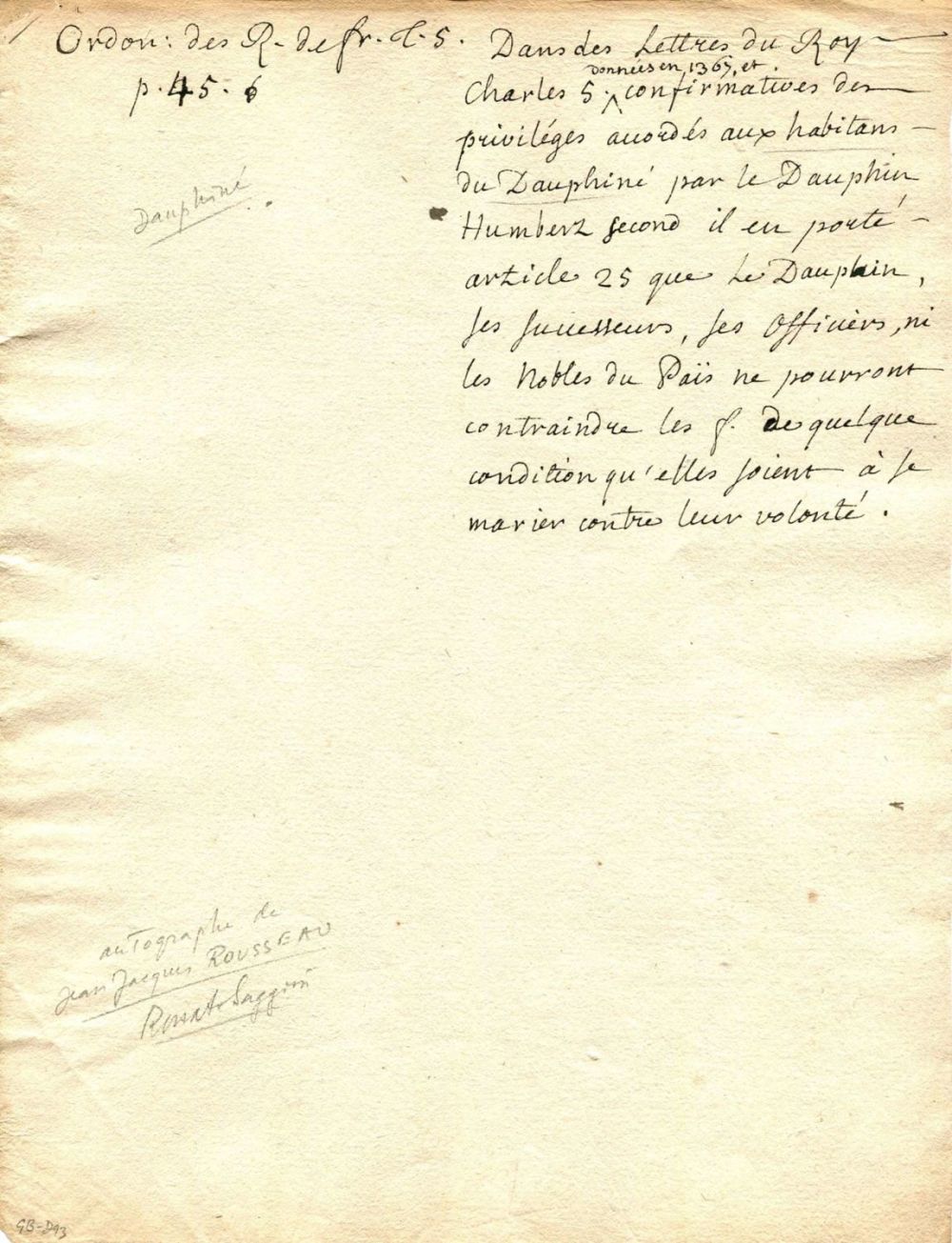
ROUSSEAU JEAN-JACQUES: (1712-1778) French Writer and Philosopher. A good autograph manuscript, one p... - ROUSSEAU JEAN-JACQUES: (1712-1778) French Writer and Philosopher. A good autograph manuscript, one page, 4to, n.p., [Paris], n.d. (c.1745), in French. The page of manuscript, in Rousseau's hand, is from his unpublished work relating to the history of women and laws which he prepared between 1745-51 for his benefactress Louise Marie Madeleine Dupin. Rousseau writes his text in the right column of the page, the left reserved for additional notes. Rousseau refers to the orders-decrees given by Kings of France which he resumed in his work Ordonnances des Rois de France, (''Ordinances of the Kings of France''), and identifies it as taken from `Ordon[nances] des R[ois] de Fr[ance], L[ivre] 5, p[age] 45´, stating `Dans Les Lettres du Roy Charles 5, données en 1367, et confirmatives des privileges accordés aux habitans du Dauphiné par le Dauphin Humbert Second, il eu porté article 25 que le Dauphin, ses successeurs, ses officiers, ni les nobles du Pais ne pourront contraindre les f.(emmes) de quelque condition qu´elles soient à se marier contre leur volonté.´ (Translation ''In the Letters of King Charles 5, given in 1367, and confirming the privileges granted to the inhabitants of Dauphiné by the Dauphin Humbert Second, article 25 had been included which the Dauphin, his successors, his officers, nor the nobles of the Country could not compel women, whatever their status is, to marry against their will '') Overall small age tone, mostly to the very slightly uneven edges, otherwise G At the time Rousseau wrote these pages, between 1745 and 1751, he was working as secretary to his benefactress Louise Marie Madeleine Dupin. Charles V (1338-1380) Also called ''Le Sage'' (''The Wise''), King of France 1364-80. His reign marked an early high point for France during the Hundred Years´ War, with his armies recovering much of the territory held by the English, and successfully reversed the military losses of his predecessors. Charles became Regent of France when his father John II was captured by the English at the Battle of Poitiers in 1356. To pay for the defense of the kingdom, Charles raised taxes. As a result, he faced hostility from the nobility, and from the French bourgeoisie, and with a peasant revolt known as the Jacquerie. Charles overcame all of these rebellions, but in order to liberate his father, he had to conclude the Treaty of Bretigny in 1360, in which he abandoned large portions of south-western France to Edward III of England and agreed to pay a huge ransom. He established the first permanent army paid with regular wages, and by the end of Charles' reign, they had reconquered almost all the territories ceded to the English in 1360. Furthermore, the French fleet, managed to attack the English coast for the first time since the beginning of the Hundred Years´ War. Charles V died in 1380. He was succeeded by his son Charles VI, whose disastrous reign allowed the English to regain control of large parts of France.