Bidspirit auction | MONET CLAUDE: (1840-1926)
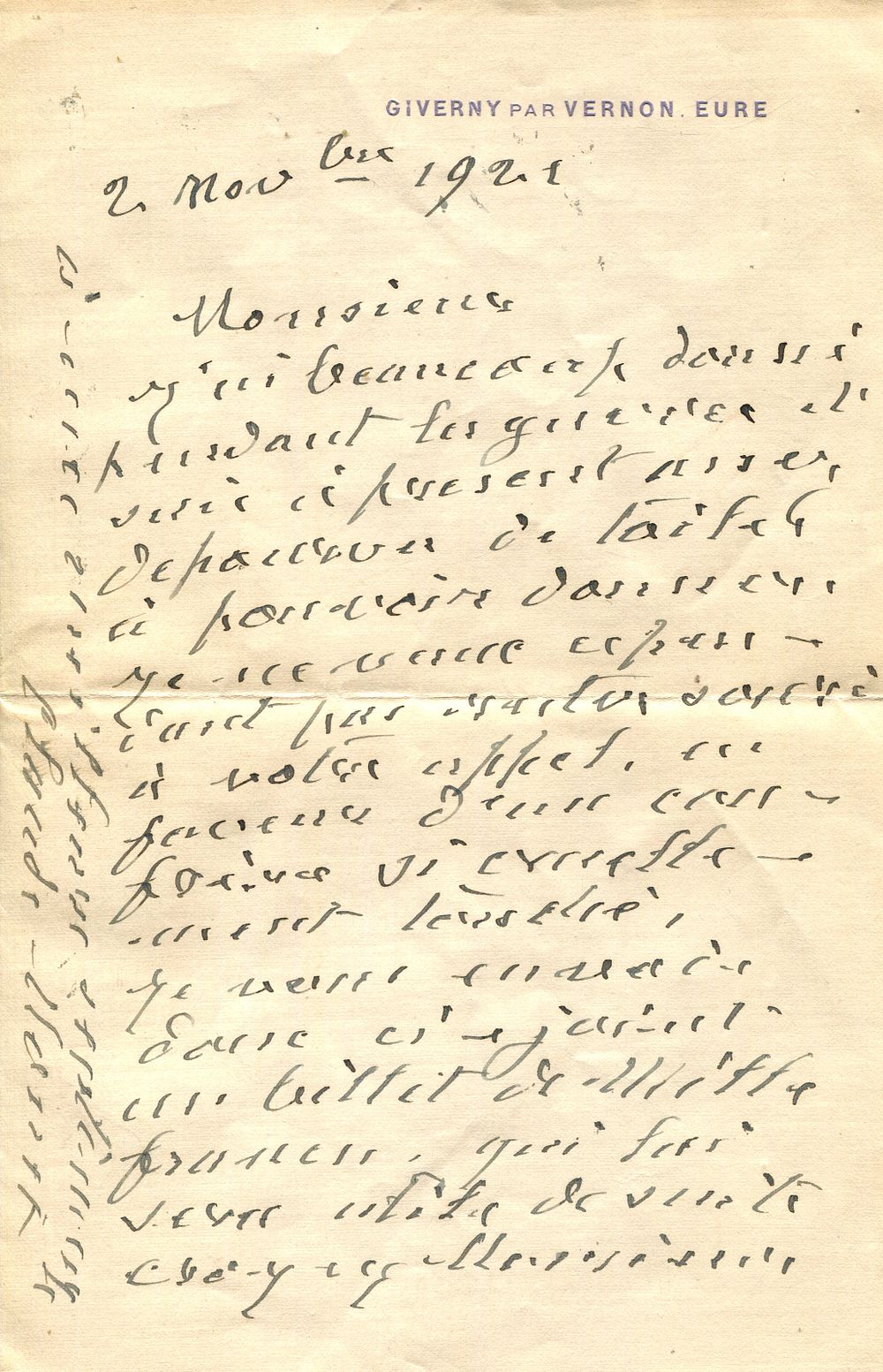
MONET CLAUDE: (1840-1926) - MONET CLAUDE: (1840-1926) French Impressionist painter. A.L.S., Claude Monet , one page, 8vo, Giverny par Vernon, Eure, 2nd November 1921, to Elie Faure, in French. Monet writes a sympathetic letter of benevolence, in full, ´J´ai beaucoup donne pendant les guerres et suis a present assez depourvu de toiles a pouvoir donner. Je ne veux cependant pas rester sourd a votre appel, en faveur d´un confrere si cruellement touche. Je vous envoie donc ci-joint un billet de mille francs, qui lui sera utile de suite´ (Translation: ´I donated a lot during the wars and am now quite short of canvases to donate. However, I do not want to turn a deaf ear to your appeal on behalf of a colleague who has been so cruelly affected. I am therefore sending you herewith a note for one thousand francs, which will be of immediate use to him´ ). With blank integral leaf. Accompanied by the original registered envelope hand addressed by Monet (area of paper loss caused by the removal of the postage stamps, slightly affecting the name of the recipient) and bearing five red wax seals to the verso, each with Monet´s initials imprinted to the centre. A few very light, extremely minor creases, VG Elie Faure (1873-1937) French medical doctor, art historian and essayist, a passionate admirer of Paul Cezanne and Diego Velasquez, and a friend of Chaim Soutine, whom Faure considered a genius. The present letter was written by Monet in response to an appeal by Faure to a number of artists, seeking their assistance in raising funds for Francisco Iturrino (1864-1924), a Spanish Post-Impressionist painter sometimes associated with Fauvism. In 1920 Iturrino had developed gangrene on one leg which required an operation and was amputated the following year. Subsequently the artist refined himself to etching, although soon ran into financial difficulties. Faure organised an exhibition at the Galerie Rosenberg, which featured works donated by Matisse, Picasso and several other of Iturrino´s friends. The money raised from the exhibition enabled Iturrino to retire to Cagnes-sur-Mer in 1922, where he died two years later.