Bidspirit auction | PASTEUR LOUIS: (1822-1895)
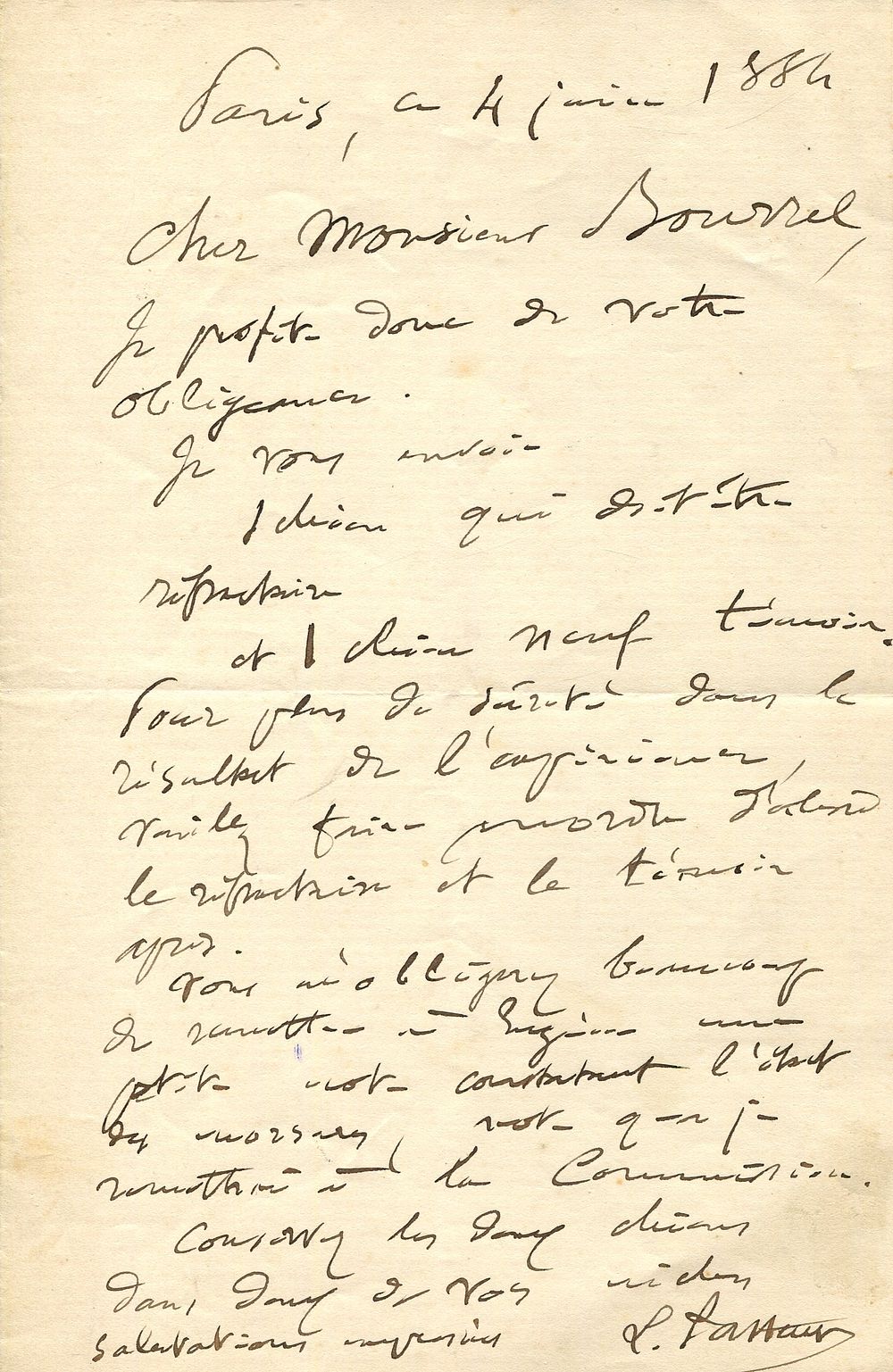
PASTEUR LOUIS: (1822-1895) - PASTEUR LOUIS: (1822-1895) French chemist and microbiologist, renowned for his discoveries of the principles of vaccination and pasteurisation. A good A.L.S., L. Pasteur , one page, 8vo, Paris, 4th June 1884, to [Jean-Aimé] Bourrel, in French. Pasteur states that he will take adavantage of Bourrel´s kindness, and explains ´Je vous envoie 1 chien qui doit etre réfractaire et 1 chien neuf témoin´ (Translation: ´I am sending you 1 dog that should be refractory and 1 new control dog´ ), further providing Bourrel with some instructions, ´Pour plus de sureté dans le resultat de l´expérience veuillez faire mordre d´abord le réfractaire et le témoin apres. Vous m´obligerez beaucoup de remettre a Eugène une petite note constatant l´etat des morsures, note que je remettrai a la commission. Conservez les deux chiens dans deux de vos niches´ (Translation: ´For greater certainty in the result of the experiment, please have it bite the refractory dog first and then the control dog afterwards. It would be very kind of you to give Eugène a short note recording the state of the bites, which I will pass on to the commission. Keep the two dogs in two of your kennels´ ). With blank integral leaf. Letters of Pasteur in which he refers to his research into a rabies vaccine (credited with subsequently saving millions of lives) are rare and desirable. VG Jean-Aimé Bourrel (1822–1892) French veterinarian and a specialist in canine rabies. Bourrel provided Pasteur with the dogs suffering from furious rabies and sullen rabies which enabled him to undertake his work on this disease in December 1880. He housed and observed dogs vaccinated by Pasteur then tested by trepanation or bite, in the aim of assessing the quality and duration of acquired immunity. It would be just over a year following the date of the present letter before Pasteur performed the first human trial of his rabies vaccine, on 9-year-old Joseph Meister in July 1885. As a result of the treatment the boy was restored to good health within months and Pasteur was hailed as a hero. In 1886 Pasteur treated 350 individuals, of which only one developed rabies. The treatment's success laid the foundations for the manufacture of many other vaccines and the first of the Pasteur Institutes was also built on the success of this achievement.