Bidspirit auction | DE LESSEPS FERDINAND: (1805-1894)
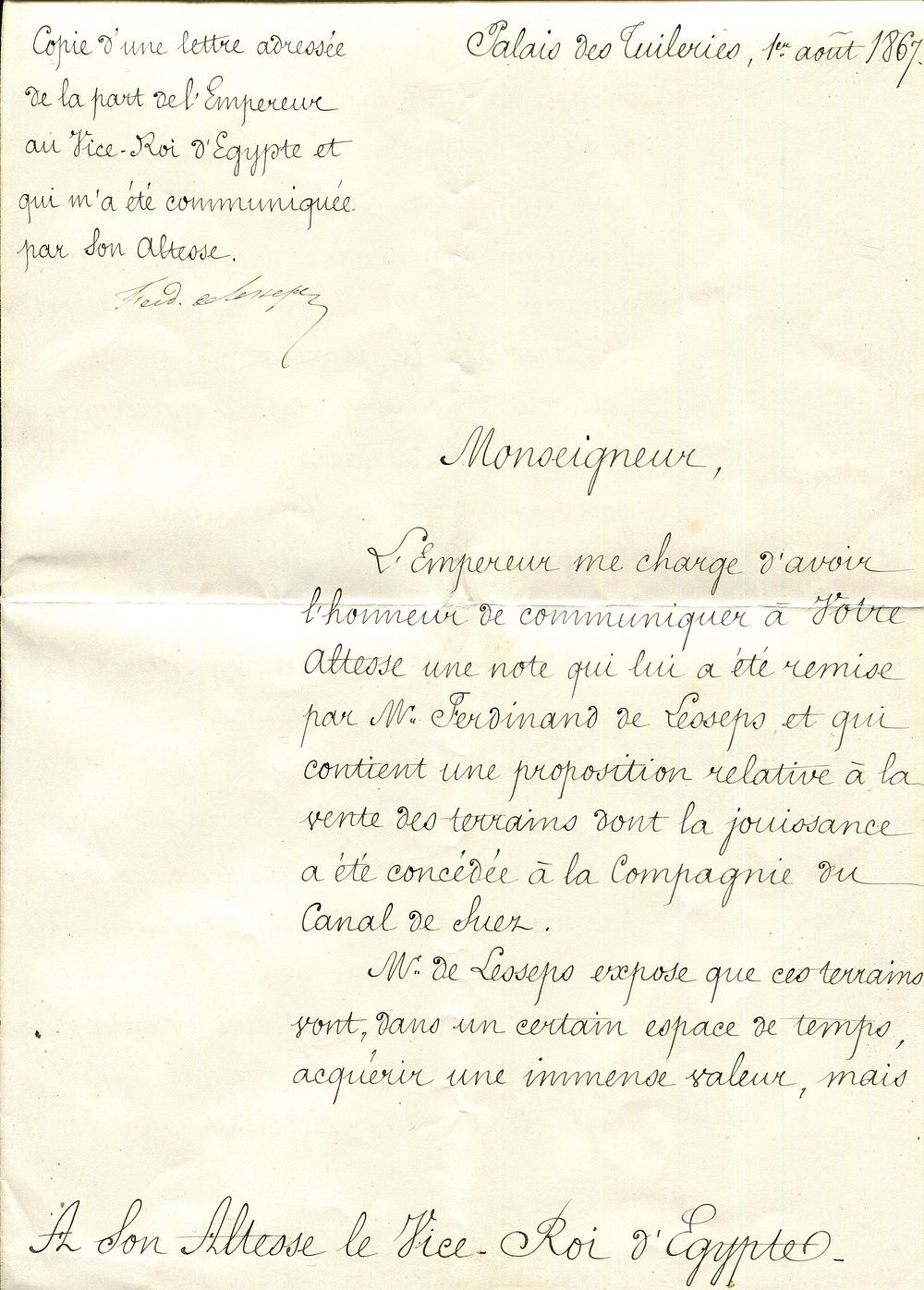
DE LESSEPS FERDINAND: (1805-1894) - DE LESSEPS FERDINAND: (1805-1894) French Diplomat and developer of the Suez Canal. A historically important content A.L.S., signed twice ` Ferd. De Lesseps ´, four pages, 4to, Paris, 9th August 1867, in French. De Lesseps writes the present letter at the conclusion of the copy of a letter sent by the personal secretary of French Emperor Napoleon III to the Vice-Roy of Egypt, Ismail Pasha, which was sent a week earlier from the Palais des Tuileries in Paris, on 1st August 1867. De Lesseps reports on the Egypt Vice-Roy´s response to Napoleon III. The letter sent to Ismail Pasha shows the great interest shown by Napoleon III on the Suez Canal project and the strong support to De Lesseps´ plans, stating in part ` Monseigneur, l´Empereur me charge d´avoir l´honneur de communiquer à Votre Altesse une note qui lui a été remise par Mr. Ferdinand de Lesseps et qui contient une proposition relative à la vente des terrains dont la jouissance a été concédée à la Compagnie du Canal de Suez. Mr. de Lesseps expose que ces terrains vont, dans un certain espace de temps, acquérir une immense valeur, mais ils resteront improductifs pour tout le monde, la Compagnie n´ayant pas le droit de les vendre. Il y a là cependant pour l´Egypte aussi bien que pour la Compagnie une source très grande de revenus, si Votre Altesse voulait bien lui accorder l´autorisation qu´elle sollicite de pouvoir vendre ces terrains en proposant de partager avec le gouvernement de Votre Altesse les bénñefices qui résulteraient de cette opération. Sa Majesté porte un vif intérêt à Mr. de Lesseps, et désire vivement voir réussir ´oeuvre qu´il a entreprise...´ (Translation: ” My Lord, the Emperor has instructed me to have the honour of communicating to Your Highness a note that was given to him by Mr. Ferdinand de Lesseps and which contains a proposal relating to the sale of the land whose use has been granted to the Suez Canal Company. Mr. de Lesseps explains that these lands will, over a certain period of time, acquire immense value, but they will remain unproductive for everyone, the Company not having the right to sell them. However, there is a very large source of revenue for Egypt as well as for the Company, if Your Highness would grant him the authorization he requests to be able to sell these lands by proposing to share with Your Highness's government the profits that would result from this operation. His Majesty takes a keen interest in Mr. de Lesseps, and earnestly desires to see the success of the work he has undertaken...”) At the conclusion of this letter and to the third and fourth page, De Lesseps transmits the Viceroy´s response and explains in detail his point of view suggesting what should be done and adding a personal request, stating in part ` Le Vice-Roi a répondu qu ´il était d´accord avec Sa Majesté et que la vente des terrains de l´isthme devant contribuer à l´établissement régulier de la propriété des Européens en Orient, il demandait de profiter de cette occasion pour établir avant tout une legislation plus en rapport que les capitulations, avec le movement civilisateur de l´Europe en Orient. Il a raison…´ (Translation: “ The Viceroy replied that he agrees with His Majesty and that the sale of the isthmus lands would contribute to the regular establishment of European property in the East, he asked to take advantage of this opportunity to establish, above all, a legislation more in keeping with the civilizing movement of Europe in the East than the capitulations. He is right...”) Further, De Lesseps applies for the important positions to be appointed, saying ` Si l´on doit nommer une commission, je sollicite l´honneur d´en faire partie, d´abord en ma qualité de ministre plénipotentiaire en disponibilité ayant longtemps résidé en Orient, et ensuite comme étant à la tête d´une entreprisequi a déjà réuni une population de 25000 personnes dans l´isthme de Suez.´ (Translation: “ If a commission is to be appointed, I request the honour of being part of it, firstly in my capacity as Minister Plenipotentiary on leave, having resided for a long time in the East, and secondly as the head of a company which has already brought together a population of 25,000 people in the Isthmus of Suez.”) VG Isma'il Pasha (1830–1895) also known as Ismail the Magnificent, was the Viceroy or Khedive of Egypt and ruler of Sudan 1863-1879. His philosophy can be glimpsed in a statement that he made in 1879: ”My country is no longer only in Africa; we are now part of Europe too. It is therefore natural for us to abandon our former ways and to adopt a new system adapted to our social conditions”. Isma'il's policies placed the Khedivate of Egypt and Sudan in severe debt, leading to the sale of the country's shares in the Suez Canal Company to the British government.