Bidspirit auction | NAPOLEON I: (1769-1821)
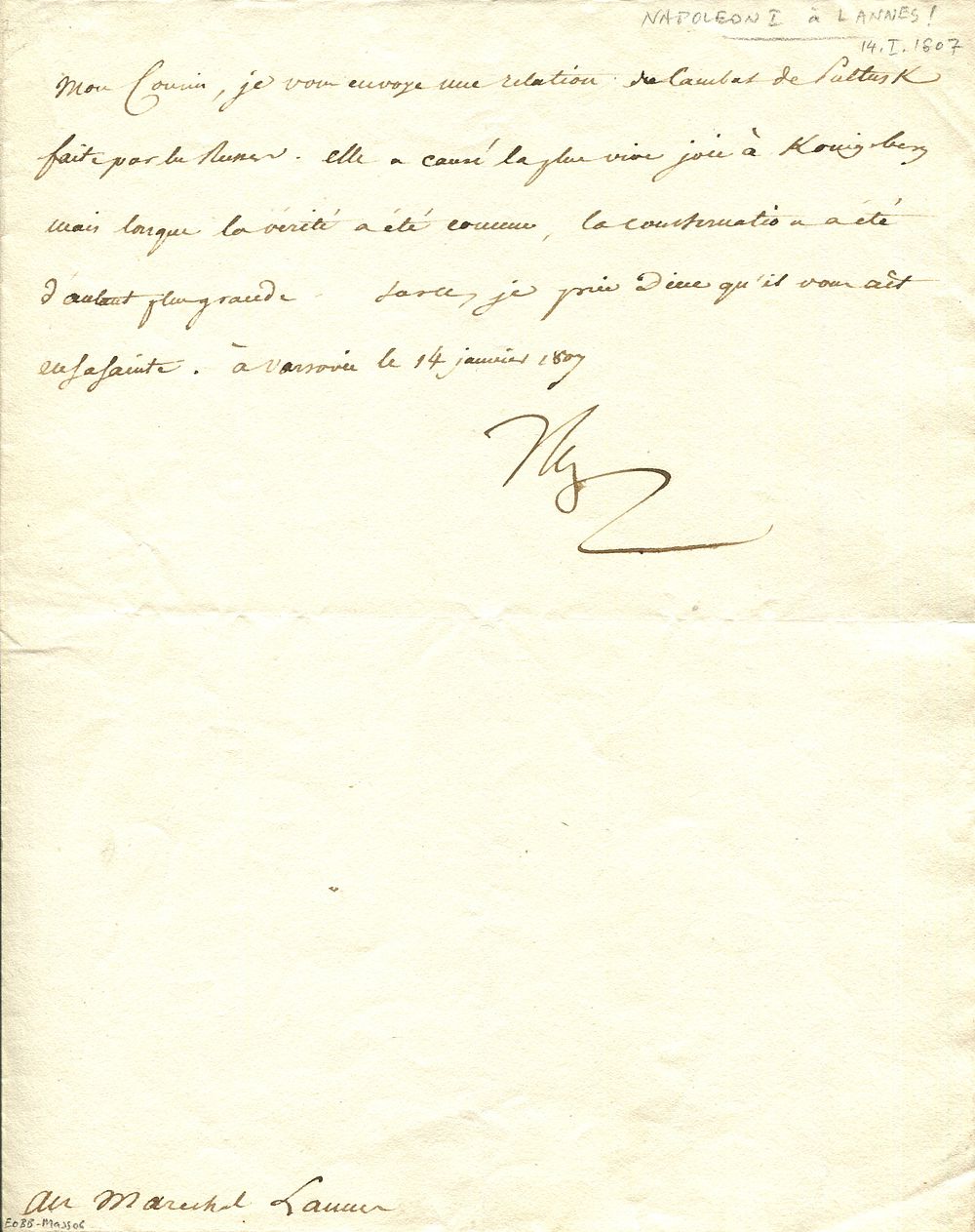
NAPOLEON I: (1769-1821) - NAPOLEON I: (1769-1821) Emperor of France 1804-14, 1815. An excellent content letter, L.S., ` Nap´, one page, gilt edges, 4to, Warsaw, 14th January 1807, to Marshal Lannes, in French. The Emperor is in Warsaw where he will spend the month of January, after having taken the Polish capital two months earlier, and where he will meet for the first time Maria Walewska. Napoleon reports to Marshal Lannes on the official fake war report published initially by the Russians and with a touch of mockery explains what was their reaction when they learned about the real outcome of the battle, stating ` Je vous envoye une relation du combat de Pultusk faite par les Russes. Elle a causé la plus vive joie à Konigsberg, mais lorsque la vérité a été connue, la consternation a été d´autant plus grande.´ (Translation: ” I am sending you a report of the battle of Pultusk, made by the Russians. It caused the greatest joy in Konigsberg, but when the truth became known, the consternation was all the greater...”) With blank integral leaf. Very smallmninor creasing, otherwise G to VG It was on 1st of January 1807, on his arrival to Poland, two weeks before the present letter was written, that Napoleon met for the first time Maria Walewska. Two weeks later and only four days after the present letter was written that he invited Maria Walewska to join him on the following days becoming from then on her mistress. The Battle of Pułtusk, in Poland, took place on 26th December 1806 during the war of the Fourth Coalition. Napoleon had ordered multiple of his main military Corps to pursue the Russians to Pultusk, including different corps under Marshals Murat, Davout, Augereau, Ney, Bernadotte, Bessieres, Soult and Lannes. Despite their strong numerical superiority and artillery, the Russians suffered the French attacks, before retiring the next day and after having suffered greater losses than the French. Marshal Lannes had orders to cross the Narew at Pułtusk with his corps. He was aware that there was a Russian force in front of him, but did not know its size. After struggling through the mud, his first troops reached the area and drove the cossacks back onto the Russian main line. Because of the terrain, Lannes could only see the Russian advance positions on the extreme left and right with the cavalry between them. Lannes was in a very difficult position with a much inferior number of soldiers than the Russians. Meanwhile the 3rd Division of Davout's 3rd Corps, temporarily commanded by his Chief of Staff Fournier, had been ordered to pursue a Russian column apparently retiring on Pułtusk. Concerned about the strength of the Russian cavalry force which was escorting guns and stores, Fournier was preparing to stop for the night when he heard the sounds of combat to his right, and so marched his men towards Pułtusk. Lannes was following his orders, and the result was to find himself facing a superior force in a good defensive position. Napoleon's orders had not allowed for this, and unaware of the odds against him, Lannes attacked. If Fournier had not used his initiative and marched to the sound of the guns, the result may have been very different. Konigsberg is the historic Prussian name of the Russian city of Kaliningrad.