Bidspirit auction | CHARLES I : (1887-1922)
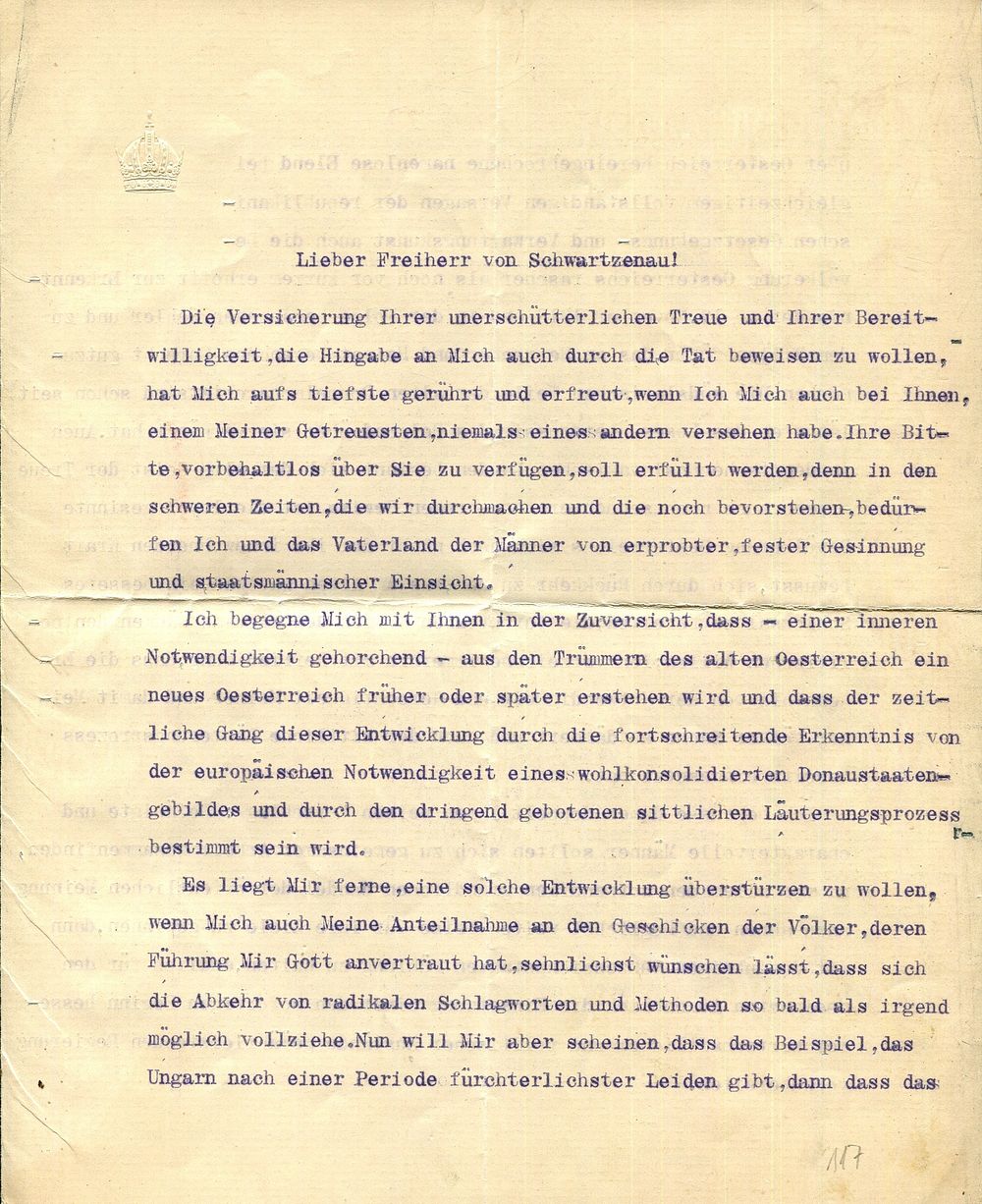
CHARLES I : (1887-1922) - CHARLES I : (1887-1922) Emperor of Austria, King of Hungary (as Charles IV), King of Bohemia (as Charles III) 1916 until the monarchy was abolished in November 1918. He was the last of the monarchs belonging to the House of Habsburg-Lorraine to rule over Austria-Hungary. The Emperor Charles died in exile at the early age of 34. A very good T.L.S., ` Franz´, three pages, 4to, Villa Prangins, Switzerland, 8th December 1919, to Von Schwartzenaul, in German. The letter bears to the heading a crown embossed seal. The very recently dethroned King refers to future of Austria, and expresses his hopes, stating `.. Ich begegne Mich mit Ihnen in der Zuversicht, dass - einer inneren Notwendigkeit gehorchend - aus den Trümmern des alten Oesterreich ein neues Oesterreich früher oder später erstehen wird und dass der zeitliche Gang dieser Entwicklung durch die fortschreitende Erkenntnis von der europäischen Notwendigkeit eines wohlkonsolidierten Donaustaatengebildes und durch den dringend gebotenen sittlichen Läuterungsprozess bestimmt sein wird. .. Nun will Mir aber scheinen, dass das Beispiel, das Ungarn nach einer Periode fürchterlichster Leiden gibt, dann dass das über Oesterreich hereingebrochene namenlose Elend bei gleichzeitigem vollständigen Versagen der republikanischen Gesetzgebungs- und Verwaltungskunst auch die Bevölkerung Oesterreichs rascher als noch vor kurzem erhofft zur Erkenntnis der am 12. November 1918 und in der Folge begangenen Fehler und zu dem Willen führt, das an Herrscher und Heimat begangene Unrecht gutzumachen. Die südslavischen Teile der alten Doppelmonarchie sind schon seit längerem des Loses überdrüssig, das Belgrad über sie verhängt hat. Auch in den tschechoslovakischen Landen beginnt sich der alte Geist der Treue ... zu regen. Gewiss ist die loyal gesinnte Bevölkerung Oesterreichs sich noch nicht der ihr innewohnenden Kraft bewusst, sich durch Rückkehr zu dem, was am Alten gut war, ein besseres Schicksal zu bereiten; die furchtbaren Sorgen des Alltags lähmen den politischen Willen; Ich verzeichne immerhin mit Befriedigung, dass die Erkenntnis von der Notwendigkeit und Gerechtigkeit Meiner und damit Meiner Völker Sache aufdämmert ...´ (Translation ” I meet with you in the confidence that—obeying an inner necessity—a new Austria will sooner or later arise from the ruins of the old Austria, and that the temporal course of this development will be determined by the progressive recognition of the European necessity of a well-consolidated Danube state structure and by the urgently required process of moral purification. .. Now, however, it seems to me that the example set by Hungary after a period of the most terrible suffering, and that the unspeakable misery that has befallen Austria, coupled with the simultaneous complete failure of the republican legislative and administrative work, will also lead the population of Austria more quickly than recently hoped to recognize the mistakes committed on November 12th 1918, and subsequently, and to the will to right the injustice committed against their rulers and their homeland. The South Slavic parts of the old Dual Monarchy have long been weary of the fate that Belgrade has imposed on them. Even in the Czechoslovak lands, the old spirit of loyalty... is beginning to stir. Certainly, the loyal-minded population of Austria is not yet aware of its inherent power to prepare a better fate for itself by returning to what was good in the old ways; the terrible worries of everyday´s life paralyze political will; I note, however, with satisfaction that the realization of the necessity and justice of my cause, and thus of my people's cause, is dawning...”) VG Charles became heir presumptive of Emperor Franz Joseph when his uncle Archduke Franz Ferdinand of Austria was assassinated in 1914. Charles succeeded to the thrones in November 1916 following the death of his great-uncle, Franz Joseph. He began secret negotiations with the Allies, hoping to peacefully end the First World War but was unsuccessful. Following the Armistice of November 1918, Charles renounced any participation in government affairs, but did not abdicate. In April 1919 the National Assembly formally dethroned the Habsburgs and banished Charles from German-Austria for life. Charles spent the early part of his exile in Switzerland. He spent the remaining years of his life attempting to restore the monarchy. He made attempts to claim the Hungarian throne in 1921, but failed due to the opposition of Admiral Miklos Horthy. Charles was exiled for a second time to the Portuguese island of Madeira where he soon fell ill and died at the very early age of 34. Erwin von Schwartzenau (1858-1926) former Minister of the Interior, one of Charles´s most loyal server in the work of restoration.