Bidspirit auction | STRAVINSKY IGOR: (1882-1971)
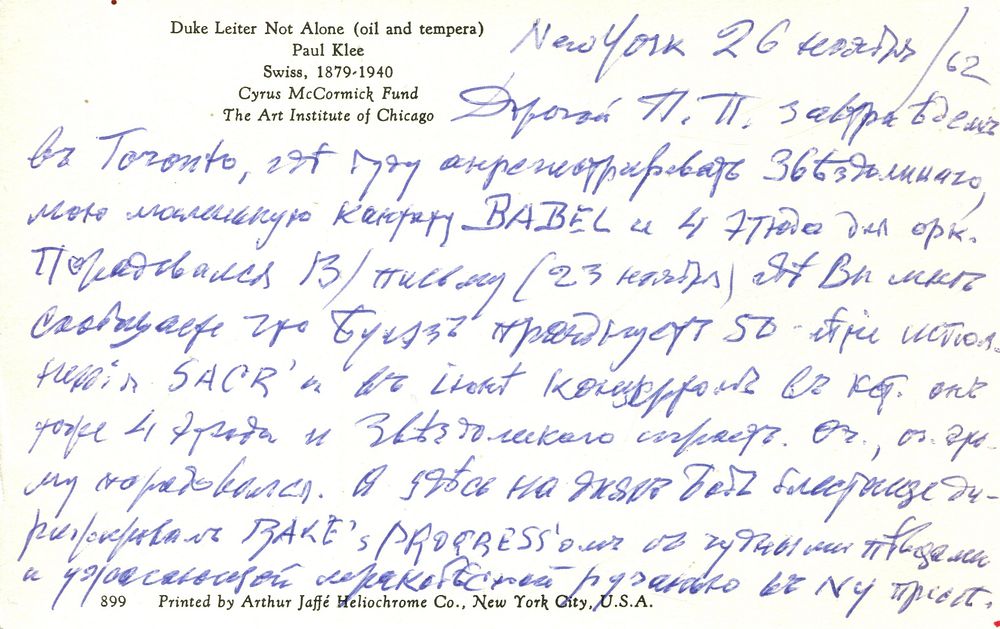
STRAVINSKY IGOR: (1882-1971) - STRAVINSKY IGOR: (1882-1971) Russian Composer, Conductor and Pianist. An excellent content, with harsh and heartfelt comments by Stravinsky, A.L.S., ` I. Str ´, two pages, to two postcards, New York, 26 th November 1962, to Piotr Souvtchinsky, in Cyrillic. Stravinsky refers to several of his main works, both works of his youth and also new ones that he is performing at the time of this letter. He has learned with his correspondent´s letter that Pierre Boulez will be celebrating the 50 th anniversary of the premiere of Le Sacre du Printemps (“The Rite of Spring”) , stating in part ` We are leaving tomorrow for Toronto where I will record Zvezdolikii, my little cantata BABEL and 4 studies for orchestra. I was delighted with your letter (November 23rd) in which you tell me that Boulez will be celebrating the 50th anniversary of the performance of the Rite [Sacre] with a concert in June in which he will also play the 4 studies and “Zvezdolikii”.´ Despite his joy for the news coming from Paris and for the forthcoming performances and registering, Stravinsky confesses his sadness for the treatment and incomprehension his new compositions receive in his new Homeland, the United States. Indeed, Stravinsky got the French citizenship in 1934 after leaving Russia, and would later get the American citizenship in 1945. He cannot understand why his new compositions are so badly welcomed in his new Homeland, and why the history repeats itself fifty years later, as it happened with his first works also very badly welcomed in his previous Homeland, France, and which are now worldwide acclaimed. With harsh words, Stravinsky states ` These days Beb has brilliantly conducted ”Rake's Progress” here, with wonderful singers and horrible obscurantist insults in the NY press. The rage of these musically illiterate ignorant people towards ”Rake” and my current music is simply incomprehensible! There is something personal in this hatred against me and my music in my new ”homeland´. The postcards, intentionally chosen by the Russian composer show two paintings of Paul Klee (1879-1940), the Swiss artist who was also a close friend of Stravinsky. VG to EX Piotr Souvtchinsky (1892-1985) Russian artistic Patron and Writer on music. The heir to a sugar fortune, he was the patron and co-publisher of the Saint-Petersburg musical journal Muzikalniy sovremennik founded in 1915. Souvtichinsky was a close friend of Prokofiev and Stravinsky and was the real author of the book La poétique musicale , published as by Stravinsky. Pierre Boulez (1925-2016) French Composer and Conductor. Boulez, in his policy of paying tribute to the great avant-garde composers, was going to celebrate the 50th anniversary of TLe Sacre du Printemps (“The Rite of Spring”) with the Paris Orchestra in 1963. Stravinsky was a young, virtually unknown composer when Diaghilev recruited him to create works for the Ballets Russes. Le Sacre du printemps was the third of such major projects, after the acclaimed Firebird (1910) and Petrushka (1911). Le Sacre du printemps is a ballet and orchestral concert work. The original choreography was by Vaslav Nijinsky. When first performed at the Theatre des Champs-Elysées on 29th May 1913, the avant-garde nature of the music and choreography caused what many have called a ”riot”. The music achieved greater recognition as a concert piece and is widely considered to be one of the most influential musical works of the 20th century. Zvezdolikii, or “The King of the Stars” is a cantata by Stravinsky, dedicated to Claude Debussy, and composed in 1911–12. It is set to a text by the Russian poet Konstantin Balmont. The original Russian title literally means ”Star-face” or ”The Star-Faced One”. Long considered unplayable, the work is very rarely performed, primarily because it is written for an unusually large orchestra, (including quadruple woodwind, eight horns, three trumpets, three trombones, drums, tam-tam (the entire percussion section only plays in one measure), two harps and heavily divided strings, plus six-part men's chorus) and because it lasts barely five minutes and encompasses just 54 measures. The work was not performed in public until 1939.