Bidspirit auction | NAPOLEON I: (1769-1821)
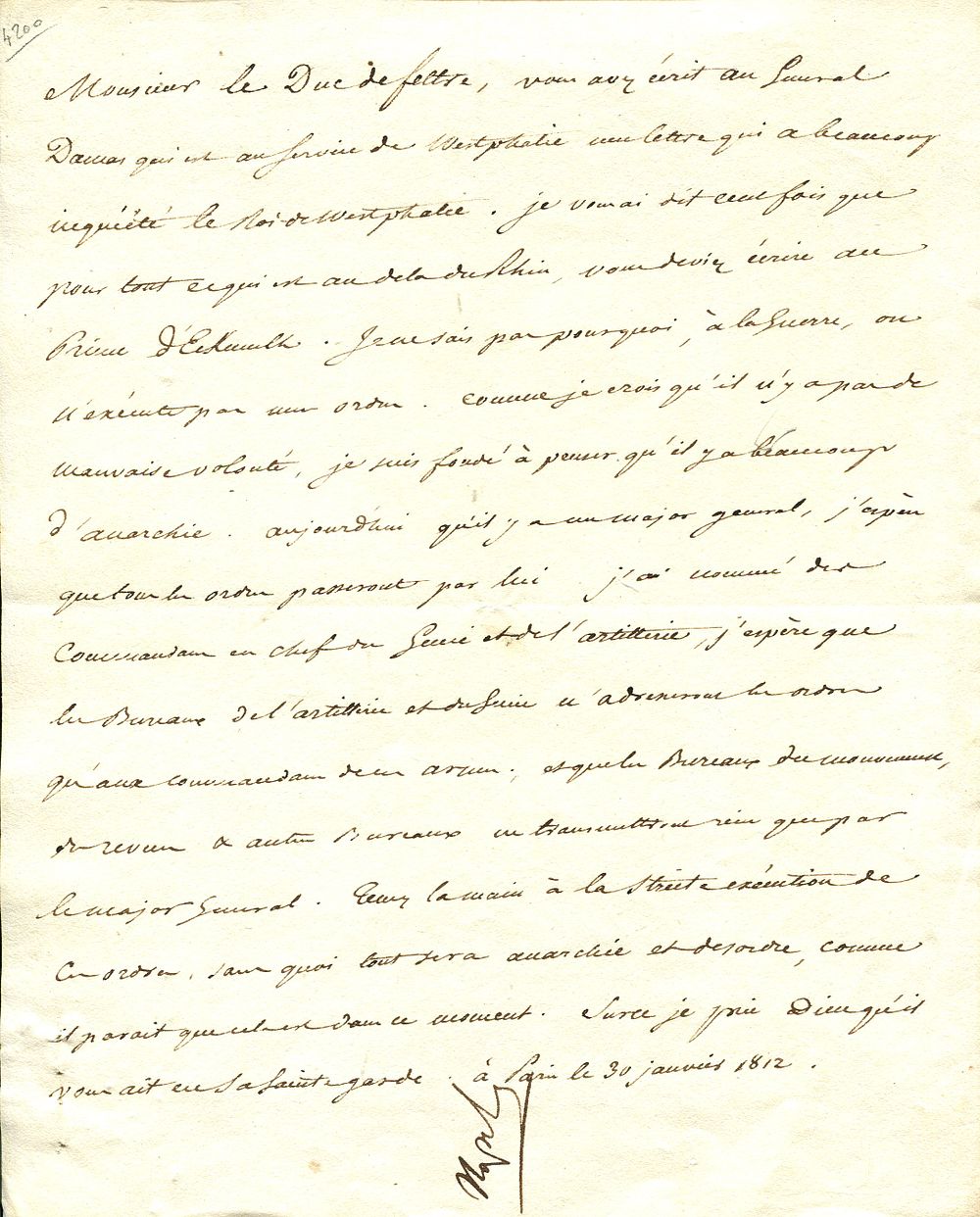
NAPOLEON I: (1769-1821) - NAPOLEON I: (1769-1821) Emperor of France 1804-14, 1815. An excellent content L.S., ` Napol´, signed at the base vertically, one page, gilt edges, 4to, Paris, 30th January 1812, to the Duc de Feltre, In French. Napoleon is furious because his orders have not been fulfilled as he expects and very angrily states in part ` Monsieur le Duc de feltre, vous avez écrit au Général Damas, qui est au service de Westphalie, une lettre qui a beaucoup inquiété le roi de Westphalie. Je vous ai dit cent fois que, pour tout ce qui est au-delà du Rhin, vous deviez écrire au Prince d´Eckmuhl. Je ne sais pas pouquoi, à la Guerre, on n´exécute pas mes ordres.´ (Translation: ” Monsieur the Duke of Feltre, you wrote to General Damas, who is in the service of Westphalia, a letter that greatly worried the King of Westphalia. I have told you a hundred times that, for everything beyond the Rhine, you should write to the Prince of Eckmuhl. I do not know why, at War, my orders are not carried out.”) Napoleon is planning the Russian campaign and wants as usual to have everything under control. After almost shouting on the Duc de Feltre saying ” I have told you a hundred times...”, Napoleon seems to accept that it was an involuntary mistake, although complains bitterly for the lack of order, saying ` Comme je crois qu´il n´y a pas de mauvaise volonté, je suis fondé à penser qu´il y a beaucoup d´anarchie. Aujourd´hui qu´il y a un major-général, j´espère que tous les ordres passeront par lui...´ (Translation: ” Since I believe there is no ill will, I am justified in thinking that there is a great deal of anarchy. Now that there is a Major-General, I hope that all orders will go through him....”) Napoleon further refers to the important appointments he has ordered, including Chief Commandants of engineers and artilery, commenting again that he expects that their commandments will only forward information through the new Major General. Before concluding, the Emperor refers again to the disorder and anarchy he is feeling, stating ` Tenez la main à la stricte exécution de ces ordres, sans quoi tout sera anarchie et désordre, comme il parait que cela est dans ce moment.´ (Translation: ” Keep a hand in the strict execution of these orders, otherwise all will be anarchy and disorder, as it seems to be at this moment.”) Accompanied by the original small 12mo holograph receipt. Very small trace of the receipt staple trace to the lower left corner. Extremely small minor creases to borders. otherwise VG Henri Jacques Guillaume Clarke (1765-1818) Duc de Feltre and Minister of War under Napoleon. Later Marshal of France in 1816, one of six created under King Louis XVIII from 1815-24 François-Etienne Damas (1764-1828) French General who joined the National Guard on 14th July 1789. He was appointed Chief of Head Quarters under Kleber and was noted for his conduct at the assault on Alexandria and during the French invasion of Egypt. Damas, appointed General, commanded troops in Egypt after Kleber´s death. On his return from Egypt, Damas was disgraced by Napoleon. Marshal Murat, as Grand Duke of Berg, would later appoint him as his Secretary of State and military Commander. Damas fought in the French invasion of Russia, distinguishing himself at the battle of Berezina. The restored King Louis XVIII appointed him Commander of the Garde Royale of Paris. Jerome Bonaparte (1784-1860) Prince of Montfort and King of Westphalia 1807-13, the youngest brother of Napoleon I. Louis Nicolas Davout (1770-1823) Marshal of France, Duc d´Auerstaedt and Prince of Eckmuhl. Known as the Iron Marshal, Davout was the only Napoleonic Marshal not to have been defeated in battle by 1815. Louis-Alexandre Berthier (1753-1815) French Marshal of the Empire who served during the French Revolutionary Wars and the Napoleonic Wars and who was chief of staff to Napoleon Bonaparte. He is the Major-General that Napoleon refers to in the present letter.