Bidspirit auction | LAFARGUE PAUL: (1842-1911) (x2)
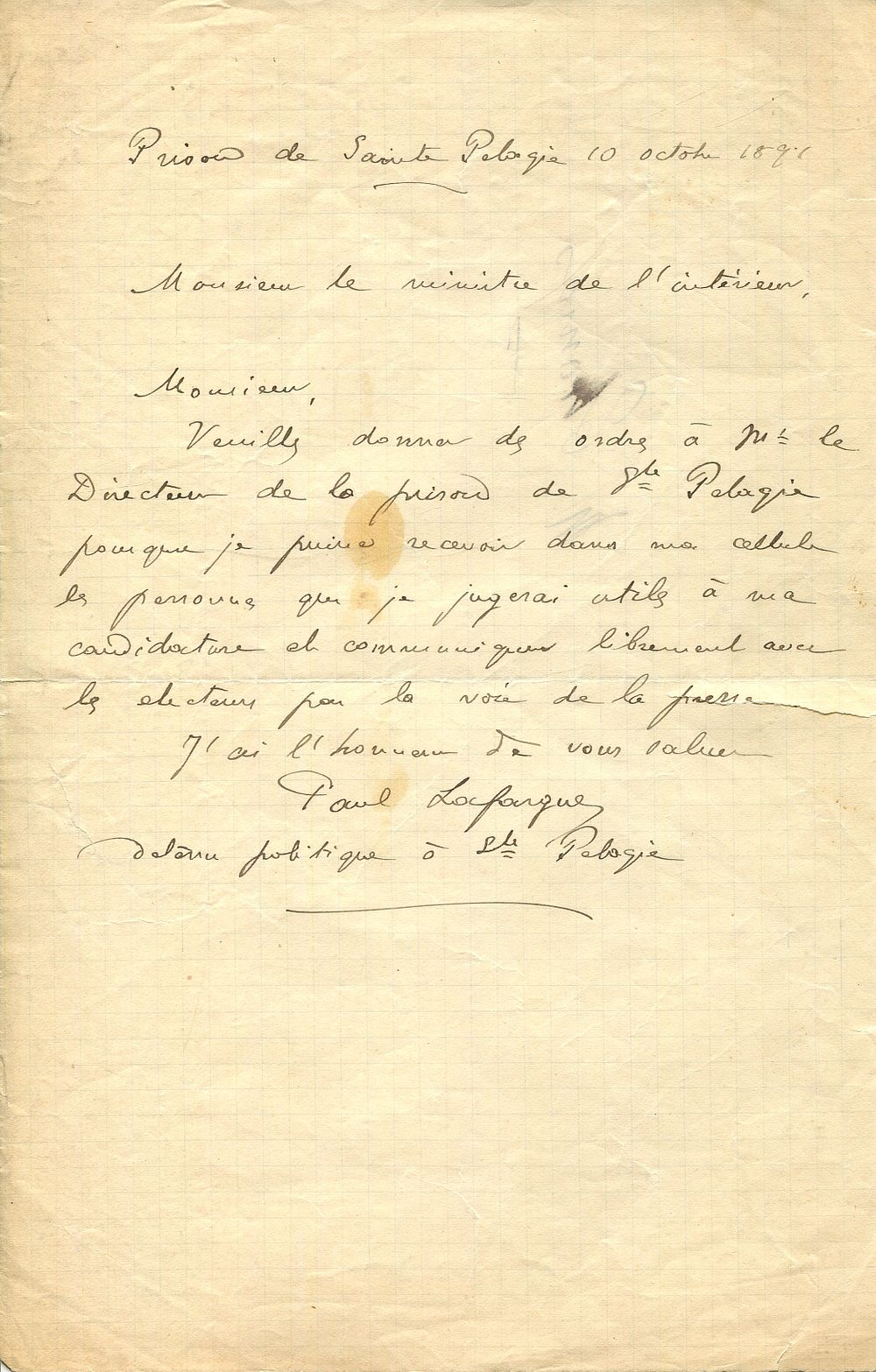
LAFARGUE PAUL: (1842-1911) (x2) - LAFARGUE PAUL: (1842-1911) Cuban-born French revolutionary Marxist socialist, political writer, economist and literary critic, the son-in-law of Karl Marx. A.L.S., Paul Lafargue , one page, 8vo, Prison de Sainte-Pélagie (Paris), 10th October 1891, to the Minister of the Interior, in French. Lafargue makes a request of his correspondent, ´Veuillez donner des ordres à M. le Directeur de la prison Ste Pélagie pour que je puisse recevoir dans ma cellule les personnes que je jugerais utiles à ma candidature et communiquer librement avec les électeurs par la voie de la presse´ (Translation: ´Please give orders to the Director of Sainte-Pélagie Prison so that I may receive in my cell those persons whom I deem useful to my candidacy and communicate freely with voters through the press´ ). Beneath his signature Lafargue has added the words ´détenu politique à Ste Pélagie´ (Translation: ´political prisoner at Sainte-Pélagie´ ). Together with a second A.L.S., Paul Lafargue , one page, 8vo, Prison de Sainte-Pélagie (Paris), 10th October 1891, to the director of the Agence Libre , in French. Lafargue asks ´Veuillez communiquer aux journaux la lettre ci-jointe que j'adresse au Ministre de l'Intérieur´ (Translation: ´Please communicate to the newspapers the attached letter that I am sending to the Minister of the Interior´ ). A rare pair of letters. A couple of very minor, light stains and a neat tear to the right edge of the first letter, only very slightly affecting the text and signature, and the second letter with just some light age wear. G to VG, 2 Lafargue was imprisoned in 1883 at Sainte-Pélagie prison for revolutionary propaganda, where he republished his famous book The Right to Be Lazy. After the tragedy of Fourmies (1st May 1891), where troops fired on workers, Lafargue was again convicted of incitement to murder. To capitalise on the impact of the Fourmies affair and secure the release of the prisoner from Sainte-Pélagie, the French Workers' Party nominated Lafargue as a candidate and, through the voices of Guesde, Delory, Ghesquière, Duc-Ǫuercy and Ferroul, led a passionate campaign. On 8th November 1891, despite being in police custody, Lafargue was elected to the French Parliament for Lille in a by-election, becoming the first-ever French Socialist to occupy such an office.