Bidspirit auction | [BEETHOVEN LUDWIG VAN]: (1770-1827) LYSER
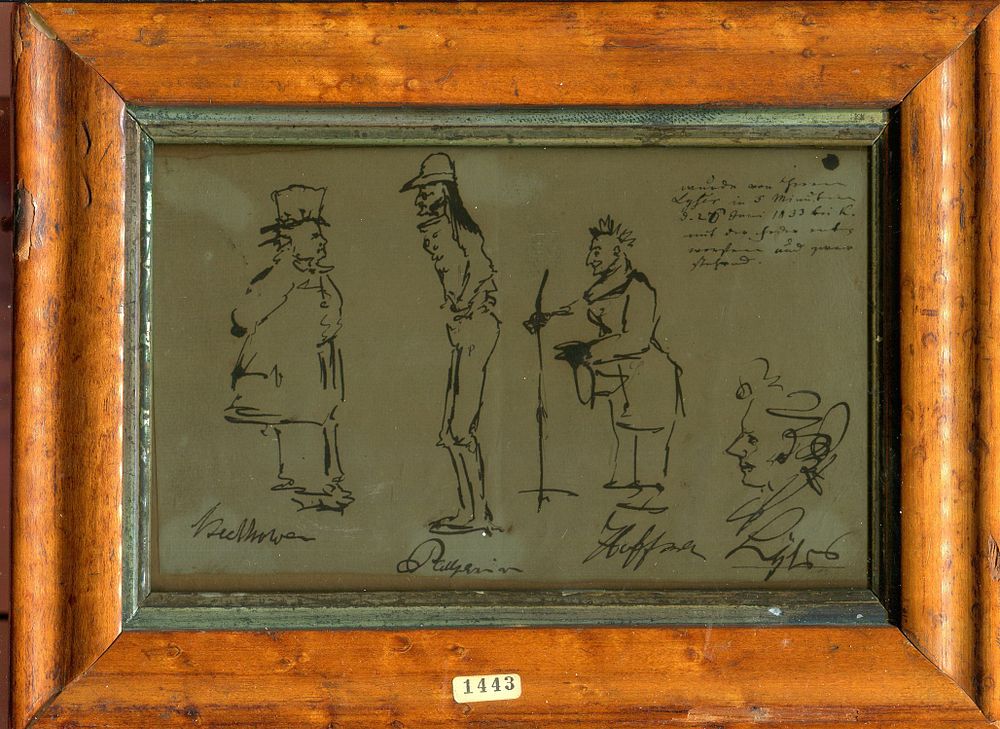
[BEETHOVEN LUDWIG VAN]: (1770-1827) LYSER JOHANN PETER: (1803-1870) - [BEETHOVEN LUDWIG VAN]: (1770-1827) German composer and pianist. LYSER JOHANN PETER: (1803-1870) German writer, painter, illustrator, and music critic of the Romantic era who created some of the most famous and widely reproduced portraits of Beethoven, including a distinct silhouette of the composer walking the streets of Vienna in a top hat and coat. An excellent, rare original set of pen and ink caricatures executed and signed by Lyser, one page, oblong 8vo (approximately 20.5 x 13.5 cm), n.p., 26th June 1833. The wonderful, boldly penned caricatures comprise (from left to right), Ludwig van Beethoven , shown standing in a full-length profile pose, highly reminiscent of some of Lyser´s most celebrated images of the composer, dressed in his signature long coat and crumpled top hat, standing with his hands clasped behind his back, facing the Italian violinist and composer Niccolò Paganini (1782-1840) who is depicted as a tall, lanky figure, wearing a hat and breeches, with his back turned to Lyser´s ultimate literary hero and major creative inspiration, the German romantic author, composer, music critic and artist E. T. A. Hoffmann (1776-1822) who is also seen standing in a full-length profile pose, with the face of a mischievous imp, holding a cane in one oustretched arm and a hat in the other. The final image is a self-caricature by Lyser in the lower right corner, depicting his head only, as he looks upwards in admiration and awe of his musical and literary idols. Signed ( ´Lyser´ ) by the nomadic bohemian beneath his image, and also adding the names of Beethoven, Paganini and Hoffmann beneath each of their studies. Annotated in German in an unidentified hand to the upper right corner, ´ wurde von Herrn Lyser in 5 Minuten d. 26 Juni 1833 bei K. mit der Feder entworfen und zwar stehend´ (Translation: ´ Drawn by Mr Lyser in 5 minutes on 26 June 1833 at K.'s, using a pen whilst standing´ ). Neatly laid down and with a few small areas of discolouration, consistent with age. Framed and glazed in the original wooden frame to an overall size of 11.5 x 9 (a small exhibition label, numbered 1443, is affixed to the lower part of the frame). Together with an original 3.5 x 5 (approximately 9 x 12.5 cm) engraving of Beethoven by Lyser, the lithograph being the famous image (after Lyser´s own drawing, Hamburg, 1833) depicting the composer as a stocky man, frowning, with his hands clasped behind his back, wearing a top hat and overcoat as he takes a walk through the streets of Vienna, a lady and gentleman visible in the background, engaged in conversation. Framed and glazed in the original gilt frame to an overall size of 6 x 7.5 (a small exhibition label, numbered 1456, is affixed to the lower part of the glazing, and to the back of the frame appears a stamp indicating that the engraving was previously part of the musical collection of André Meyer, deceased in May 1974, and then passed to F. Meyer, October 1984). A truly magnificent and remarkable series of caricatures by Lyser. G, 2 Provenance: Acquired by our vendor at a Sotheby´s auction and with their labels (Lot 375) still attached to the versos of the frames. Despite facing profound personal challenges, including losing his hearing (akin to Beethoven) around the age of 18, Lyser became a notable figure in 19th-century German cultural circles. He worked closely with Robert Schumann as a music critic for Schumann's famous publication, the Neue Zeitschrift für Musik ( New Journal for Music ) and also served as the editor and illustrator for Abendländische Tausend und eine Nacht (1838–39), a multi-volume collection of Western fairy tales, legends, and ghost stories that included adaptations of the Brothers Grimm. Decades later, his unique illustration style in this work was highly praised by cultural critic Walter Benjamin. Lyser frequently bounced between jobs as a stage painter, actor, and drawing teacher, and because of his unstable career path and inability to perform music, he frequently fell into severe financial debt. At one point, Lyser was even thrown into a debtors' prison until his close friend, composer Felix Mendelssohn, paid his debts to secure his release. Tragically, despite his immense talent and famous friendships, Lyser died in poverty at an almshouse in Altona (Hamburg) in 1870.