Bidspirit auction | LYAPUNOV SERGEI: (1859-1924)
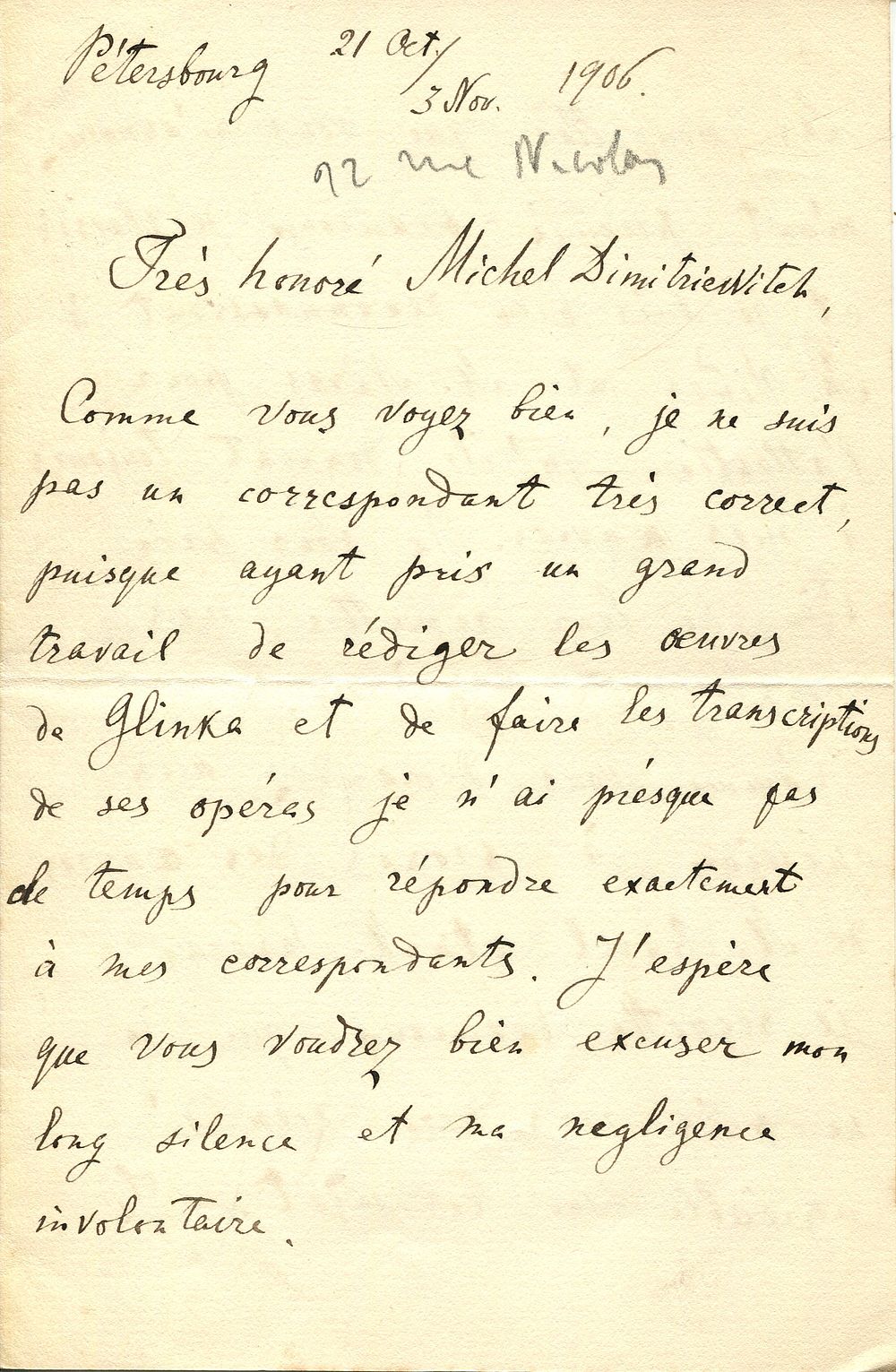
LYAPUNOV SERGEI: (1859-1924) - LYAPUNOV SERGEI: (1859-1924) Russian composer, pianist and conductor. An interesting, lengthy ALS, S. Liapounov , eight pages, 8vo, Saint Petersburg, 21st October/3rd November 1906, to Michel Dimitriewitch, in French. The composer asks to be excused for his long silence, explaining 'since having undertaken the major task of editing Glinka's works and transcribing his operas, I have almost no time to reply properly to my correspondents ' and continues ' As you ask for my opinion about the works of Mr. Ravel and Mr. Séverac, I regret that I cannot tell you anything agreeable on this subject.' I find that these authors have chosen the wrong path, from whatever angle one analyzes their works. (Translation: 'As you have asked for my opinion regarding the works of Mr. Ravel and Mr. Séverac, I regret that I cannot say anything favorable on this subject. I find that these composers have chosen the wrong path, whichever angle from which one analyzes their works' ), further remarking, 'Firstly, being a proponent of program music, I nevertheless think that there are limits that cannot be crossed without negating music itself. It seems that by following the details of the programs, these authors forget the main point—that all these details give a certain character to the subject of the composition, but do not replace it. Then, as far as harmonic style is concerned, I don't even believe that one can properly explain all these errors and horrors from your point of view.' The overtones you mention are always audible, even on the piano, if one listens for them, but they are very faint while the fundamental tone always dominates. The false notes found almost everywhere in the works of Mr. Ravel and Mr. Séverac will never replace these overtones, and I think it's a misguided idea to try to fit them into the harmony . ´Firstly, whilst being a supporter of program music, I nevertheless believe there are limits that cannot be crossed without negating the very essence of music. It seems that, by focusing on the details of the programs, these composers overlook the main point – namely, that whilst all these details lend a certain character to the subject of the composition, they do not replace it. Furthermore, as regards harmonic style, I do not even believe that one can properly explain all these errors and horrors from your point of view. The harmonic tones (overtones) of which you speak are always audible, even on the piano, if one wishes to listen for them, but they are very faint whilst the fundamental tone always dominates. The wrong notes found almost everywhere in the works of Mr Ravel and Mr Séverac will never replace these overtones, and I think it is a misconception to try to fit them into the harmony´ ) and also adding ´Quant aux quintes Défensees etc. In particular, they are found even in the works of the great masters, but there they are always well-motivated, whereas here they merely mar the harmony. Lyapunov further writes , “You tell me that you have not yet found a single Slav who likes these works. I would like to ask you, do the great French masters like Mr. Saint-Saëns or Mr. Bourgault-Ducoudray like these works and find this style worthy of imitation? Are they not of our opinion, that is to say, of Mr. Balakirew and myself? As an ardent admirer of Mussorgsky, I never forgive him for extravagances and uncleanness of harmony.” But beyond that there is music in his works!´ (Translation: ´You tell me that you have not yet found a single Slav who likes these works. I would venture to ask you, do the great French masters such as Mr Saint-Saëns or Mr Bourgault-Ducoudray like these works and find this style worthy of imitation? Are they not of our opinion, that is to say, of Mr Balakirev's and mine? As an ardent admirer of Mussorgsky, I can never forgive him for the extravagances and sloppiness of his harmony. But apart from that, there is music in his works!´ ) before concluding ´I fear that I am causing you great annoyance with this long and harsh criticism . long and harsh criticism; it grieves me enough, but I feel I must speak my mind frankly, if asked´ ). A letter of excellent content. VG Mikhail Glinka (1804-1857) Russian composer who is widely regarded as the fountainhead of Russian classical music. Glinka strongly influenced future Russian composers, notably the members of The Five. Maurice Ravel (1875-1937) French composer, pianist and conductor who liked to experiment with musical form developing a style of great clarity and incorporating elements of modernism, baroque, neoclassicism and, in later works, jazz. Déodat de Séverac (1872-1921) French composer. Camille Saint-Saens (1835-1921) French composer, organist, conductor and pianist of the Romantic era. Louis-Albert Bourgault-Ducoudray (1840-1910) French Breton composer, pianist, and professor of music history/theory.