Bidspirit auction | CEZANNE PAUL: (1839-1906)
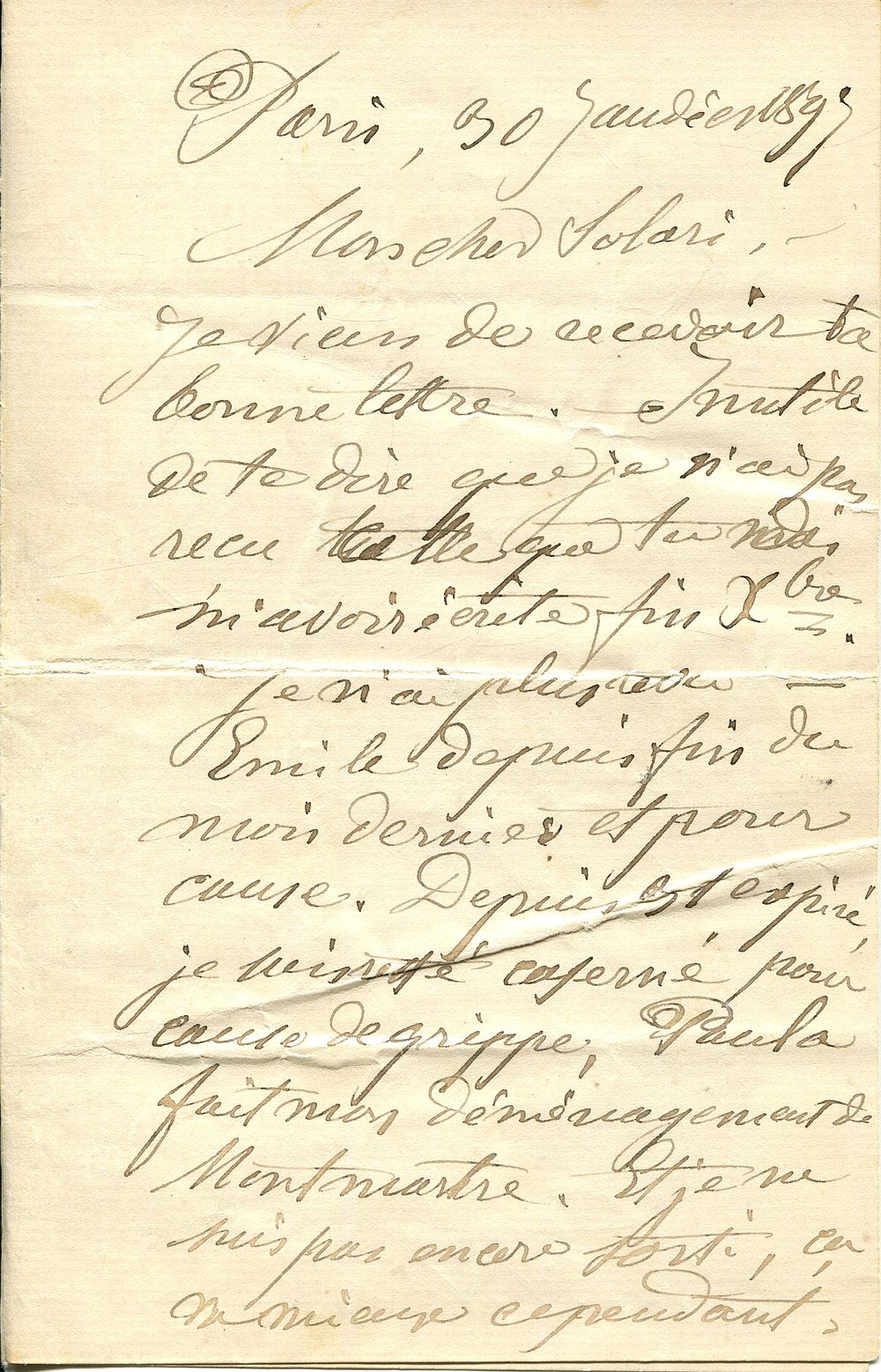
CEZANNE PAUL: (1839-1906) - CEZANNE PAUL: (1839-1906) French Post-Impressionist painter. A good A.L.S., Paul Cezanne , four pages, 8vo, Paris, 30th January 1897, to Philippe Solari, in French. Cezanne states that he has just received Solari´s lovely letter, although didn´t receive one that Solari wrote to him at the end of December, further referring to Solari´s son, Emile, and informing his friend ´Je n´ai plus revu Émile depuis fin du mois dernier et pour cause. Depuis 31 expiré, je suis resté caserné pour cause de grippe, Paul a fait mon déménagement de Montmartre. Et je ne suis pas encore sorti, ça va mieux cependant. Dès que je vais pouvoir, j´écrirai un mot à Émile pour rendez-vous´ (Translation: ´I haven’t seen Émile since the end of last month, and for good reason. Since the 31st, I’ve been confined to my quarters with the flu; Paul sorted out my move from Montmartre. I haven’t been out yet, though I’m feeling better now. As soon as I can, I’ll write a note to Émile to arrange a meeting´ ). Cezanne continues to write concerning another friend, Joachim Gasquet, ´Maintenant venons à Gasquet. Sa demande me touche profondément, et fais-lui part du souhait que je fais, de faire agréer les deux toiles en question à Monsieur Dumesnil. A cette fin je te prierai de t´adjoindre à Gasquet et d´aller chez ma soeur, 8, rue de la Monnaie et la prier de vous conduire au Jas, où se trouvent les susdites toiles. Je vais écrire à ma soeure relativement à ce sujet. Sauf un peu de marasme inhérent à la situation, ça ne va pas plus mal, mais si j´avais su organiser ma vie pour vivre là-bas, ça m´aurait mieux convenu. Mais famille oblige à pas mal de concessions´ (Translation: ´Now, on to Gasquet. His request touches me deeply, and please convey to him my wish that the two paintings in question be approved by Monsieur Dumesnil. To this end, I would ask you to join forces with Gasquet and go to my sister’s, 8 Rue de la Monnaie, and ask her to take you to the Jas, where the aforementioned paintings are located. I shall write to my sister regarding this matter. Apart from a bit of the gloom inherent in the situation, things are not going any worse, but if I had known how to organise my life to live there, it would have suited me better. But family obligations require quite a few concessions´ ). The artist concludes his letter by sending his warmest regards, asking for his greetings to be conveyed to his friends around Solari, and in a postscript adds ´Tu trouvers ma soeur chez elle, ou vers 11 heures du matin, heure de son déjeuner; ou vers 6 heures du soir, heure du dîner´ (Translation: ´You’ll find my sister at home, either around 11 o’clock in the morning, when she has breakfast; or around 6 o’clock in the evening, when she has dinner´ ). A letter of good associations and content. A couple of heavy creases and a few minor stains, G Philippe Solari (1840-1906) French sculptor. Like Cézanne, Solari was a native of Aix-en-Provence, and the two men, contemporaries and close friends from an early age, remained deeply attached throughout their lives. Solari belonged to Cézanne’s innermost circle, and shortly before his death executed two sculpted busts of the painter. Emile Solari (1873-1961) French novelist and poet, the son of Philippe Solari. Joachim Gasquet (1873-1921) French author, poet, and art critic, best known for his writing about the artists of his era, particularly Cezanne, a friend and business partner. The present letter was written during a period of transition and physical fragility for Cézanne. Recently moved from Montmartre to the Rue Saint-Lazare — a relocation arranged by his son, Paul — the artist explains that he has been confined indoors with influenza since the end of December. Despite his illness, the letter reveals Cézanne actively overseeing the disposition of two important paintings intended for the philosopher Georges Dumesnil. The intermediary in this exchange was Gasquet, whom Cézanne held in particularly high regard; it was Gasquet who introduced him to Dumesnil, to whom the painter wished to offer two landscapes : Rocks at L’Estaque and The Bibémus Quarry . In the letter, Cézanne writes with evident sincerity and then instructs Solari and Gasquet to collect the works from the Jas de Bouffan, the Cézanne family estate near Aix, via his sister at Rue de la Monnaie. These paintings would later inspire Dumesnil’s short story The Humanity of Landscapes , published in La Nouvelle Revue on 15th November 1899.