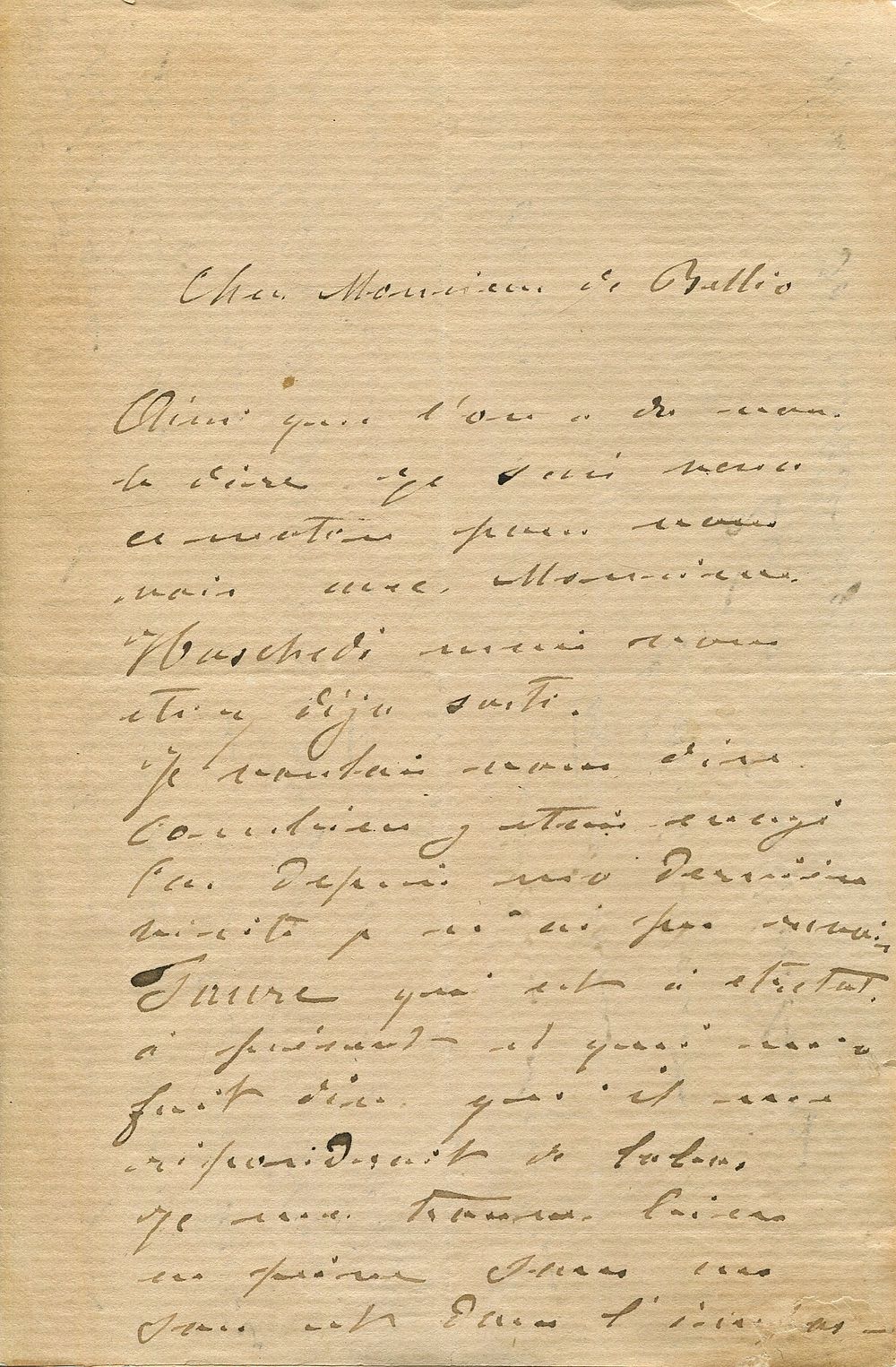
Bidspirit auction | MONET CLAUDE: (1840-1926) Monet seeks
MONET CLAUDE: (1840-1926) Monet seeks a loan days before settling at Vétheuil ´ where the best things I do......will be for you´ - MONET CLAUDE: (1840-1926) French Impressionist painter. A fine, early A.L.S., Claude Monet , three pages, 8vo, Rue d´Édimbourg (Paris), 30th July 1878, to [Georges] de Bellio, in French. Monet states that, as his correspondent is no doubt aware, he had called on de Bellio that morning in the company of [Ernest] Hoschedé, however they had not found him at home, remarking ´Je voulais vous dire combien j´étais ennuyé car depuis ma derniere visite je n´ai pu revoir [Jean-Baptiste] Faure qui est à Etretat à présent et qui m´a fait dire qu´il me répondrait de la bas´ (Translation: ´I wanted to tell you how disappointed I was, for since my last visit I have not been able to see Faure again; he is in Etretat at the moment and has asked me to tell you that he will write to me from there´ ), and further seeking de Bellio´s financial assistance, ´Je me trouve bien en peine sans un sous et dans l´imposibilité de partir à la campagne si vous ne me venez pas un peu en aide. Je connais trop votre obligeance pour savoir que si vous l´aviez pu l´autre jour, vous auriez accepté pourtant de suite l´arrangement en question, mais j´espère que vous voudrez bien faire un effort en ma faveur en m´avançant 150 ou 200 fr pour ce mois ne serait ce même que 100 fr, cela m´obligerait infiniment. Car nous sommes prêts à partir et si je n´ai de suite un peu d´argent je perds l´occasion d´aller dans un pays délicieux où les meilleures choses que j´y ferais seront pour vous´ (Translation: ´I find myself in a tight spot, penniless and unable to go to the countryside unless you can lend me a little help. I know you well enough to realise that, had you been able to the other day, you would have agreed to the arrangement in question straight away; but I hope you will be kind enough to make an effort on my behalf by advancing me 150 or 200 francs for this month—even if it were only 100 francs, I would be infinitely grateful. For we are ready to leave, and if I do not have a little money straight away, I shall miss the opportunity to go to a delightful country where the best things I do there will be for you´ ). In concluding Monet states that he shall send for a reply at de Bellio´s home tomorrow morning, in case he cannot come himself. A letter of excellent content and good association. Some light age wear and with a few very small tears to the edges, about VG Georges de Bellio (1826-1894) Romanian doctor, a friend and patron of the Impressionist painters including Monet, Pierre-Auguste Renoir, and Alfred Sisley. De Bellio offered the artists medical advice gratis or at reduced cost and frequently purchased paintings when they needed money, sometimes paying in advance for works that were not yet finished. De Bellio bought the iconic 1874 Monet painting that gave its name to the Impressionist movement: Impression, Soleil Levant (Impression, Sunrise). De Bellio´s art collection today forms the core of the Musée Marmottan Monet´s collection in Paris, having been donated by the doctor´s daughter in 1940. Ernest Hoschedé (1837-1891) French businessman, art collector and critic, the first husband of Alice Hoschedé (who would later become Monet´s second wife). Jean-Baptiste Faure (1830-1914) French baritone and art collector. An enthusiastic and avid collector of Impressionist art, Faure´s collection included works by Monet, Edouard Manet, Edgar Degas, Alfred Sisley, and Camille Pissarro. Monet´s letter was written shortly after the Exposition Universelle of 1878, an occasion which inspired Monet to produce two famous paintings, which would be the last he ever made in Paris. As the artist´s biographer, Daniel Wildenstein, observed of this time in Monet´s life ´The approach of the Exposition Universelle of 1878 discouraged the Impressionists from organising their own exhibition. Opened with great ceremony on 1 May by General Mac-Mahon, the President of France, the Exposition attracted vast crowds to the Champ de Mars and the Trocadéro Palace, which had been specially constructed for this purpose. The Salon at the Palais de l´Industrie was eclipsed; its opening was postponed from 15 to 26 May......Théodore Duret published Les Peintres Impressionistes (The Impressionist Painters), a booklet intended to aid his friends´ cause.....and proclaimed Monet as ”the Impressionist par excellence”......meanwhile [Monet] was close to going under. Unable to exhibit, he was forced to invite potential clients to visit, but when in their company was embarrassed to make his needs known to them, preferring to do so by letter. This required a campaign of letter-writing, conducted on rainy days or after the light had gone. After his excursions to la Grande Jatte, he remembered that he had, in the past, painted in the Parc Monceau, and went back to working there; it was a mere ten minutes from his flat.