Bidspirit auction | MONET CLAUDE: (1840-1926) ´ I
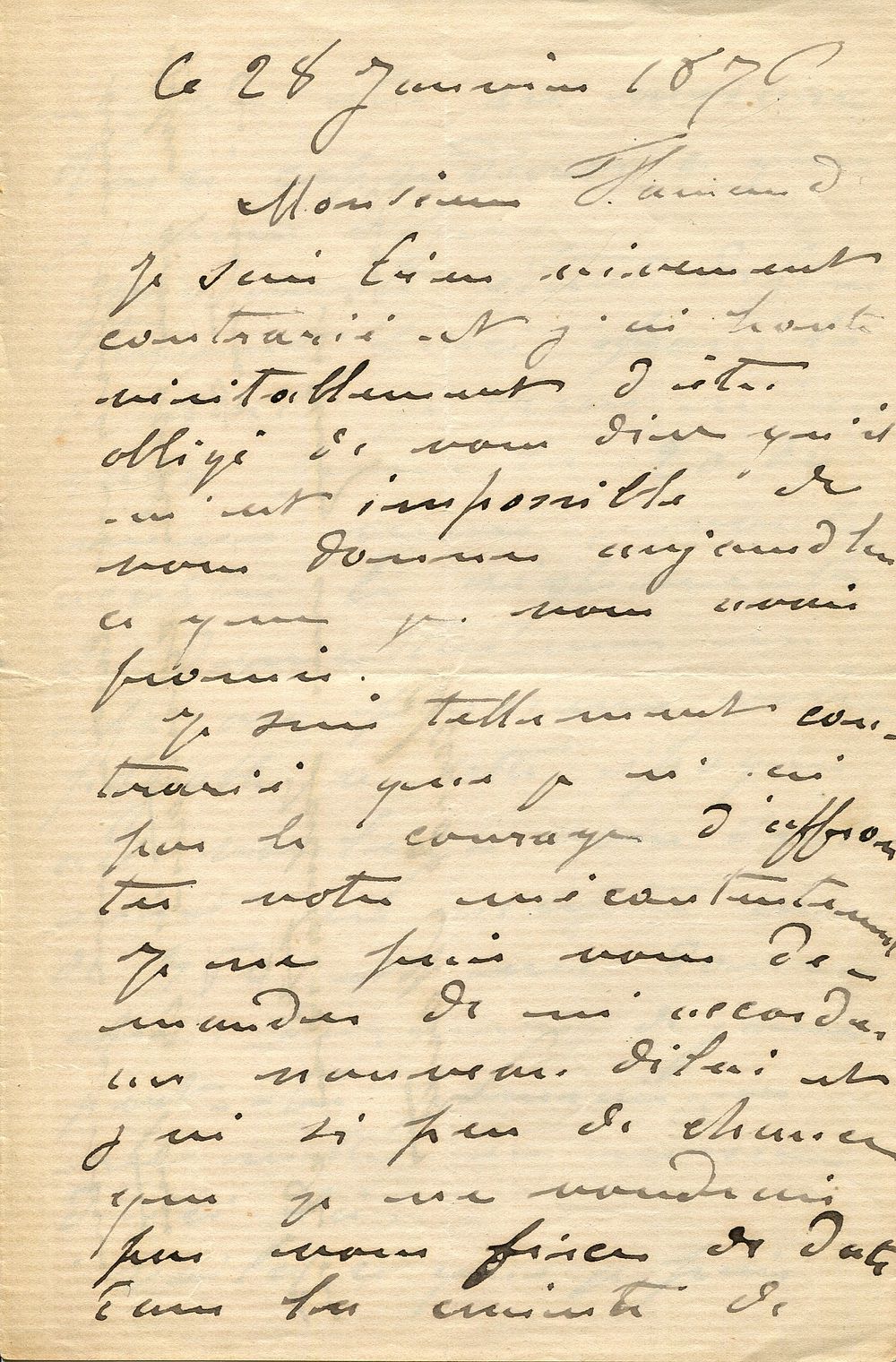
MONET CLAUDE: (1840-1926) ´ I am deeply distressed and, inevitably, ashamed.....´ - MONET CLAUDE: (1840-1926) French Impressionist painter. An early A.L.S., Claude Monet , three pages, 8vo, n.p., 28th January 1876, to Monsieur [Alexandre-Adonis] Flament, in French. Monet writes an anguished letter to his landlord, declaring ´Je suis bien vivement contrarié et j’ai honte inévitablement d’être obligé de vous dire qu’il m’est impossible de vous donner aujourd’hui ce que je vous avais promis. Je suis tellement contrarié que je n’ai pas le courage d’affronter votre mécontentement. Je ne puis vous demander de m’accorder un nouveau délai et j’ai si peu de chance que je ne voudrais pas vous fixer de date dans la minute de ne pas être en mesure´ (Translation: ´ I am deeply distressed and, inevitably, ashamed to have to tell you that I am unable to deliver what I promised you today. I am so upset that I do not have the courage to face your displeasure. I cannot ask you to grant me a further extension, and I am in such a difficult position that I would not wish to set a date only to be unable to meet it´ ). The artist continues to bargain with Flament, ´Voici cependant ce que je vous offre. Ma rente étant définitivement fixée pour le 11 avril je puis m’engager pour le 20 du même mois voulez accepter le règlement de deux termes en une ou plusieurs valeurs payable à cette époque ou voulez-vous seulement un acompte mens de 350 et me donnerai dizaine de jours. Peut-être pourrais je me mettre en mesure d’ici là´ (Translation: ´Here, however, is what I can offer you. As my annuity is definitively set for 11th April, I can commit to the 20th of the same month: would you accept payment in two instalments, in one or more sums, payable at that time, or would you prefer just a monthly advance of 350 and give me ten days? Perhaps I might be able to sort things out by then´ ) and concludes by remarking ´Voilà ce que je puis vous offrir et croyez que je suis plus que vous contrarié de tous ces instant´ (Translation: ´That is what I can offer you, and believe me, I am even more upset than you are by all this´ ). VG Alexandre-Adonis Flament, a carpenter, had agreed to rent Monet a bungalow in Argenteuil from 1st October 1874 at a cost of 1,400 francs per annum. Despite this representing an increase in his domestic expenses, Monet moved to Argenteuil mainly because it offered a balance of affordability, easy access to Paris, and rich visual material—especially the Seine, modern leisure scenes, and changing light that suited his Impressionist experiments. By 1876, it had become both his home and an artistic laboratory, where he painted his surroundings repeatedly to study atmosphere and colour. The house he rented, built in 1871, was a modest suburban villa in a Swiss chalet style, with decorative woodwork, balconies, and distinctive green shutters. Monet developed its garden himself, filling it with flowers like hollyhocks and using it as a central subject in his paintings, often including his wife Camille and their son. Argenteuil was both a creative breakthrough and, as demontsrated by the present letter, a period of acute financial anxiety, with the rented house itself becoming a place where artistic innovation and personal insecurity coexisted very closely.