Bidspirit auction | MONET CLAUDE: (1840-1926) ´ I
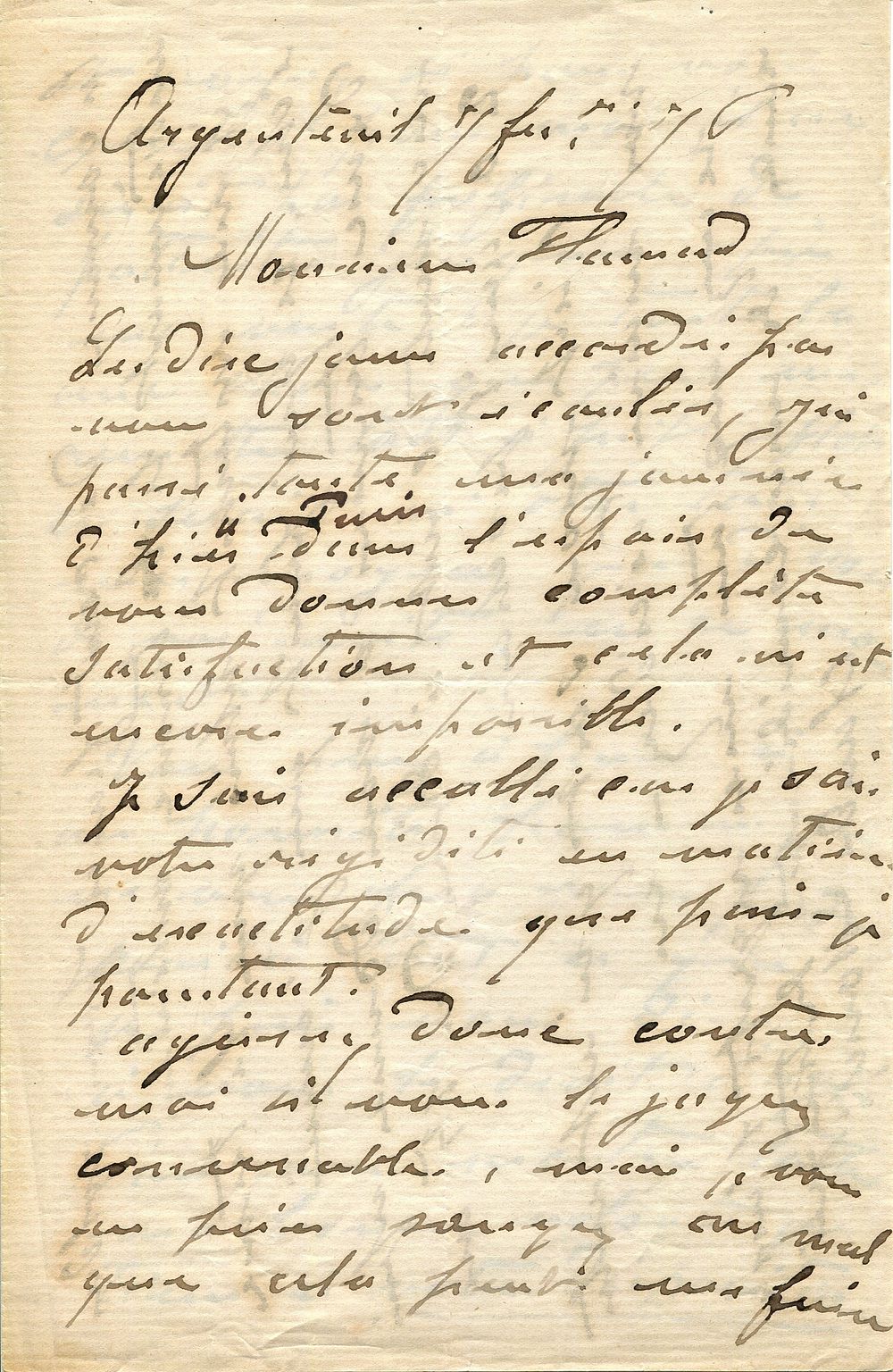
MONET CLAUDE: (1840-1926) ´ I am attempting something that could put me back on my feet entirely´ - MONET CLAUDE: (1840-1926) French Impressionist painter. An early A.L.S., Claude Monet , three pages, 8vo, Argenteuil, 7th February 1876, to Monsieur [Alexandre-Adonis] Flament, in French. Monet, experiencing finacial difficulties, writes to make an earnest, emotional request of his landlord, commencing his letter by stating ´Les dix jours accordés par vous sont écoulés, j’ai passé toute ma journée d’hier à Paris dans l’espoir de vous donner complète satisfaction et cela m’est encore impossible. Je suis accablé car je sais votre rigidité en matière d’exactitude qu’y puis-je pourtant? (Translation: ´The ten days you granted have now passed. I spent the whole of yesterday in Paris in the hope of fully satisfying you, but I am still unable to do so. I am at my wits’ end, for I know how strict you are when it comes to punctuality; yet what can I do?´ ) and continuing ´Agissez donc contre moi si vous le jugez convenable, mais je vous en prie songez au mal que cela peut me faire et voyez si pour vous comme pour moi il ne serait pas profitable de patienter jusqu’après ma vente. Je tente la une chose qui peut me remettre tout à fait à flot, ce serait m’ôter tous mes moyens que d’user de vos droits en ce moment´ (Translation: ´Do take action against me if you see fit, but I beg you to consider the harm this may cause me and to consider whether it might not be beneficial for both you and me to wait until after my sale. I am attempting something that could put me back on my feet entirely; to exercise your rights at this moment would be to deprive me of all my means´ ) before concluding by remarking ´Vous avez affaire à un honnête homme qui ne vous fera rien perdre. Voilà tout ce que je puis vous dire, à vous le droit d’agir. Pour vous montrer toute ma bonne volonté, je tiens à votre disposition la somme de cent francs pour solder entièrement le terme antérieur. Il ne resterait alors que le terme échu, ce qui ferait que j’aurai deux termes à vous donner après ma vente, c’est-à-dire du 15 au 20 avril prochain. C’est mon sort qui est entre vos mains décidez-en´ (Translation: ´You are dealing with an honest man who will not cause you any loss. That is all I can tell you; the decision is yours. To show you the full extent of my goodwill, I am placing at your disposal the sum of one hundred francs to settle the previous instalment in full. That would leave only the overdue instalment, meaning I would have two instalments to pay you after my sale, that is to say from 15 to 20 April. My fate is in your hands; the decision is yours´ ). A fraught letter by the distressed Monet to his landlord concerning debts which would culminate in an early monumental masterpiece being pawned. Some very light, extremely minor age wear, VG Alexandre-Adonis Flament, a carpenter, had agreed to rent Monet a bungalow in Argenteuil from 1st October 1874 at a cost of 1,400 francs per annum. The Second Impressionist Exhibition took place at the Galerie Durand-Ruel in Paris in April 1876. Driven early on by the enthusiasm of Monet and Pierre-Auguste Renoir, it served as a crucial follow-up to their heavily criticised 1874 debut. Officially named La 2e Exposition de Peinture, Monet was a central figure of the 1876 exhibition, contributing a total of nineteen paintings including La Japonaise. This famous painting, depicting his wife, Camille, wearing a blonde wig and a heavily embroidered red kimono while holding a fan, was the sensation of the show and proved to be a commercial triumph, selling for the remarkably high sum of 2,000 francs. Monet´s other notable entries included La Seine à Argenteuil and Le Pont du Chemin de fer (Argenteuil). For the first few years of his tenancy at Argenteuil, Monet was actually enjoying a period of relative financial security. Backed by regular sales to his art dealer Paul Durand-Ruel, and an inheritance from his father, Monet lived quite comfortably. He paid his rent on time, employed a gardener and two servants, and spent heavily on cultivating the lush gardens that he loved to paint. However, by 1877 the French economy had taken a downturn and Monet was faced with mounting debts and additional expenses, largely caused by Camille´s poor health. Near-eviction happened too often (Flament had taken Monet to court in July 1876, before withdrawing his complaint) , and by the end of the year the landlord had again lost patience with his unreliable tenant. When Monet was forced to abandon Argenteuil in January 1878 to escape his creditors, his debt to Flament was so massive that he had to leave behind his early monumental masterpiece Le Déjeuner sur l’herbe (1865) as collateral. Monet was only able to settle his debt with Flament and recover his painting six years later. The canvas, poorly preserved in the landlord´s basement, had suffered from damp and sustained irreparable damage;