Bidspirit auction | MONET CLAUDE: (1840-1926) Monet writes
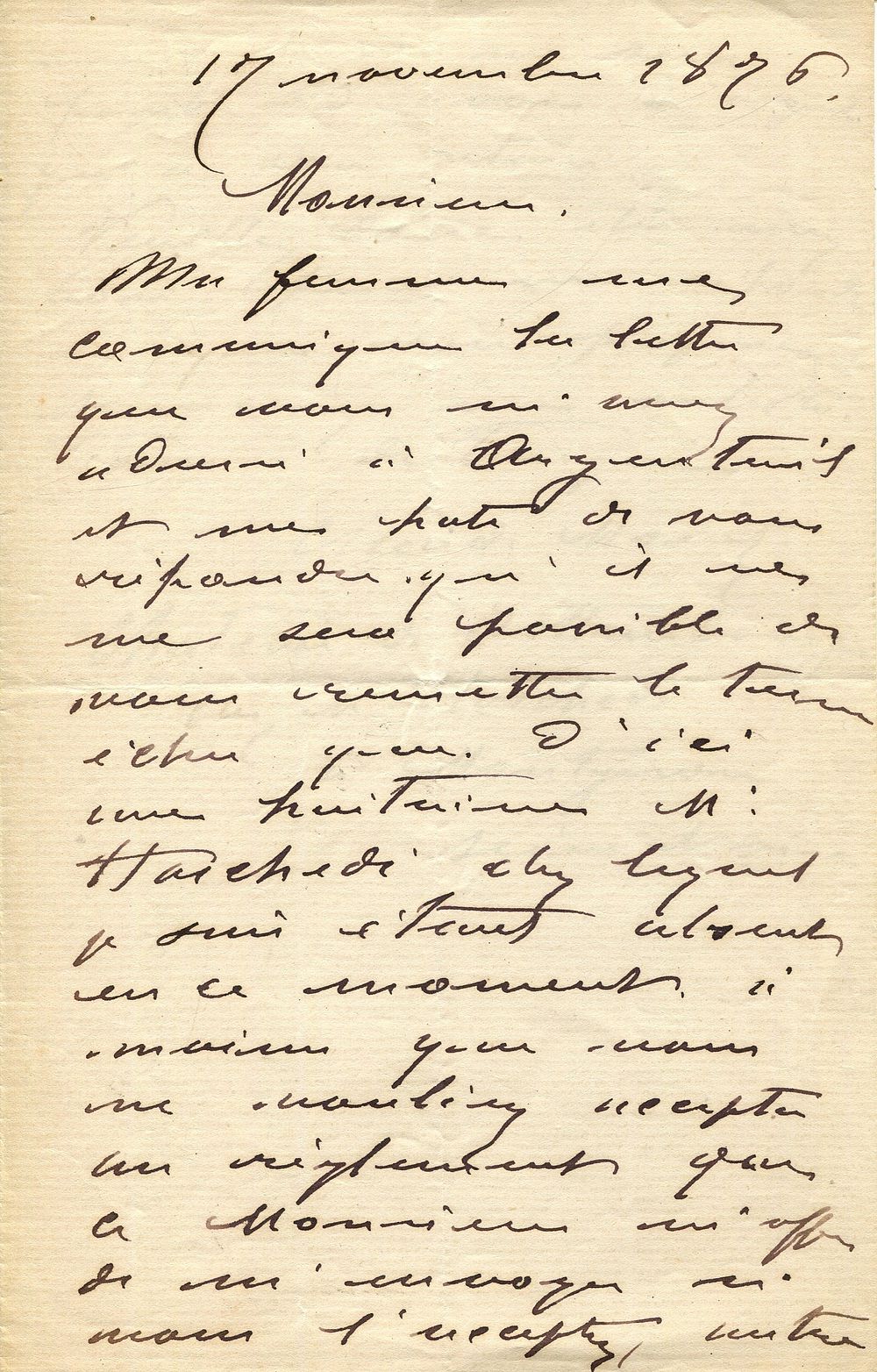
MONET CLAUDE: (1840-1926) Monet writes from the country estate of Ernest Hoschedé - MONET CLAUDE: (1840-1926) French Impressionist painter. An early A.L.S., Claude Monet , two pages (written to the first and third sides of the bifolium), 8vo, Château de Rottembourg, Montgeron, 17th November 1876, to [Alexandre-Adonis Flament] ( ´Monsieur´ ), in French. Monet writes to his landlord from the country estate of Ernest Hoschedé, explaining ´Ma femme me communique la lettre que vous m’avez adressée à Argenteuil´ (Translation: ´My wife has shown me the letter you sent me in Argenteuil´ ) and adding that ´me hate de vous répondre qu’il ne me sera possible de vous remettre le terme échu que d’ici une huitaine M. Hoschédé chez lequel je suis étant absent en ce moment´ (Translation: ´I am eager to reply that I will only be able to pay the overdue amount in about a week’s time, as Mr Hoschédé, with whom I am staying, is away at the moment´ ). Monet continues to make a propsal to Flament, ´ à moins que vous ne vouliez accepter un règlement que ce Monsieur m’offre de m’envoyer si vous l’acceptez, autrement il ne me sera possible d’avoir d’argent qu’à son retour. Veuillez donc être assez bon pour me répondre ce que vous préférez´ (Translation: ´Unless you would be willing to accept a settlement which this gentleman has offered to send me, should you agree to it; otherwise, I shall not be able to obtain the money until his return. I would therefore be grateful if you would let me know which option you prefer´ ). To the verso of the final page appear a series of pencil calculations, presumably in the hand of Flament and evidently relating to Monet´s rental payments. About EX Alexandre-Adonis Flament, a carpenter, had agreed to rent Monet a bungalow in Argenteuil from 1st October 1874 at a cost of 1,400 francs per annum. Ernest Hoschedé (1837-1891) French businessman, art collector and critic, the first husband of Alice Hoschedé (who would later marry Monet in 1892). The present letter is written at a highly significant time in both Monet´s personal life and career, details of which Jackie Wullschlager devotes a whole chapter to in her biography of the artist; ´Blanche Hoschedé, ten years old in August 1876, was keenly awaiting the new visitor to her family home, the Château de Rottembourg, ´I remember well his arrival at Montegron, my parents´house´, she wrote. ´He had been announced to me as a grand artiste with long hair. That impressed me and I was immediately drawn to him, for one could feel that he liked children. He was a great tease.´.....The children grew up in the company of artists, and their adorning parents were quick to commission their portraits.....Hoschedé, or rather his wife, born Alice Raingo, had acquired the Château de Rottembourg on the death of her father in January 1870. With indecent haste, the couple made it a pleasure palace. Amid the tensions of the impending Franco-Prussian War, they sent out invitations decorated, in deliberately infantile style, with flying geese and ducks waddling around their ornamental pond, asking guests ´to avoid the rush of the opening of the Salon and come to spend the day ´Ô plein air!´......Hoschedé spent the first half of 1876 buying and then selling paintings he could not afford. Ernest ´is thrilled, he´s made a sale of pictures and thinks he´s won everything´, his mother reported in February. ´I don´t understand him, is he mad?´ she concluded in June. Hoschedé was then forming a new company, Hoschedé-Tissier, Bourely et Cie, launched on 1 August 1876 with capital of 2.9 million francs. It survived less than a year, but reassured Alice. ´At last we´ve achieved the long-sought result. My poor dear husband has been able to reorganize his company as he wished. He´s so happy today: the deed has been signed and at last he can put his heart back into his work and into his home, ´ she wrote on 26 August. A few days later Monet arrived in Montegron. He loved it. Although Hoschedé had been known to charter a train to bring visitors to Montegron, Monet travelled alone from the Gare de Lyon on his first visit. The lyrical painting The Arrival at Montegron reads like a spontaneous expression of joy. The villa´s grounds were fringed by the railway and Monet depicted red and white flowers bursting over a small barrier before the track and climbing the embankment. The train shoots into sight on the line which marked the boundary of Hoschedé´s estate and divided it from the river Yerre; the engine puffs blue spirals into a golden, heady atmosphere. The picture captures a rush of heightened sensations - hissing locomotive, fragrant wild flora, drowsy heat, gleaming track tapering to infinity in the sunlit distance. It is a memory of happy anticipation, the pleasure of disembarking for the paradise of nature, luxury and attention to his art awaiting him at Rottembourg. Years later Monet tracked this painting down and bought it back from a dealer.