Bidspirit auction | MONET CLAUDE: (1840-1926)
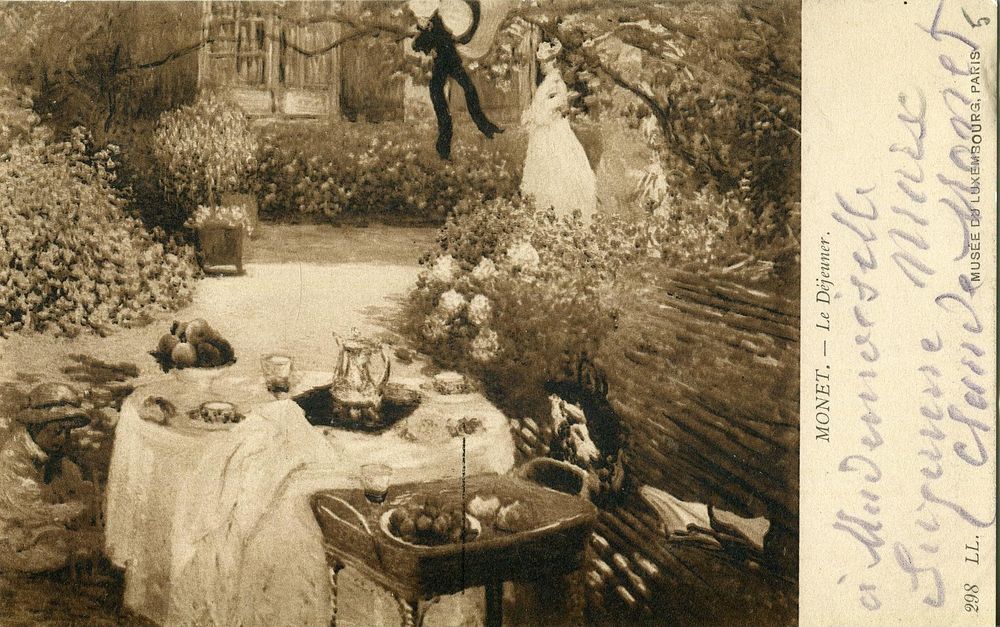
MONET CLAUDE: (1840-1926) - MONET CLAUDE: (1840-1926) French Impressionist painter. An attractive vintage signed and inscribed 5.5 x 3.5 picture postcard by Monet, the sepia image showing the artist´s famous painting Le Déjeuner , and published by Lévy and Neurdein (298 LL) as part of their Musée de Luxembourg series. Signed by Monet in bold pencil to the right margin, ´À Mademoiselle Suzanne Marx, Claude Monet´ . Accompanied by the front panel of the original envelope hand addressed (also in bold pencil) by Monet to Marx in Paris and postmarked at Mantes-la-Jolie, 24th October 1915. A wonderful, appealing example of Monet´s autograph, and extremely rare in this form. About EX The Impressionist painting Le Déjeuner (Lunch) depicts a family scene in Monet´s garden at Argenteuil. Of the work the artist´s biographer, Jackie Wullschläger, notes that the painting was the largest produced by Monet in 1872-73 and writes ´A still-life bourgeois table - silver coffee pot, compotier laden with peaches, glistening wine glasses, a half-eaten brioche - and little Jean with his building blocks occupy the foreground, at the back Camille and a visitor are half hidden by a tree. Blazing geraniums enclose everything. High up on a branch hangs an oversized straw hat; its black ribbons flutter in a swirling emptiness in the centre of the canvas, giving a faint sense of threat, that all this may be precarious. Monet´s last canvas of this size had been completed five years before: the cramped Luncheon of 1868, to which this painting alludes. The cast of Camille, Jean and a woman visitor, the discarded straw hat with black ribbon, the white-clothed table still life, are all repeated elements, paraphrased, expanded, relocated. Monet´s Luncheon compositions are statement pictures, each a moment of personal consolidation, and commemorating domestic pleasures, including his delight in food. He painted the repeated Camilles in Déjeuner sur l´herbe in 1865, at the start of a love affair; Camille and baby Jean in 1868 marked his pride in his young family; and the Luncheon of 1873 celebrates their improved circumstances, luxuriating in the garden of their first permanent home´ (from Monet: The Restless Vision , 2023, pp.153-154). Le Déjeuner was exhibited by Monet in 1876, at the second major Impressionist exhibition, and was part of Gustave Caillebotte´s collection from 1878-94. Since 1986 the painting has been housed at the Musée d´Orsay in Paris, on loan from the Louvre Museum. The French town of Mantes-la-Jolie, from where Monet mailed the present postcard, appears in a number of the artist´s works. Monet painted the bridge at Mantes, capturing the town's position on the river, although most famously found inspiration in the 12th-century Gothic collegiate church Collégiale Notre-Dame de Mantes, which he painted multiple times. His most famous depiction, The Cathedral at Mantes (1886), illustrates Monet´s fascination in how light interacts with stone, a precursor to his later Rouen Cathedral series.