Bidspirit auction | MONET CLAUDE: (1840-1926) Monet departs
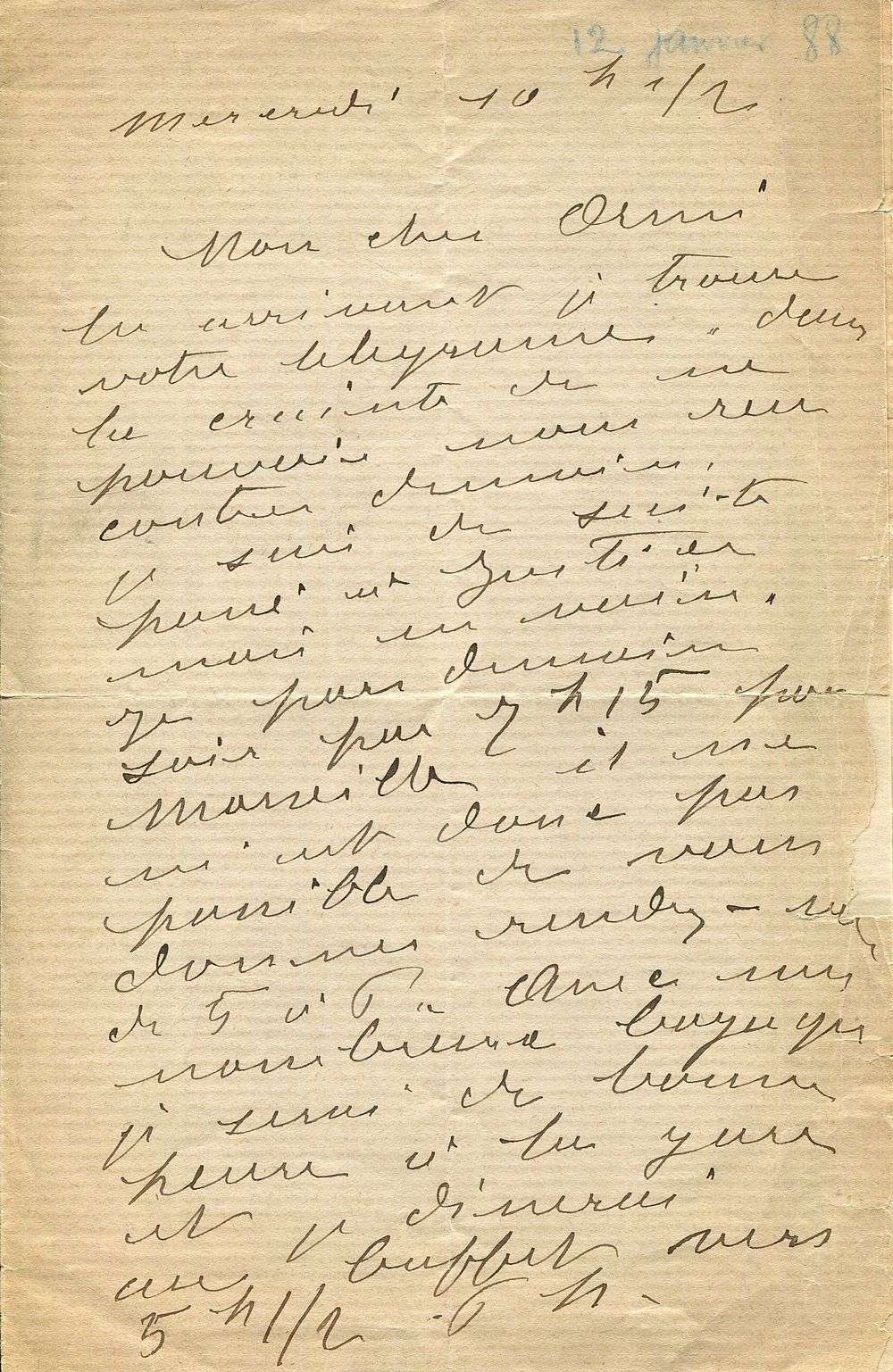
MONET CLAUDE: (1840-1926) Monet departs for a painting expedition on the French Riviera - MONET CLAUDE: (1840-1926) French Impressionist painter.A.L.S., Claude Monet , two pages (written to the first and third sides of the bifolium), 8vo, n.p., n.d. ( ´Mercredi 10h 1/2´ ; 11th January 1888), to [Gustave Geffroy] ( ´Mon cher ami´ ), in French. Monet states that he found Geffroy´s telegram upon his arrival, and remarks ´Dans la crainte de ne pouvoir vous rencontrer demain, je suis de suite passé à [La] Justice, mais en vain´ (Translation: ´Fearing I might not be able to meet you tomorrow, I went straight to [The] Justice, but to no avail´ ), further informing him of his travel arrangements, ´Je pars demain soir par 7h 15 pour Marseille. Il ne m´est donc pas possible de vous donner rendez-vous de 5 à 6. Avec mes nombreux bagages, je serai de bonne heure à la gare et je dînerai au buffet vers 5h 1/2 - 6h´ (Translation: ´I am leaving tomorrow evening on the 7.15 pm train for Marseille. It is therefore not possible for me to meet you between 5 and 6 pm. With all my luggage, I shall be at the station early and shall have dinner at the buffet around 5.30–6.00´ ). In the knowledge that the two friends won´t be able to meet, Monet concludes by wishing Geffroy good luck, and adds ´Quand je serai fixé quelque part, je vous donnerai de mes nouvelles´ (Translation: ´When I have settled somewhere, I shall let you know how I am´ ). A few small tears and minor areas of paper loss to the edges (with some old repairs, one only very slightly affecting the conclusion of Monet´s signature) and a couple of neat splits in the folds, G Gustave Geffroy (1885-1926) French journalist, art critic and historian, a friend and champion of Monet. Geffroy was a contributor to La Justice , the newspaper founded by Georges Clemenceau, from January 1880 onwards. Monet´s letter was written as he prepared to travel to the French Riviera, the artist´s biographer Daniel Wildenstein noting ´On 13 January [1888], after a luxurious overnight journey by train, Monet reached Cassis. He spent the following night in Toulon and the next day went by omnibus via Agay and Le Trayas to Juan-les-Pins. From there he had himself driven to the Cap d´Antibes, where an ”immense” room awaited him in the Château de la Pinède, a mansion now converted into a ”painters´ house”. A recommendation from Guy de Maupassant had ensured him a pleasant welcome. Monet was not greatly impressed either by his first meeting with a group of painters centred around Harpignies or his first sight - it was raining - of the subjects that his colleagues insisted on pointing out to him. Two days prospecting for motifs took him west to Agay and Trayas, then east to Monte Carlo, whence he returned on foot as far as Nice via Turbie, Eze, Beaulieu and Villefranche, a good 25 kilometres´ walk. He then went by railway from Nice to Antibes where he saw ”very beautiful things”. He therefore decided to remain at the Château de Pinède. From there it was easy to reach both Juan-les-Pins on the west of the promontory, and. on the far side, the Salis gardens, the Garoupe plateau and the beaches that ran round the Bacon headland as far as Ponteil. All of these places offered admirable views of Antibes and the Alps. He quickly discovered five or six motifs which he found ”superb” and which the ”resplendent” weather enhanced; his optimism was at its height. On 20 January, he had decided on his first goal: ”I am painting the town of Antibes, a little fortified town all golden in the sun that stands out against beautiful blue and pink mountains and the eternally snow-capped range of the Alps”. But things were not as easy as they initially seemed; Agay quickly came to symbolise a paradise to which Monet should return forthwith and yet which he had somehow forfeited for ever. The company of Harpignies and his students proved onerous, and Renoir, who was staying with Cézanne at Aix and later on his own at Martigues, was not wanted either. The hostess of the Château, ”a real character, a friend of Manet and Degas”, was charming, and even took Monet to visit ”a marvellous estate” whence they returned laden with flowers. Few if any of Monet´s painting ”campaigns” had begun in an atmosphere like that of his first days in Antibes´ (from Monet - The Triumph of Impressionism , 2023 edition published by Taschen, pp.297-298). An annotation in another hand in indelible pencil at the head of the first page of the letter indicates the date to be 12th January 1888. However, in his catalogue raisonné Daniel Wildenstein provides a date of 11th January 1888, based on the postmark of the envelope which originally accompanied the letter (although, today, is no longer present).